@saylor Grok is estimating that Strategy will pass Satoshi in late December of this year. Have you decided upon a name for the day? I suggest Stratoshi Day.
You can hold bitcoin and risk that maybe, if several gargantuan quantum engineering problems are solved at scale and at fantastic speed, and you hold your coins in a vulnerable address, and bitcoin fails to upgrade, someone might theoretically be able to run a currently nonexistent machine at enormous operational cost 5-10 years from now to steal your money.
Or you could sell your bitcoin for fiat and let the government start stealing your money today.
@martypartymusic Grok has calculated the “Crossover Day” when the BTC held by Strategy passes the number of BTC left to be mined to be 9/20/26 — at this new rate it could occur much sooner.
This is an excellent perspective — BTC and MSTR have such a long way to go. No one invested in them now is “late to the party”. If you buy and hold for 4-5 years, there is a high probability that you will feel fortunate for arriving early.
Today, there are only 1 million BTC left to mine. I asked @grok to calculate the Crossover Day —the day when the BTC holdings of MSTR will pass the remaining BTC to mine if @saylor maintains the same accumulation pace. Answer 9/20/26 —only 195 days.
This is leadership. While we know that a real quantum threat will not be present for quite some time, resolving this issue will make many people and institutions, with a long term focus, more likely to invest. This is community leadership in action.
This is an excellent read. Send it to your friends who are still asleep. My favorite quote: “Since the founding of the Federal Reserve in 1913, the dollar has lost more than 96% of its purchasing power. Erosion is a feature not a bug, it’s a structural necessity for a system dependent on perpetual credit expansion.”
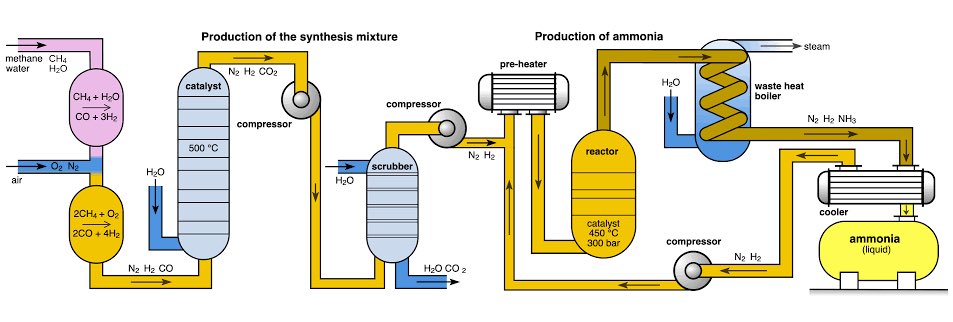
This is extremely debatable. The Haber-Bosh process allowed plants to grow larger and create more total calories. Prior to this process, plants would use up to 50% of the energy obtained from photosynthesis to feed the “soil food web” — a collection of bacteria, fungi, nematodes, arthropods, etc, that would bring Nitrogen to the plants to allow growth. Without the need to feed the “web”, all of the energy from photosynthesis could be used for the plants to grow larger and also create more seeds and fruits. However, this came with a cost: the “web” also provided the plants with many other biologically valuable nutrients, including minerals. For many years, we have been fed Haber-Bosh created foods. There is significant data to suggest that this could be negatively impacting human health. As in most things in life the Haber-Bosh process is a two edged sword: we are benefitting from the calories and suffering from the lack of biologically valuable nutrients.
This professor deserves a great deal of credit. He was presented with new information and changed his long held beliefs — this is rare. As an NYU lecturer/professor, it would be much easier for him to continue to spout the Wall Street dogma. Max Plank (physicist) famously said “A new scientific truth does not triumph by convincing its opponents and making them see the light, but rather because its opponents eventually die, and a new generation grows up that is familiar with it."
Former Finance Professor: "After 25 years teaching finance, I realised at 58:
If the money printer grows 8-10% annually and the S&P 500 returns ~9%, it’s just treading water. True wealth comes from outpacing the printer.
That’s the #Bitcoin journey."
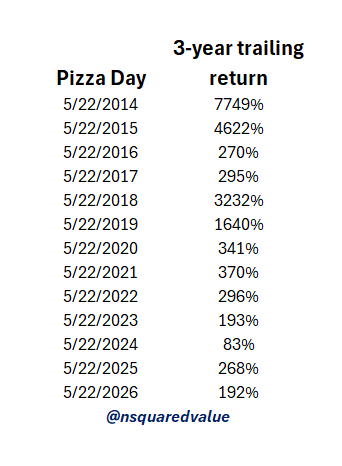
On January 3, 2009, an anonymous computer programmer mined the first Bitcoin block. Every ~10 minutes since, a new block of transactions are cryptographically chained to the last with electricity. The record has remained perfectly in sync and secure with 930,775 blocks now mined.
“Turns out, when you fake the money, everything else follows and you screw the next generation over…” and the next generation, and the next generation…. This video is a good view — pass it on.
They will print. Deflation destroys the assets of the wealthy. Inflation harms those with no or few hard assets. The wealthy and powerful will protect themselves.
In 1980, gold represented 20% of all financial assets. Gold & bitcoin today represent less than 1% so there's plenty of upside in this sound money if one assumes that they can never stop printing & I believe that with every bone in my body.
@LawrenceLepard
NEW: Lyn Alden just posted the most brutal chart in macro.
230 years of data showing the buying power of the US dollar collapsing to almost zero after the Federal Reserve, the Gold Reserve Act, and the Nixon Shock.
Nothing stops this train.
I wanted to give everyone something meaningful, a gift…
This comes from Global Macro Investor (GMI) and a deep, long-running body of research developed by @RaoulGMI and myself.
Many of you already know The Everything Code, which is our framework for understanding the macro landscape and why major central banks are debasing their currencies to manage aging demographics and overwhelming debt loads.
I call this a gift because these four charts, while only scratching the surface of The Everything Code, give you the big-picture context you actually need in moments like this.
They stop you from getting lost in every Bitcoin pullback and explain why Raoul and I never panic, even when, to borrow one of his expressions, everyone’s acting like monkeys throwing poo at each other.
Once you understand The Everything Code, you stop trading short-term noise and expand your time horizon. You cannot unsee it.
The starting point is what we call The Magic Formula:
GDP growth = population growth + productivity growth + debt growth.
Population growth and productivity growth have been falling for decades. Debt growth is the only thing filling the gap.
The private sector has been deleveraging since 2008, mainly households, but debt levels are still around 120% of GDP. The public sector sits at roughly the same level.
Here’s the problem…
If the government is running debt at 100% of GDP and the private sector is sitting on another 100%, and for simple math we call rates 2% even though they are really closer to 4%, then the entire 2% trend growth of the economy is being consumed by servicing private-sector debts. That is a completely unproductive use of GDP. And then there’s the issue of public-sector debts. There’s just not enough organic growth to service the existing debt load.
To understand why this dynamic persists, you need demographics.
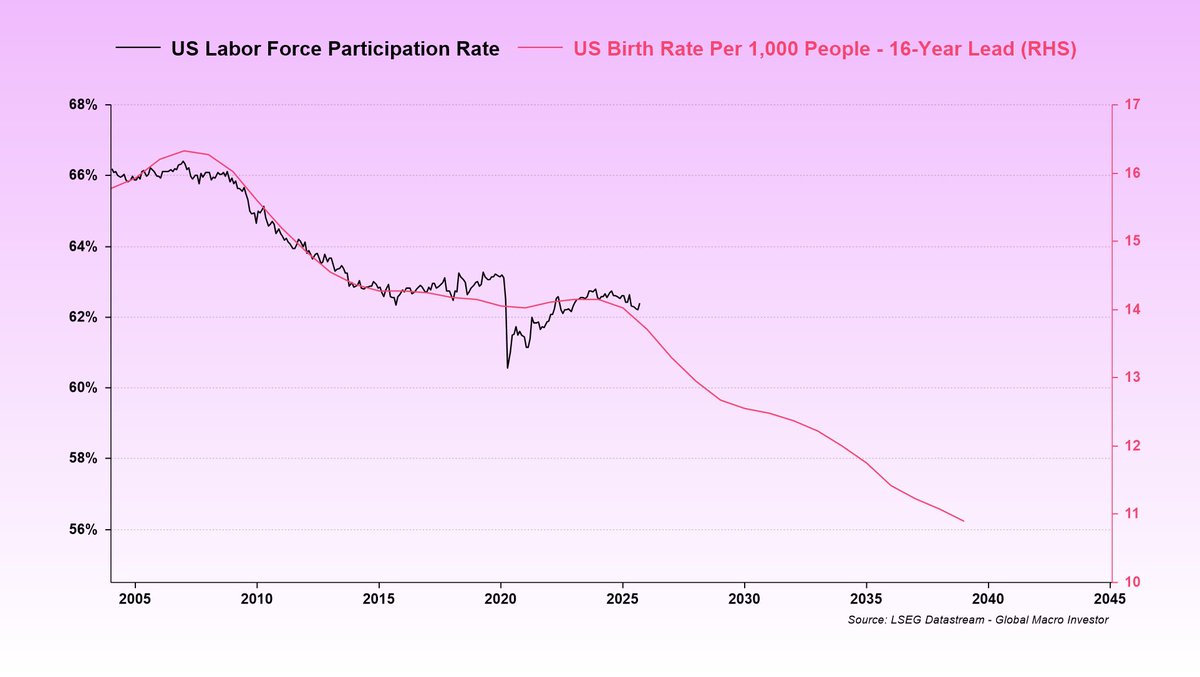
Birth rates peaked in the late 1950s and have been declining ever since. This shows up about sixteen years later in the labor force participation rate as each generation enters the workforce (chart 1).
That means the labor force participation rate is not going to rise any time soon. It is set to keep drifting lower. This is a structural problem.
Aging populations, falling birth rates, and rapidly expanding automation make the backdrop even more deflationary. AI and robotics are replacing humans at scale, and we are only at the beginning. This reinforces the need for ongoing stimulus to keep the system functioning.
With weak population growth and sluggish productivity, the only way to keep GDP expanding is through debt.
Now here’s where it gets interesting…
Government debt growth is completely offsetting the demographic decline and policymakers know exactly what they are doing (chart 2).
And what happens next?
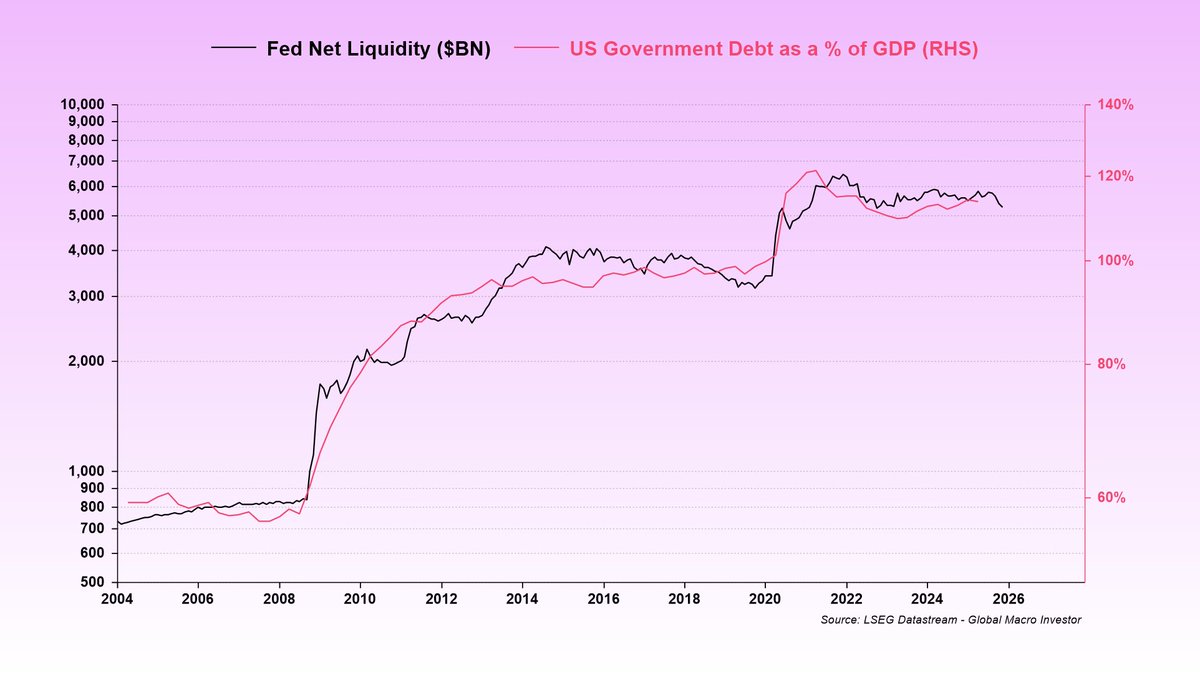
All debt growth in excess of GDP gets monetized (chart 3).
Basically, since 2008, magic money has effectively been paying the interest. Governments issue new debt to cover old interest, and once rates fall enough, central banks absorb it onto their balance sheets.
So to wrap this up, demographics drive the decline in the labor force. Governments offset that decline with more debt. That debt eventually gets monetized through quantitative easing (QE) style operations, not always directly by the Fed, but through the coordinated ecosystem of the Fed, the Treasury, and the banking system. And the bottom line is that there’s still a massive wall of interest that needs to be monetized, far more than GDP can ever cover. Liquidity is literally the only game in town.
And what thrives in a world of perpetual debasement? Bitcoin (chart 4).
I know this correction has been painful, but it’s all part of the journey. These periods feel brutal in the moment, then they fade and the trend resumes. This too shall pass…
To quote Walter White from Breaking Bad, later echoed by @LynAldenContact, nothing stops this train.
MOAR COWBELL (liquidity) = number go up over time. Zoom out and be more bullish…
@maison_d_ami Amy, you are the definition of a good steward in the Bible. Congratulations! As the father of 4 adult daughters, I know exactly how proud your parents would be of you.
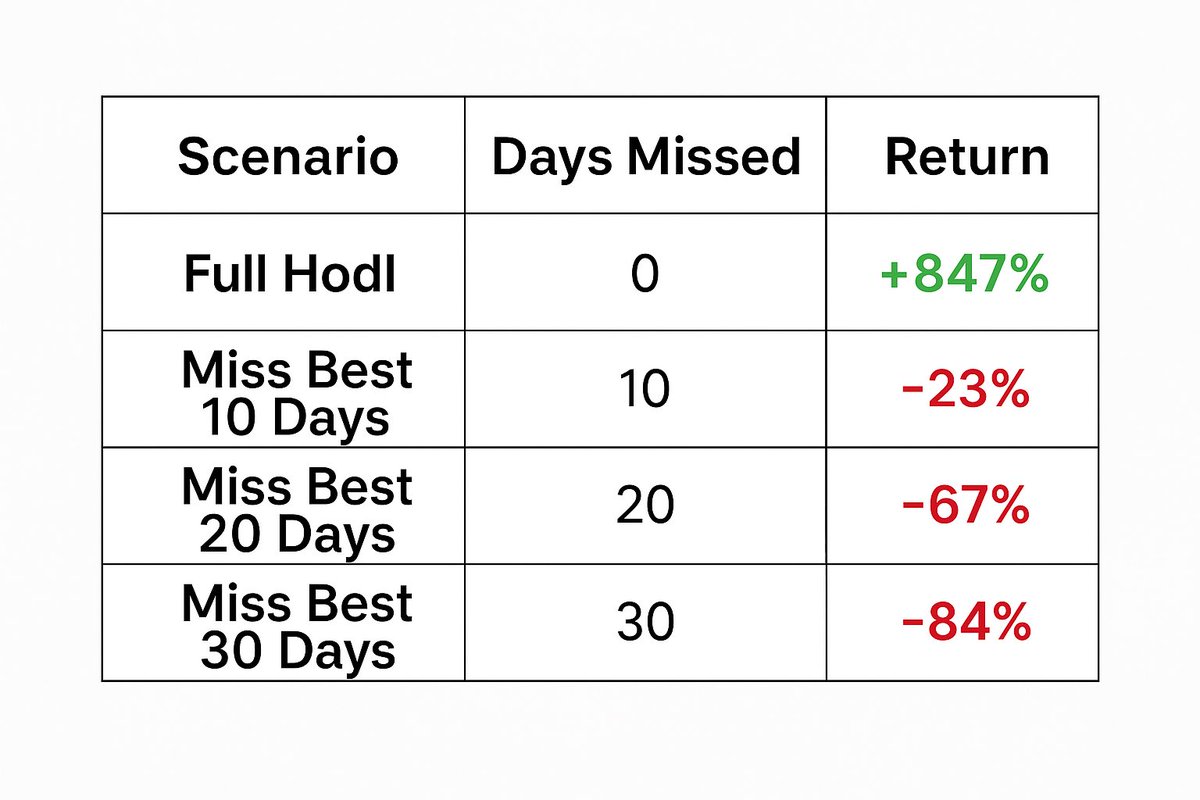
Missing just 10 days can destroy your Bitcoin returns.
If you held Bitcoin from 2017 to 2024 without selling, your return was +847%.
But if you missed the 10 best trading days, you’d be down 23%.
Miss the best 20 days? Down 67%.
Miss the best 30? Down 84%.
Most of Bitcoin’s gains come from a few explosive days.
Trying to time the market means risking missing them entirely.
Moral of the story:
Just hold.