What are some of the most interesting astronomical objects you can see in the night sky?
Armed with a good pair of binoculars or a small telescope, if you live in the Northern Hemisphere, you can look for the very popular objects in the Messier Catalog. Most of them, but not all, are also visible from the southern half of the Earth.
The featured image shows all 110 objects in the catalog at uniform scale -- the same magnification. Charles Messier created the catalog in the 18th century. He was interested in comets, and his catalog was a list of known comet-like "objects to avoid" in the sky when observing or hunting for comets.
The deep sky objects in the catalog include a supernova remnant (the Crab Nebula, M1), other galaxies (such as Andromeda, M31), nebulae (e.g. the Orion Nebula, M42, a star-forming region) and stellar clusters (such as the Pleiades, M45, a bright young open cluster).
Text: Cecilia Chirenti (NASA GSFC, UMCP, CRESST II)
Image Credit: Sylvain Villet
BREAKING: Sugars essential for life have been found in pristine asteroid Bennu samples collected by NASA’s OSIRIS-REx spacecraft. Combined with previous detections of amino acids and nucleobases, we see that life’s ingredients were widespread throughout the solar system: https://t.co/Tb3HpwZG9J
More on the study led by Yoshihiro Furukawa of @TohokuUniPR⤵️
-@DustAnja (Professor Anja C. Andersen) was delighted to return to Riyadh, after many years, and expressed her admiration for @SaudiVision2030@DKAmbKSA https://t.co/AeeNbNU0Z1
🌌 A night Under the Stars hosted by @DKAmbKSA, bringing together science, culture, and curiosity in Riyadh.
Prof. Anja C. Andersen shared her cosmic journey — from stardust to galaxies — inspiring minds across borders. 🇸🇦🇩🇰
#UnderTheStars#SaudiTimes#Riyadh#Denmark#Astronomy
✨ A fascinating evening Under the Stars hosted by @DKAmbKSA at the Royal Danish Embassy in Riyadh.
Prof. Anja C. Andersen has begun her presentation, taking guests on a cosmic journey through dust, planets, and the mysteries of the universe. 🇸🇦🇩🇰
#UnderTheStars#SaudiTimes #Riyadh #Denmark #Astronomy
🏆 Congratulations to our President, Maria Leptin, on winning the 2025 LASDB Lifetime Award! 👏🏼
And congratulations also to the other laureates. @LASDB_DevBiol
Today, a decision to increase ERC support for researchers moving to Europe was adopted.
On top of normal grants, the ERC offers 'start-up' funding to help PIs establish laboratories/research teams in Europe.
This extra is now x2 (up to €2 million!) https://t.co/ikGj3DoFAO
Jeg har et naivt håb om, at regeringen vil lytte til den massive og velbegrundede kritik af deres seneste påfund. Selvfølgelig skal efterretningstjenesten ikke have fri leg med vores data. Vi skal værne om tillid, retsstat og vores frie samfund. #dkpol
https://t.co/tqNp1saP17
I dagens episode tager vi en afstikker til Egyptens pyramider. De seneste måneder har et forskerhold påstået, at have beviser på at der under Giza-pyramiderne gemmer sig spiralformede konstruktioner mange gange større end pyramiderne selv. Det har pustet til de sejlivede rygter om at ikke-jordiske kræfter har haft en finger med i spillet, og at pyramiderne måske slet ikke er menneskeskabte. Men er det overhovedet plausibelt? Hvad ved vi om byggeprocessen vedrørende pyramiderne? Og hvad med de påståede underjordiske søjler - er der hold i den pressemeddelelse de to forskere har udsendt med de vilde påstande?
@DustAnja og jeg har i dagens afsnit besøg af PhD i ægyptologi og seniorforsker ved Nationalmuseet Anne Haslund Hansen som har kigget på de nye opdagelser og som har en kæmpe viden om pyramiderne generelt. https://t.co/Qt1OAyzrLD
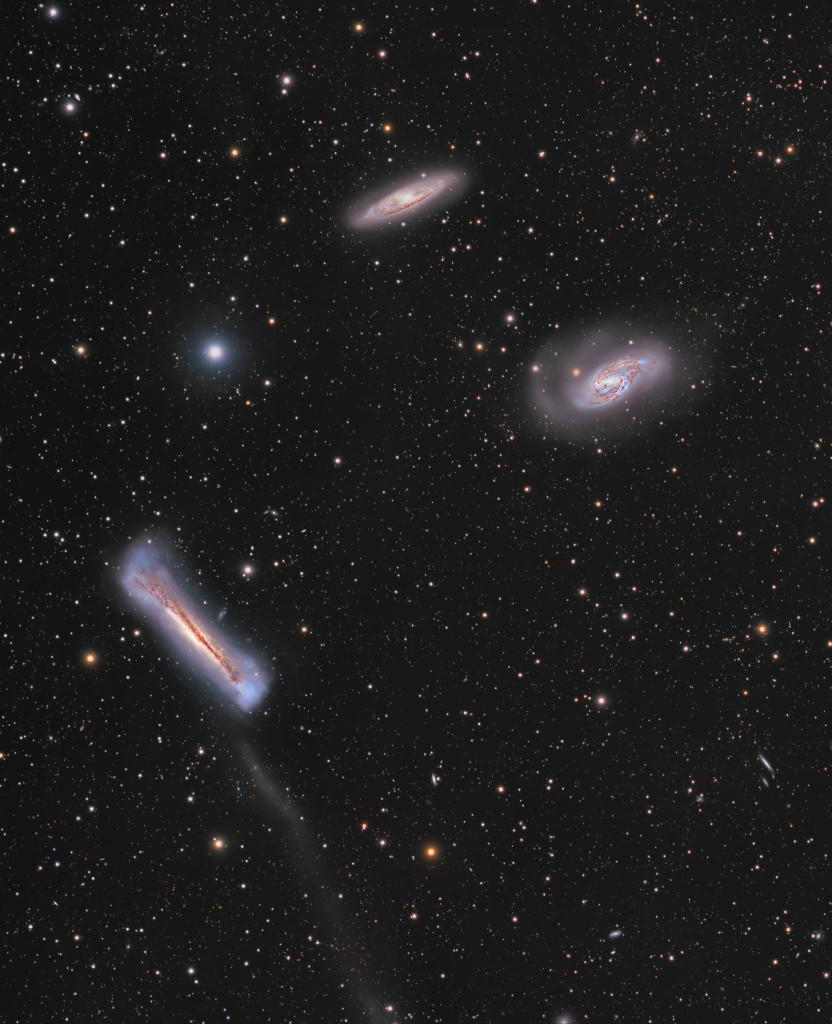
This popular group leaps into the early evening sky around the March equinox and the northern hemisphere spring. Famous as the Leo Triplet, the three magnificent galaxies found in the prominent constellation Leo gather here in one astronomical field of view. Crowd pleasers when imaged with even modest telescopes, they can be introduced individually as NGC 3628 (bottom left), M66 (middle right), and M65 (top center). All three are large spiral galaxies but tend to look dissimilar, because their galactic disks are tilted at different angles to our line of sight. NGC 3628, also known as the Hamburger Galaxy, is temptingly seen edge-on, with obscuring dust lanes cutting across its puffy galactic plane. The disks of M66 and M65 are both inclined enough to show off their spiral structure. Gravitational interactions between galaxies in the group have left telltale signs, including the tidal tails and warped, inflated disk of NGC 3628 and the drawn out spiral arms of M66. This gorgeous view of the region spans over 1 degree (two full moons) on the sky. Captured with a telescope from Sawda Natheel, Qatar, planet Earth, the frame covers over half a million light-years at the Leo Trio's estimated 30 million light-year distance.
Image Credit & Copyright: Rabeea Alkuwari
A mission to the moon would be nice; Interview with Danish astronaut and adjunct professor at DTU -Technical University of Denmark - @Astro_Andreas Mogensen, on his work at the European Astronaut Centre, dreams of the Moon, and the beef with Elon Musk.
https://t.co/c0hcZAcuk6
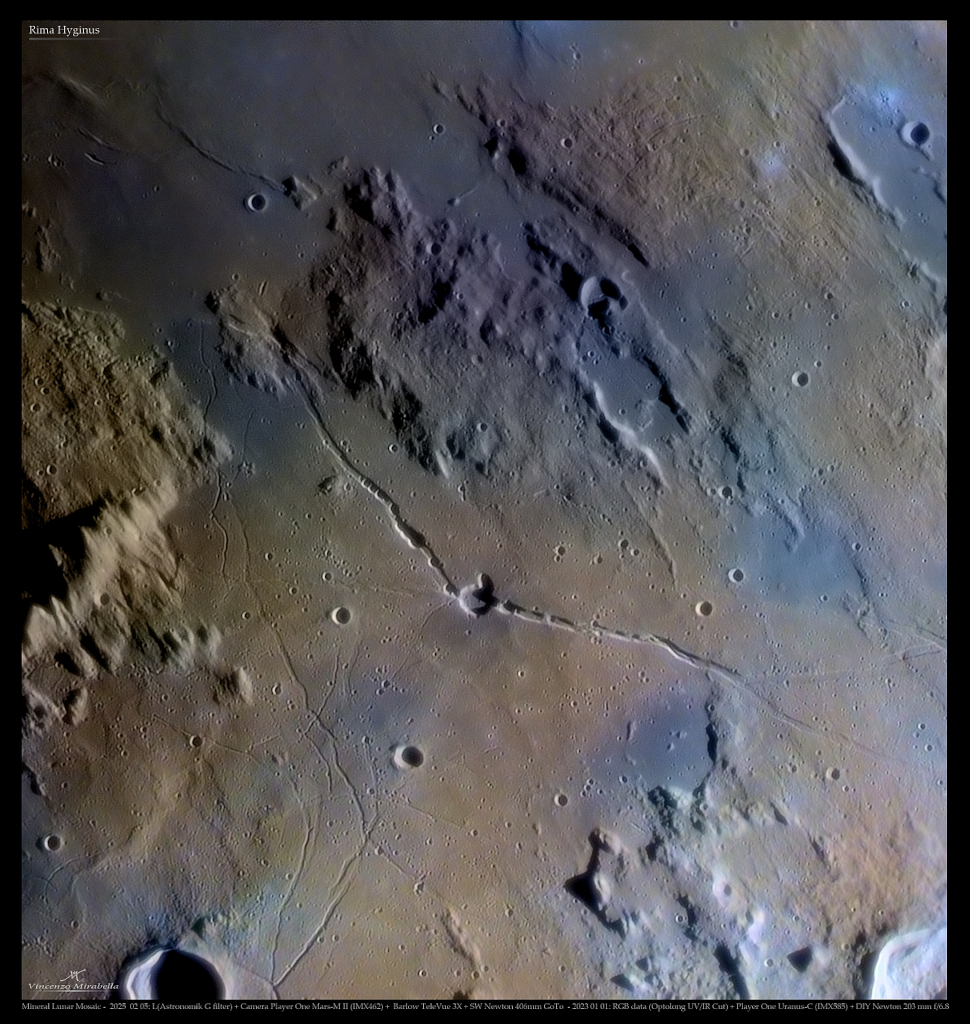
Rima Hyginus is a spectacular fissure, some 220 kilometers long, found near the center of the lunar near side. Easy to spot in telescopic views of the Moon, it stretches top left to bottom right across this lunar closeup. The image was made with exaggerated colors that reflect the mineral composition of the lunar soil. Hyginus crater lies near the center of the narrow lunar surface groove. About 10 kilometers in diameter, the low-walled crater is a volcanic caldera, one of the larger non-impact craters on the lunar surface. Dotted with small pits formed by surface collapse, Hyginus rima itself was likely created by stresses due to internal magma upwelling and collapse along a long surface fault. The intriguing region was a candidate landing site for the canceled Apollo 19 mission.
Image Credit & Copyright: Vincenzo Mirabella
A new photo of the Sombrero galaxy from @NASAWebb reveals finer details of the hat-like formation. It has a smooth inner disk, while its “brim” – the outer ring – is made of intricate lumps. https://t.co/9Hj5pd2TmL
I dag er der konference om børns fritid i Fællessalen. Den perfekte vært er @LotteRod, der åbner med historien om Pippi som tingfinder. Senere skal vi blandt andet lytte til @DustAnja og @Astro_Andreas. Selv er jeg kun tilhører, da jeg sidder i bestyrelsen for @Videnskabsklub
The Sun emitted a strong solar flare on Oct. 31, peaking at 5:20pm ET. NASA’s Solar Dynamics Observatory captured an image of the event, which was classified as X2. https://t.co/4c5RCG9TOf