A few friends and I started the Multiomics Reading Group a while back, but we never got around to announcing it. So we're doing that now!
Alongside my co-host César Miguel Valdez Córdova and organizer @DylanMannK we have (mostly) weekly presentations from 11 AM-12 PM EST.
1/6 🍍🍕🧬 What do a photo of Italians savoring pineapple pizza and a synthetic DNA sequence have in common? Both can be intricately crafted by generative AI! Introducing DNA-Diffusion, our AI model set to advance #SyntheticBiology and #GeneRegulation: https://t.co/rK4MzRnvw7
Interested in interpretable single-cell multi-omic integration? Check out this work by Zhou et al! Led by @feiwang03 and Yue Li.
Single-cell multi-omics topic embedding reveals cell-type-specific and COVID-19 severity-related immune signatures:
https://t.co/44ssc4dBDY
@evp82 Our paper on our prognostic risk score for chronic pain spread is finally out in @NatureMedicine and officially the first paper from our lab @evp82 ! Thanks and congrats to everyone involved 🥳https://t.co/V9ZxEefvho
📣Multi-omics Molecular Alzheimer’s disease Taxonomy!! Unified Epigenomic, Transcriptomic, Proteomic and Metabolomic AD stratification based on >1800 post-mortem and in-vivo samples.
In @ScienceAdvances journal.
A quick thread 👇
https://t.co/YEZw1eqlXT
Excited to have our first single cell club meeting tomorrow!! Please join us virtually if you can make it!! #singlecell@SingleCellMedia https://t.co/Fo4KqAnaEZ
FiNNalLLlYYyy (can't stress this enough) out! If you're into EEG-fMRI fusion you may want to check this out 👇
Extracting electrophysiological correlates of functional magnetic resonance imaging data using the canonical polyadic decomposition https://t.co/ywLez6Hmgn
And of course, huge thanks to my master's supervisor Georgios Mitsis for his unflinching support and constant guidance! Also many thanks to @bbme_mcgill!
We propose the canonical polyadic decomposition (aka PARAFAC) for studying EEG correlates of BOLD-fMRI dynamics. There's also something for you fellow computational neuro nerds
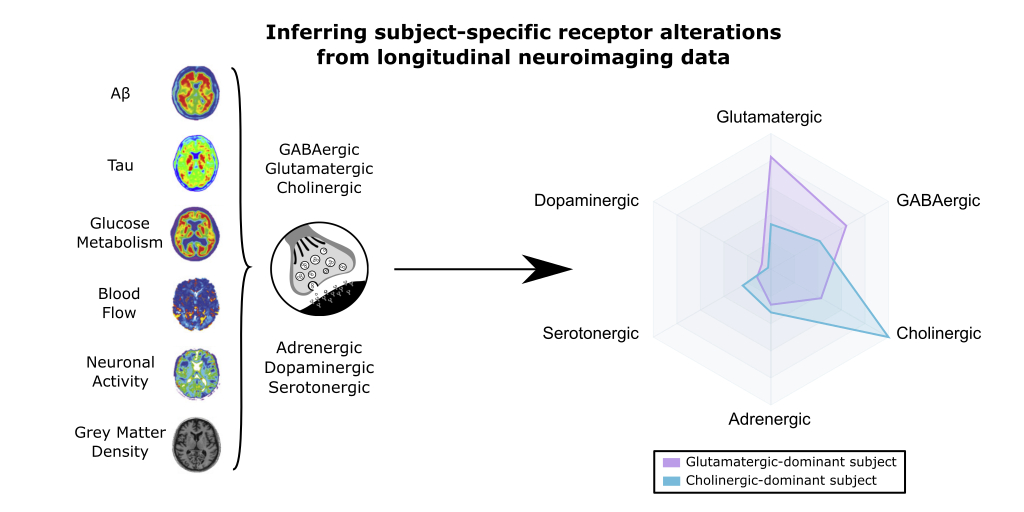
Khan et al. use a personalized, multimodal computational model of the brain to identify neurotransmitter receptor changes in Alzheimer’s disease. https://t.co/Cdop7Ox8qO
Data processing and analysis is an essential step of mathematical modeling. In our recent work we provide an image processing, segmentation and analysis framework for 3D cell culture data. https://t.co/go1Yp1UOGM
Find out what the PREVENT-AD is, what data is made openly available and where to get it @NeuroLibre! Thank you to all who contributed to acquire and make this data available. We look forward to the community using the data! #openscience https://t.co/ZHt1UE4ZoM
We are sharing a large iEEG-fMRI dataset (>50subjs) from stimulation with a short audiovisual film! Data can be used to study language, auditory, visual, multimodal perception, fMRI-iEEG coupling and more! @UtrechtBCI@MJvanSteensel@gpiantoni
https://t.co/uFUGERPpeE a🧵! 1/5 RT