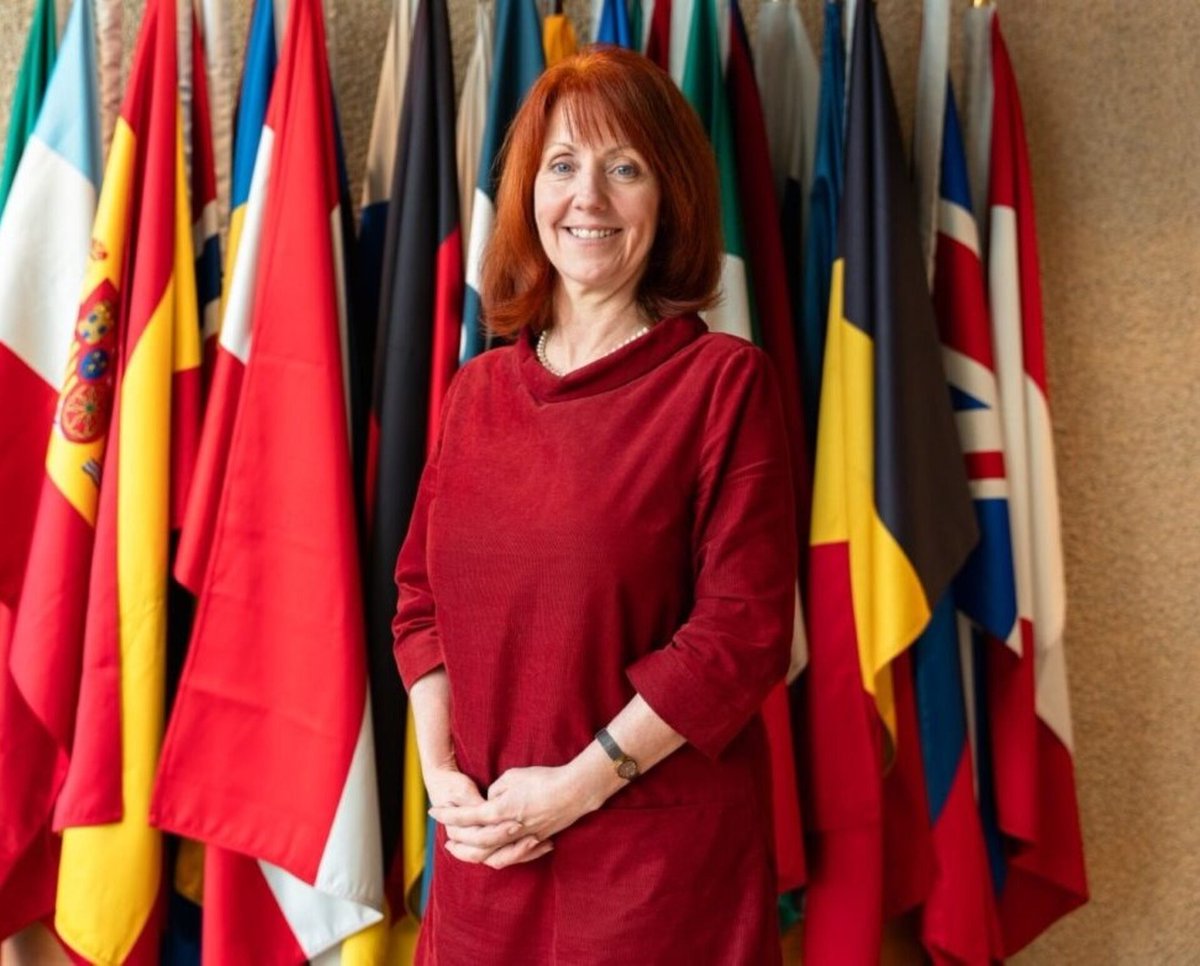
💫🎉 Behind every successful ESA space mission, there is a woman. Behind Solar Orbiter, there are more than a hundred of them!
Yesterday, we celebrated our 5th launch anniversary - Join us today in celebrating these women who make our mission a success, on international day of women and girls in science!
#WomenInScience #WomenInSTEM
https://t.co/SmXn3J373w
☀️ 🛰️@ESASolarOrbiter’s daring trajectory close to the Sun is paying off, giving us the highest-resolution full views of the Sun’s surface to date.
Full story 👉 https://t.co/Cy0H6JZmlp
Join the @ESA Science Directorate ! 🌌
We're hiring an Archive Scientist at the European Space Astronomy Centre (ESAC) near Madrid, Spain on a 3-year contract to work with the @ESASolarOrbiter, @ESA_Cluster and other Heliophysics data archives.
🔍 If you have a passion for space science, a background in heliophysics, and a desire to work with ESA's missions, this opportunity is for you!
Apply now to be part of groundbreaking space discoveries!
📅 Deadline: 7th October 2024
🌍 Location: Madrid, Spain
🔗 https://t.co/M5g54VTbHS
#SpaceJobs #ESA #DataScience #Astronomy #SpaceCareers #ESAJobs #ESAC
There is no smooth sailing with the solar wind 🌊⛵️
@ESASolarOrbiter observations confirm that the solar wind gets gusty at its roots. Its turbulent motion begins very close to the Sun, inside the solar atmosphere known as the corona 👇
https://t.co/4sxZ76seoO
How does solar wind reach speeds of almost 2 million km/h?
🌊 The investigative duo @ESASolarOrbiter and @NASASun’s Parker Solar Probe demonstrate that fast wind gets its energy by riding magnetic waves 👉 https://t.co/76UMUur5YO
🏆 It's success for @ESASolarOrbiter in the #ESAGames space diving! 🤿
An hard-fought battle between our Sun explorer and our Venus orbiter, with Solar Orbiter ultimately taking the top spot due to its impressive plunge into the scorching environment of our star ☀️
Have you voted in the #ESAGames yet?
👉 https://t.co/J1UGpYypow
Competing in space diving 🤿 is @ESASolarOrbiter
🌞🛰️The spacecraft is aiming for a medal for taking a plunge in the scorching environment of our star, taking images of the Sun from closer than any spacecraft before and being the first to look at its polar regions.
In the last month, #SolarOrbiter has been on 🐙monster-hunting duty.
💥While hiding from Earth's view, the active sunspot region AR3664 has produced more X-class (the highest category) solar flares, insanely energetic solar particles, and humongous coronal mass ejections👉https://t.co/xb1l8z6I4p
👀Seeing double?👀 No, you’re just seeing
🌞 ESA’s Proba-2 satellite filming the Sun’s front, and
☀️@ESASolarOrbiter filming the Sun’s back
Good thing, too, otherwise we would have missed the largest flare of the current solar cycle (class X12)! 💥
More👉https://t.co/dCUnO4Ct8S
A #SolarOrbiter success story!
A key mission goal was to link the solar wind detected around the spacecraft back to its source regions on the Sun.
A new paper, using data taken during our first close approach to the Sun, confirms that it's possible.
More👉https://t.co/khepcTx3Fd
This morning, the same active region showed its face once more, producing a very large Class X2.9 flare and coronal mass ejection…
...and @MissionSOHO caught it on camera! (Watch the left side of the video)
Be prepared for more solar activity this week!
📹SOHO (ESA & NASA)
What a blast! 💥
On 21 May #SolarOrbiter witnessed one of the biggest solar outbursts in the last 30 years.
Various instruments detected a MASSIVE solar flare (estimated class X12) accompanied by a big burst of particles coming from the active region visible in the centre of the images shown below.
📷 ESA & NASA/Solar Orbiter/EUI Team
#SolarOrbiter is currently watching the backside of the Sun, so the blast it witnessed didn’t affect Earth.
However, it came from the same active region that caused the recent spectacular auroras 🌌
Starting from tomorrow this active region will face Earth again 👀 More auroras to come??
📷 J. Schmidt, taken on 11 May 2024 near Frankfurt, Germany.
Delighted to invite you to my first virtual Science Directorate Town Hall!
Independent of career stage or affiliation in the scientific community, join us Tues 28 May 9:30-12:30 CEST to learn, ask questions, share views & ambitions: https://t.co/XwDvKLOqt8 @esa@esascience
🚨 We are launching the ESA Science Newsletter!
It serves the scientific community and welcomes everyone interested in more programmatic and technical news from the Directorate of Science.
More info & subscription link here 👉 https://t.co/9WWS8V2eBm