You may need to obtain supraceliac aortic control 🩸👇🏼
✔️ The fastest, easiest way is to compress the aorta against the spine with your fingers 🟢. .
✔️ If you want to clamp, it is often easiest to do so in the chest. Open the diaphragmatic crus at the 2 o’clock 🕑 position to expose the aorta, where it is less invested in fibrous tissue.
SEE THE FULL @BehindTheKnife video ➡️ https://t.co/6cbVAgCeB6
🧵 3/3
The surgeon Benjamin Brodie once eloquently described that as surgeons gain experience, they eventually reach a point where it all starts coming together, even though “you are not aware of having made an effort for that purpose.”
🚨🚨ESTES ON TOP
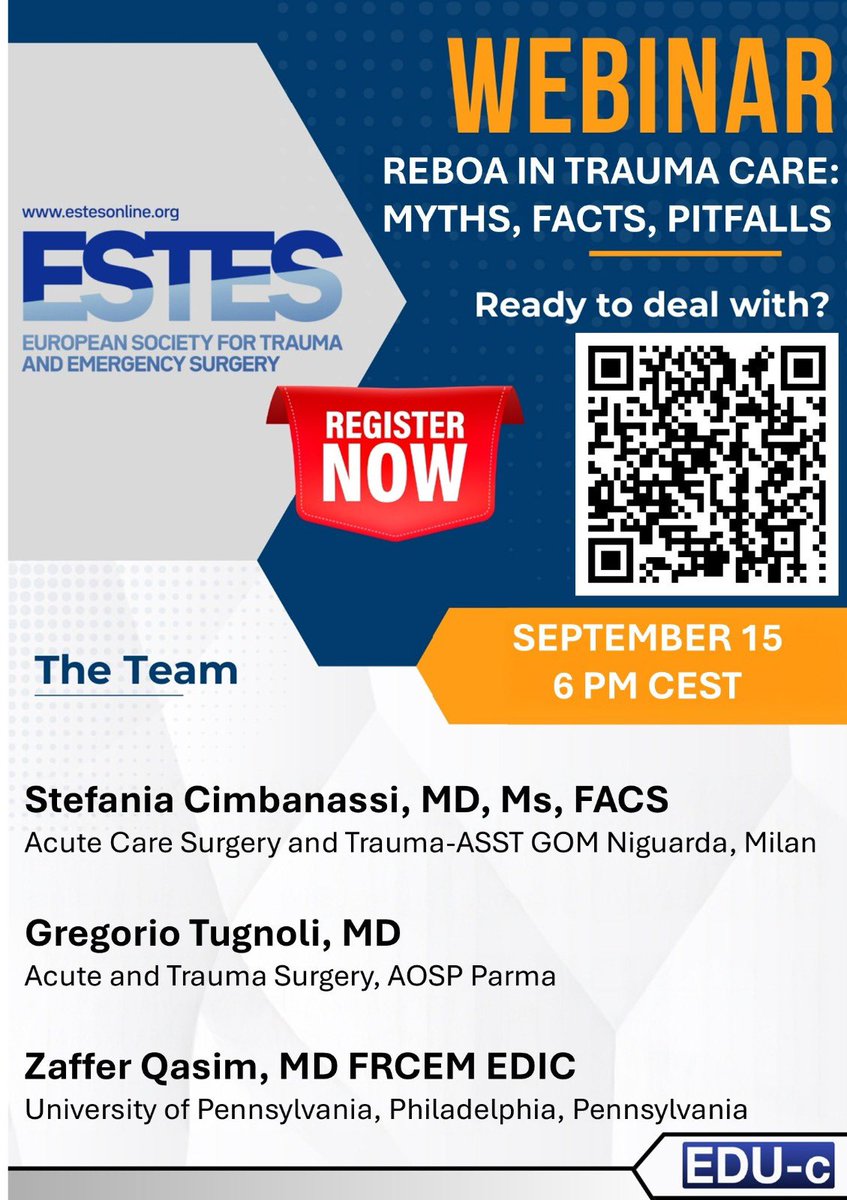
For those who wish, I will have the pleasure and honor of moderating the two distinguished colleagues on a topic that continues to spark discussions. ®️🚧To register for free.
https://t.co/PZLTYzwWGt
📢 Sign up now!
The joint congress of ESTES & WTC is an excellent opportunity to bring the world together to discuss, learn, collaborate, and educate healthcare providers about the many facets of trauma as a disease.
Take advantage of the opportunity to register at the current early bird rates and be part of this global exchange.
👉 You can access the online registration here: https://t.co/M55UKsSdqm
#ECTES2026 #WTC2026 #ESTES #TraumaSurg #rescuesurgery
💧 Encore Webinar – Introduction to the Fluid Champion Course: Myths, Misconceptions & Misunderstandings
📅 Tuesday | 5:00 – 7:00 PM CEST
🎥 Back by Popular Demand!
Missed it the first time or eager for a refresher? Don’t miss this exclusive replay of our highly rated session with Prof. Dr. Manu Malbrain and Dr. Niels Van Regenmortel, co-founders of the International Fluid Academy.
🔍 Key takeaways:
✔️ Core principles of fluid homeostasis and IV fluid properties
✔️ How to prescribe fluids: maintenance, resuscitation & replacement — with a sneak peek at Fluid Accumulation Syndrome (FAS)
✔️ Debunking the most common myths and misunderstandings in fluid therapy
💡 Ideal as a kick-off to the Basic Fluid Champion Course and essential for all healthcare professionals involved in fluid management.
📌 Reserve your spot now!
🔗 https://t.co/L66HoW7QF6
#FluidChampion #FluidStewardship #CriticalCare #MedicalEducation #IFAWEBINAR #CEFS #ICU #HealthcareEducation
The list of speakers for EST, in november, is stellar.
Can't wait to see all this wonderful people.
See you in November.
https://t.co/MS6XjoBqOg
Book your place now, early-bird registration ends September 19.
The list of speakers for EST, in november, is stellar.
Can't wait to see all this wonderful people.
See you in November.
https://t.co/MS6XjoBqOg
Book your place now, early-bird registration ends September 19.
Achieving a Negative Fluid Balance in critically ill patients, a key aspect of fluid management in conditions like sepsis, AKI, and post-operative states.
https://t.co/iBCrFQrY4Y
Today's Paper of the Day is:
A New Perspective on Overfeeding in the Intensive Care Unit (ICU): Challenges, Dangers and Prevention Methods
https://t.co/JKgcYjlUQ5
Join us to read 1 paper per day and stay up-to-date as we cover the spectrum of critical care across 2025
🎥 Meet Brian Fletcher, MS, RN, ACNP-BC – NP at Grant Medical Center and proud EAST Associate member!
💬 “I decided to join EAST because it's very welcoming to advanced practice providers… when I'm working with my attendings, they would often ask me what's the EAST guidelines; and so that's why I got interested in EAST.”
📘 Learn more: https://t.co/yGPJmM9aWO
🗓️ Join EAST by Nov 15: https://t.co/f3rnaJrbfj
#JoinEAST #AdvancedPracticeProvider #NursePractitioner #TraumaCare #EAST4ALL #EASTGuidelines #TraumaGuidelines
Random fact:
The usually cited incidence of post-intubation cardiac arrest (PICA) is 2.0%. But this is for all emergent intubations. I am reading now the data from the Hartford Hospital registry & the elderly (>70 yo) abdominal septic shock pts exhibited a PICA incidence of 8.7%
What's the estimated right atrial pressure in this spontaneously breathing patient based on this subxiphoid scan?
POLL in thread
#POCUS#Nephpearls#FOAMed
🚨 General surgeons & residents in Europe: Help us improve emergency endoscopy training! Take our 5-min anonymous survey on the use, perception & teaching of upper/lower GI endoscopy in daily & on-call practice.
🔗 https://t.co/75QHZyjtze #ESTES#surgery@diemar70@garybassmd
Emergency Laparoscopic Repair of Delayed Perforated Duodenal Ulcer
Patient Presentation
🔵Admitted with:
➡️3 days history of pain
➡️Frailty
➡️Sepsis
➡️Low albumin
➡️High CRP
🔵Initial conservative treatment
🔵No improvement therefore decision to proceed to surgery
Surgical Approach
🔴Source control critical
🔴T-tube can be a life saver in select cases
➡️Delayed presentation
➡️Severe sepsis
➡️Older and frail patients
🔴Newer T-tube is less reactive due to being latex free
➡️Longer time for tract formation
➡️Leave in-situ at least 8-12 weeks
🔴+/- Tubogram prior to T-tube removal
🔴OP OGD
If there's something I wish could be taught at a snap of the fingers, fluid management would be it. You can learn surgical technique, managing fluids is an art.
Love to see @Fluid_Academy making the small and apparently tedious steps towards the truth.
✍️ A Logical Approach to IV Fluid Prescription
Too often, patients receive excessive volumes of IV fluids—especially non-physiological 0.9% sodium chloride. Once in the body, sodium overload is hard to eliminate and can contribute to patient harm.
🔹 Key Considerations Before Every IV Fluid Prescription
Safe prescribing follows the “4 D’s” framework: Drug, Dose, Duration, De-escalation. The goal? Administer the right fluid, at the right dose, to the right patient, at the right time.
🔹 Apply These 5 Essential Steps:
- Evaluate the Patient’s Fluid Status
- Measure Body Weight
- Review U&E (Urea & Electrolytes) from the Past 24 Hours
- Calculate the 24-Hour Fluid Balance
- Prescribe Fluids Daily Based on Reassessment
🔹 Maintenance Fluids
Debate continues over isotonic vs. hypotonic solutions. While limited evidence suggests isotonic fluids may lead to net fluid retention—manifesting as reduced urine output, suppressed aldosterone, and hyperchloremia—hypotonic fluids have not been linked to hyponatremia or hypokalemia in healthy volunteers or in critically ill surgical patients.
Studies show isotonic solutions can cause fluid gains of ~600 mL (150 mmol Na⁺) in healthy volunteers and ~900 mL (300 mmol Na⁺) in ICU patients after 48 hours (Fig. 28.2).
🔎 Want to learn more? Dive into the details at the Fluid Academy!
🔗 https://t.co/oC6ZgKE7df
#FluidBalance #MaintenanceFluids #IVFluids #FluidTherapy #ICU #FluidAcademy