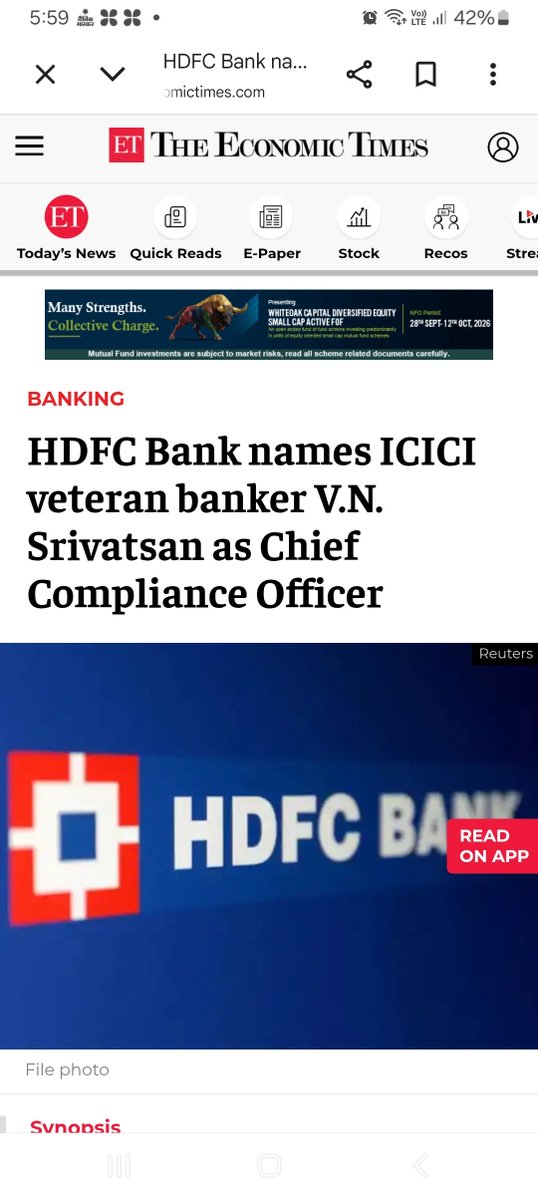
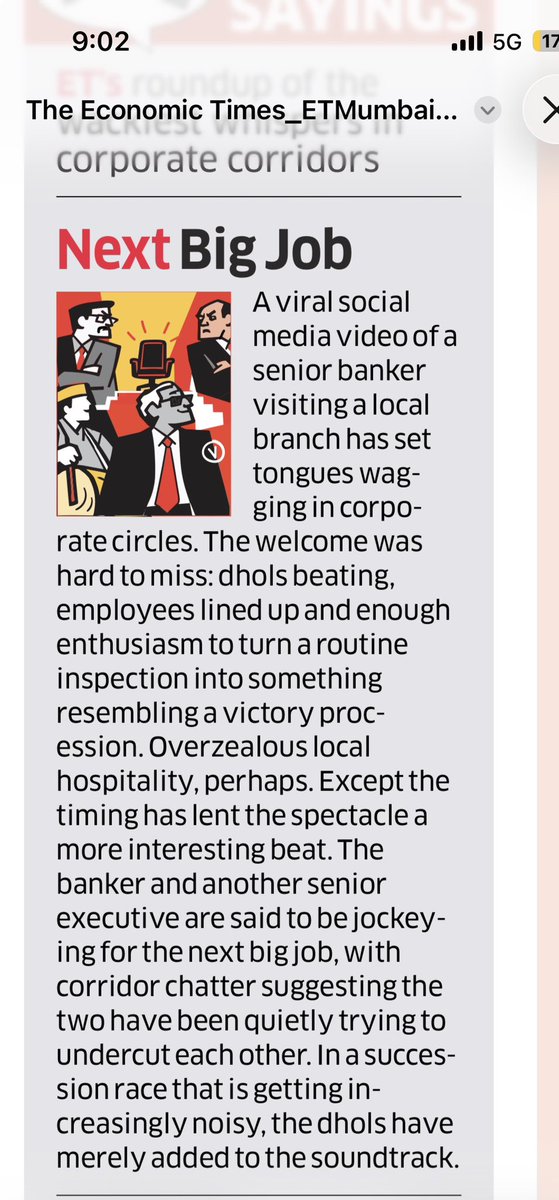
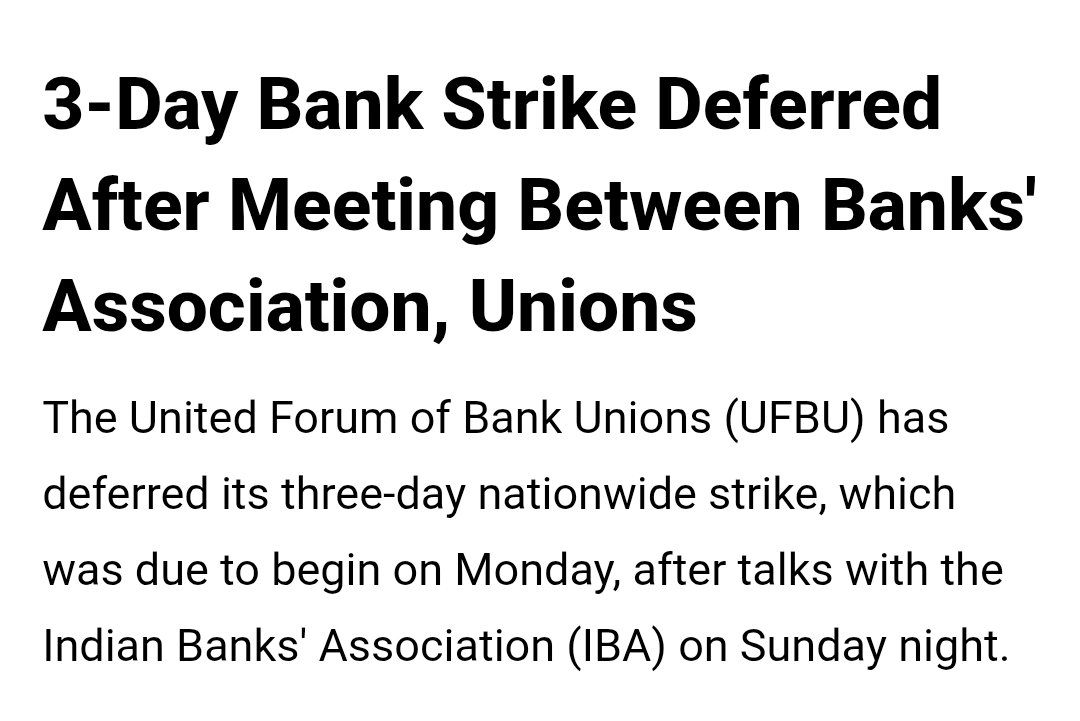
So much Transperency, How would @HDFC_Bank would cop with this ?
New Fixed Deposit (FD) Rules from October 1, 2026
1️⃣ Deposits of ₹3 Crore or More Will Be Treated as Bulk Deposits
Fixed deposits of ₹3 crore or more will fall under the Bulk Deposit category.
2️⃣ Interest Rates Must Be Updated Daily
Banks will have to publish the applicable interest rates for bulk deposits on their websites by 10:00 AM on every working day.
3️⃣ Same Rate for Similar Deposits Across Branches
Different branches of the same bank cannot offer different interest rates for bulk deposits with the same amount and same terms.
4️⃣ Banks Must Follow the Declared Interest Rate
The interest payable to the depositor must be based on the interest rate declared by the bank for that deposit.
5️⃣ Different Rates May Be Allowed Based on Liquidity Risk
Banks may offer different rates on certain bulk deposits based on their liquidity characteristics and risk.
@MDahariya@RenuVarun194165@RBI@PSBPunch@kanalmedia23@idesibanda@bankaffairs
The employees of the Banks were called on sunday
1) Two show the power to Nationalised and private banks
2) Then the strike was called off to show the power to employees.
3)Now this meeting is postponded
again to show the power
only one solution do not ask your child to prepare or join the banks. Do not sit in exams
@PSBPunch@bankaffairs@kanalmedia23@bankmajdur@idesibanda@MDahariya@RenuVarun194165
The debate around a 5-day banking week in India is both a myth and a practical reality depending on how it is implemented.
If we consider a 30-day month, with around 8–10 weekly offs and 2 public holidays, the effective customer-facing working days for banks may reduce to nearly 20 days.
Many argue this could increase workload pressure on operational days, especially in retail banking where branch traffic is already very high.
However, the larger question is not only about the number of working days, but about how banks utilize non-customer-facing time.
Instead of completely shutting operational productivity, an alternative approach could be:
1st, 3rd and 5th Saturdays to remain public holidays for customers.
These days should be internally utilized by bank employees for:
Audit checks and compliance reviews
Customer grievance resolution
Reading circulars and policy updates
Mandatory training and skill enhancement
Completing pending operational work
Customer committee and review meetings
Such a structure can:
Improve compliance quality
Reduce operational errors
Enhance employee knowledge
Create better work-life balance
Reduce stress-driven decision making
Build a healthier and pressure-free banking environment
In the present scenario, banking employees are handling:
Aggressive business targets
Regulatory compliance
Digital migration support
Customer servicing
Audit accountability
Continuous policy changes
Without dedicated administrative and learning time, employees often end up completing critical work after customer hours, leading to burnout and operational risk.
A structured semi-5-day model may therefore be more practical than a complete reduction in working days. The focus should be on sustainable productivity rather than only counting branch-open days.
@RBI@RBIsays@nsitharaman@DFS@MDahariya@CNBC_Awaaz
Removing only Mr. Sashidhar Jagdishan will not solve HDFC Bank’s deeper problems.
The bank must review its entire old senior-management structure, particularly officials at the Vice President level and above. Many senior executives have remained in the same territories and comfortable locations for years, gradually becoming too powerful and behaving as though their regions are personal domains.
A genuine transformation requires:
• Rotation of long-serving senior officials
• Transfers outside their established territories
• Clear performance and accountability reviews
• Independent assessment of conduct, culture and governance
• Fresh leadership opportunities for capable professionals
• Strict checks against favoritism and territorial control
Senior management should also be required to work in challenging locations and prove their productivity, adaptability and leadership—not merely supervise others from positions of comfort.
HDFC Bank does not need only a change at the top. It needs a complete refresh of its senior leadership cadre.
Refresh the entire fleet, break the comfort zones, restore accountability—and the difference will become visible.
@HDFC_Bank@HDFCBank_Cares@RBI@livemint@CNBC_Awaaz@IndianExpress@ETNOWlive@PSBPunch@bankaffairs@RenuVarun194165@bankmajdur@idesibanda
@HDFC_Bank@HDFCBank_Cares@MDahariya@RBI@RenuVarun194165@bankaffairs@PSBPunch@idesibanda@bankmajdur@CNBC_Awaaz@IndianExpress@ETNOWlive
Net interest margin was only 3.26%.
CASA ratio declined to 32%, compared with 34% in March 2026 and 38% in September 2023.
Retail loans fell to 52% of the overall AUM mix, from 55% in March 2025.
Profit was up only 5% year-on-year and declined 0.8% quarter-on-quarter.
RoE was 13.8%, which is not particularly strong for a bank historically valued as a premium retail franchise
Bank need a Chang #ShashiJadishan
@HDFC_Bank@HDFC_Bank@RBI@nsitharaman@MDahariya@RenuVarun194165@SandeepParekh@RajivKumar1@PSBPunch@bankaffairs@IndianExpress
The Ministry of Finance
announcement dated 23 September 2026 specifically directed PSBs and RRBs to remain open on Sunday, 27 September. Please provide the regulatory/management authority under which HDFC Bank has decided to open its branches on that Sunday.”
Was this decision taken by HDFC Bank internally?
Was RBI approval specifically obtained for HDFC Bank?
Is Sunday attendance mandatory or voluntary for employees?
Will employees receive compensatory overtime/other applicable benefit?
Why is HDFC Bank opening when the government announcement specifically referred to PSBs and RRBs?
@HDFC_Bank@ICICIBank@AxisBank@RBI@DFS_India@nsitharaman@MDahariya@RenuVarun194165@PSBPunch@bankaffairs@idesibanda
Questions to D-SIBs & Private Banks of India
During the 28–30 September bank strike, I have a few questions for D-SIBs and private-sector banks:
How will you conduct business in locations where your bank does not have a branch?
How will you serve customers of public-sector/nationalised banks during the strike?
How will government-related banking transactions be handled during the strike period?
When colleagues across the same banking sector are on strike and losing three days’ salary, how do you justify using this period as an opportunity to acquire their business?
Is this about customer service—or simply a business opportunity?
If employees from the same sector are sacrificing three days’ salary to raise their demands, using the situation purely for business advantage raises a serious question of professional solidarity and ethics.
“Pathetic” is the word that comes to mind.
@HDFC_Bank@ICICIBank@AxisBank@RBI@DFS_India@nsitharaman@MDahariya@RenuVarun194165@PSBPunch@bankaffairs@idesibanda
Questions to D-SIBs & Private Banks of India
During the 28–30 September bank strike, I have a few questions for D-SIBs and private-sector banks:
How will you conduct business in locations where your bank does not have a branch?
How will you serve customers of public-sector/nationalised banks during the strike?
How will government-related banking transactions be handled during the strike period?
When colleagues across the same banking sector are on strike and losing three days’ salary, how do you justify using this period as an opportunity to acquire their business?
Is this about customer service—or simply a business opportunity?
If employees from the same sector are sacrificing three days’ salary to raise their demands, using the situation purely for business advantage raises a serious question of professional solidarity and ethics.
“Pathetic” is the word that comes to mind.
HDFC Bank is a Domestic Systemically Important Bank (D-SIB) and one of India’s major banks. When HDFC takes a step, other banks often take note.
So I have one simple question:
Nationalised banks have branches covering almost every corner of the country. If they are on strike from 28–30 September, will HDFC Bank operate in places where it does not even have a branch?
Public-sector bank employees participating in the strike may lose three days’ salary for exercising their right to strike.
Then what exactly is the purpose of highlighting HDFC Bank’s operations during these three days?
Customer service is one thing. Seeking attention is another.
If the objective is genuinely customer service, let’s call it that. If it is business generation, let’s be transparent about it.
@HDFC_Bank@HDFC_Bank@RBI@nsitharaman@MDahariya@RenuVarun194165@SandeepParekh@RajivKumar1@PSBPunch@bankaffairs@IndianExpress
The Ministry of Finance
announcement dated 23 September 2026 specifically directed PSBs and RRBs to remain open on Sunday, 27 September. Please provide the regulatory/management authority under which HDFC Bank has decided to open its branches on that Sunday.”
Was this decision taken by HDFC Bank internally?
Was RBI approval specifically obtained for HDFC Bank?
Is Sunday attendance mandatory or voluntary for employees?
Will employees receive compensatory overtime/other applicable benefit?
Why is HDFC Bank opening when the government announcement specifically referred to PSBs and RRBs?
Work life balance @HDFC_Bank Great Place to Work btw @GPTW_India .
They r trying to attract new customer footfalls taking advantage of strike called by unions of PSU Banks.
Government bank employees are on strike, and there is a clear RBI notification stating that only public sector banks and regional rural banks are required to keep their branches open on Sundays. So, why has HDFC Bank asked to remain open on Sunday?@FinMinIndia@RBI@MDahariya
@MDahariya@RenuVarun194165@SandeepParekh@RajivKumar1@HDFCBank_Cares@RBI@SmalhotraRBI@PSBPunch@bankaffairs@bankmajdur@idesibanda
HDFC Bank has found a disgusting way to generate business.
Now, when other bankers are fighting for 5-Day Banking, has HDFC Bank got an opportunity to generate more business?
Are many departments like Legal and Audit not enjoying the 5-Day Week at HDFC Bank?
A few days back, following the call of PM Shri Narendra Modi, why did HDFC Bank announce Work From Home?
Every Employee of HDFC Bank is asked to place this on their Whats up Status
The Move Will Continue If… 🔎
The right person with the right vision is appointed.
All 180 whistleblower complaints are reviewed with firm timelines and proper closure.
A clear HR policy for transfers of top management is established.
Appropriate accountability is fixed where senior management failed to address whistleblower complaints in accordance with policy.
A strong compliance and governance framework is consistently followed.
Every employee is treated as an asset—not merely a tool for business.
Compensation is aligned with responsibility, business contribution and role complexity.
The cost-effectiveness of every branch opened in the last five years is reviewed.
Adequate staff is deployed in sales roles, including BSO and PB Sales, to manage business expectations sustainably.
A transparent movement/rotation policy outside comfort zones is implemented for AVP and above, with objective criteria.
@MDahariya@RenuVarun194165@idesibanda@PSBPunch@bankaffairs@bankmajdur@ETNOWlive@IndianExpress@_RituSingh@CNBC_Awaaz
@PSBPunch@bankaffairs@kanalmedia23@bankmajdur@idesibanda@MDahariya@nsitharaman@RBI
Dear, I am not against 5-Day Banking
.
But the real question is: Who will ensure that it doesn’t increase pressure on employees?
If working days reduce to around 20 days and daily working hours increase, will the same workload be compressed into fewer days?
• Will sales targets also be adjusted?
• Will banks increase staff proportionately?
• Who will ensure employees are not called on holidays?
• Who will guarantee defined working hours?
Before 5-Day Banking, we should ensure:
✅ Sufficient staff deployment
✅ Clearly defined working hours
✅ Real Work–Life Balance
5-Day Banking should mean 5 days of work—not 5 days of work compressed into 4.