A trial focused on a specific metastatic site.
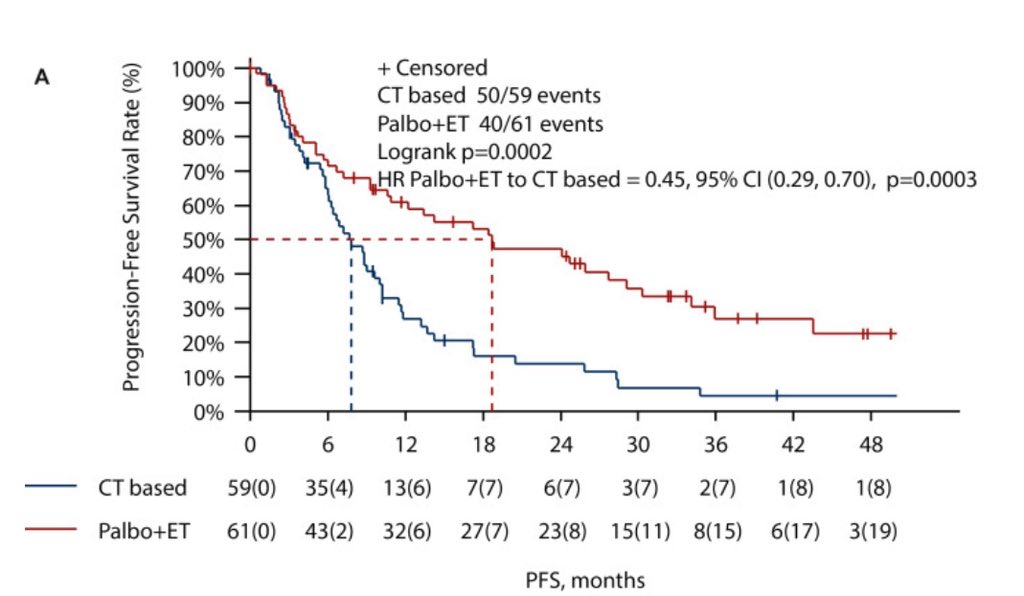
RC48-C006: In HER2+ breast cancer with liver metastases, disitamab vedotin improved PFS versus lapatinib + capecitabine (9.9 vs 4.9 months; HR 0.56).
However, these data do not position DV ahead of T-DXd. In DB03, among patients with visceral disease, PFS was 22.2 vs 5.7 months with T-DXd versus T-DM1 (HR 0.28); a liver-specific analysis was not reported—or at least I could not find one.
DV’s main potential role may be after T-DXd as an ADC with a different payload; however, because prior ADC therapy was excluded, this study does not answer that question.
https://t.co/LqR1QRn1og
pCR results from CompassHER2-pCR published in @JCO_ASCO. Several important results. THPx4 leads to pCR in 44% or pts with HER2+ eBC, with higher chance if ER ≤70% and HER2 3+. Weekly paclitaxel > q3w docetaxel. HER2DX associated with pCR. RFS pending. https://t.co/ABeepWdlX3
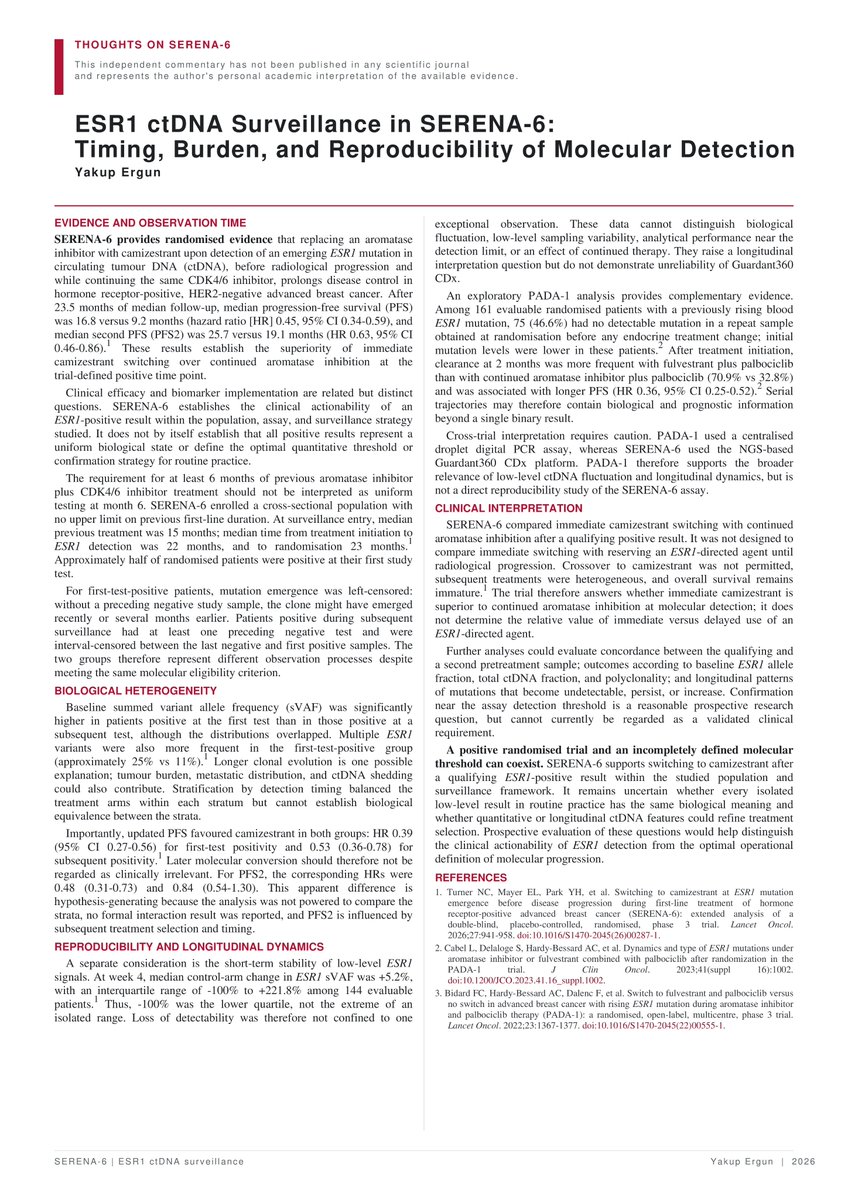
Thoughts on SERENA-6 is a personal commentary that has not been published in conventional academic journals.
From now on, I will share my personal writings in this format as a protest against a publishing system shaped by arbitrary editorial decisions, editors’ personal biases and conflicts of interest, favoritism within professional networks, excessive article processing charges, and the coercive “publish or perish” culture.
HER2+ THERAPY IS BECOMING RESPONSE-ADAPTED
A simple algorithm proposed by Tarantino et al. (JCO 2026):
▪️ Stage IIA → THP → Surgery → HP
▪️ Stage IIB → THP → Response assessment → Continue THP or escalate to T-DXd
▪️ Stage III → TCHP or THP → T-DXd → Surgery
▪️ pCR → Complete planned HER2-directed therapy
▪️ Residual disease → T-DXd or T-DM1
The concept is simple:
✓ Stage
✓ Biology
✓ Treatment response
Together determine treatment intensity.
We are moving beyond a one-size-fits-all approach toward more personalized HER2-directed therapy.
Adapted from Tarantino et al., JCO 2026.
#BreastCancer #HER2 #HER2Positive #Oncology #JCO #ASCO #TDXd
A common worldwide practice is to give chemo prior to ET to patients with untreated HR+ MBC. Multiple randomized studies have now proved that this strategy is inferior. Glad to see the #PADMA study published in @ESMO_Open, showing dramatically longer PFS with ET/palbo vs chemo.
SERENA-6 Trial — Final PFS2 Analysis #ASCO26
Switching to camizestrant + CDK4/6i at the emergence of ESR1 mutations in ER+/HER2− advanced breast cancer.
Updated PFS: median 7.6-month improvement → HR 0.45, with 1 in 3 patients still progression-free at 24 months.
PFS2 (final): 25.7 mo vs 19.1 mo → HR 0.63 (p=0.00373), confirming the benefit extends well beyond first progression.
Additional findings:
•Chemotherapy/ADC-free survival: 22.6 mo vs 18.7 mo → HR 0.64
•OS HR: 0.87, continuing to mature in favor of camizestrant
🔥 SERENA-6 updated results
We continue discussing mainly the study design, instead of discussing the trial results
30 months PFS: 17 pts (30.4%) vs 1 pts (2.7%) free of progression
Isn’t it great?
Do you think we can get it at clinical progression?
@ASCO@OncoAlert
Highly impactful update from SERENA6. Very nice plateau in the PFS curves with longer follow up, and dramatic reduction in ctDNA and improvement in QoL which suggests deep benefit. Harder to interpret PFS2. Hoping to have this option available for our patients soon. #ASCO26
Since the first phase 1 trial of T-DXd, it was clear that this drug could be transformative when taken to the curative setting. Today, the FDA approved T-DXd for the neoadjuvant or adjuvant treatment of HER2+ eBC, marking a major advancement in the field. https://t.co/p8Fyhyr5Pr
SERENA-6
Timing of ESR1m emergence
Median tests: 3
At first test, 10% ESR1m
Detection highest in 12-48 months
Cumulative detection rate 19.6%
#ESMOBreast2026@OncoAlert#bcsm
Interesting new data from #SERENA6 showing that the cumulative incidence of ESR1 muts rises steadily over time. ctDNA monitoring detected ESR1m in ~20% within 1 year, but the incidence was highest between years 1-4. #ESMOBreast26