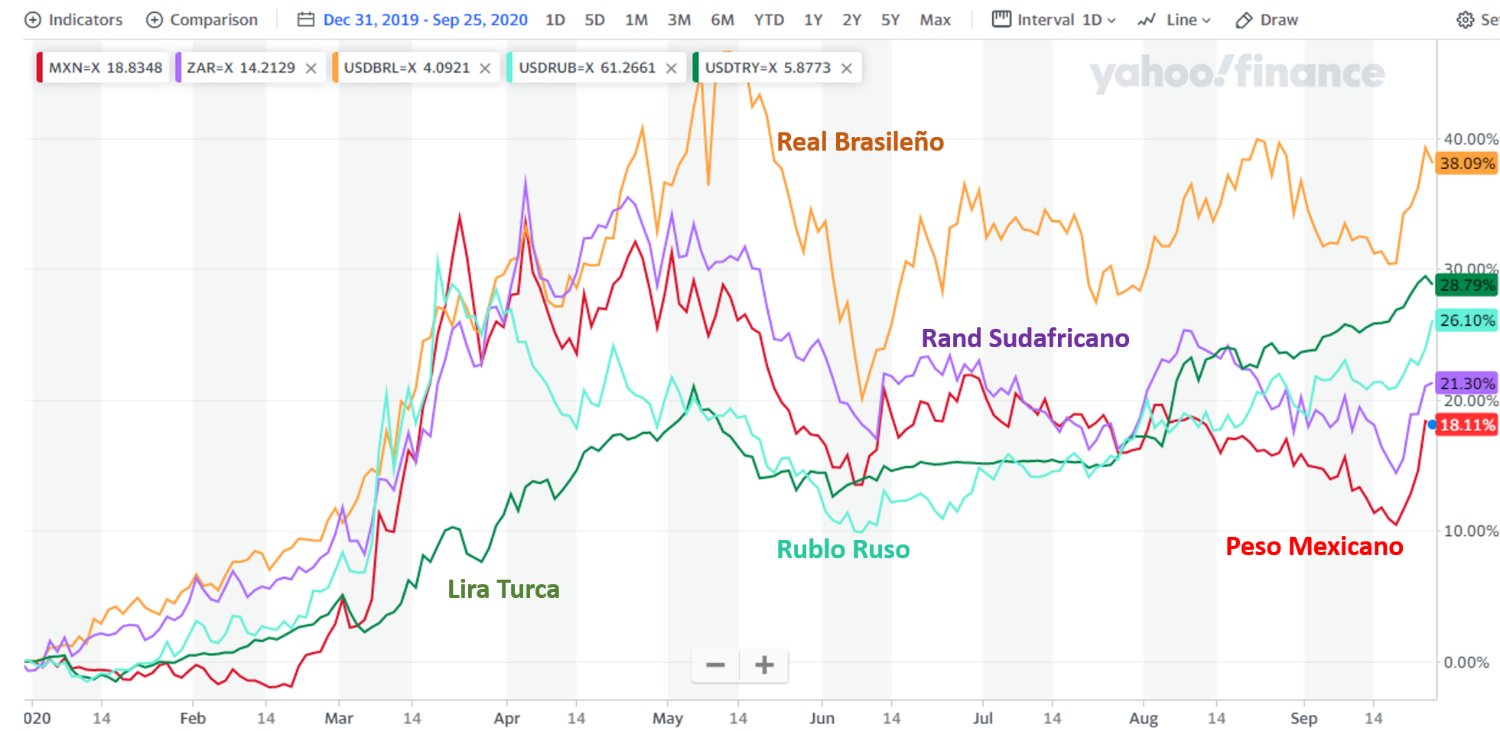
⛈️Weather or Not You're Ready: How Mexico's Environmental Shifts Are Upending Your Wallet!🌪️
Ahead of intense weather events, the economy feels the heat with inflation rates soaring, impacting the broader economy. Check our research: https://t.co/gH5cUY92Rj
I'd like to announce that drlate, a Stata module for doubly robust estimation of the local average treatment effect (LATE) and the local average treatment effect on the treated (LATT), is now available in SSC.
Siempre generoso. Un guía y amigo a quien vamos a extrañar mucho. Su legado es una vasta obra, innumerables RPV tips y una sonrisa amable a donde quiera que fuera.
Highly relevant!
"The Theory of Financial Stability Meets Reality: A Unifying Framework for Bank Regulation and Accounting Discretion" by Nina Boyarchenko, Kinda Hachem, and Anya Kleymenova.
"A large literature at the intersection of economics and finance offers prescriptions for regulating banks to increase financial stability. This literature abstracts from the discretion that accounting standards give banks over financial reporting, creating a gap between the information assumed to be available to regulators in models of optimal regulation and the information available to regulators in reality. We bridge insights from the economics, finance, and accounting literatures to synthesize knowledge about the design and implementation of bank regulation and identify areas where more work is needed. We present a simple framework for organizing the relevant ideas, namely the externalities that motivate bank regulation, the rationales for allowing accounting discretion, and the use of discretion to circumvent regulation. Our takeaway from reviewing work in these areas is that academic studies of bank regulation and accounting discretion require a more unified approach to design optimal policy for the real world."
https://t.co/FNTo0cyCQx
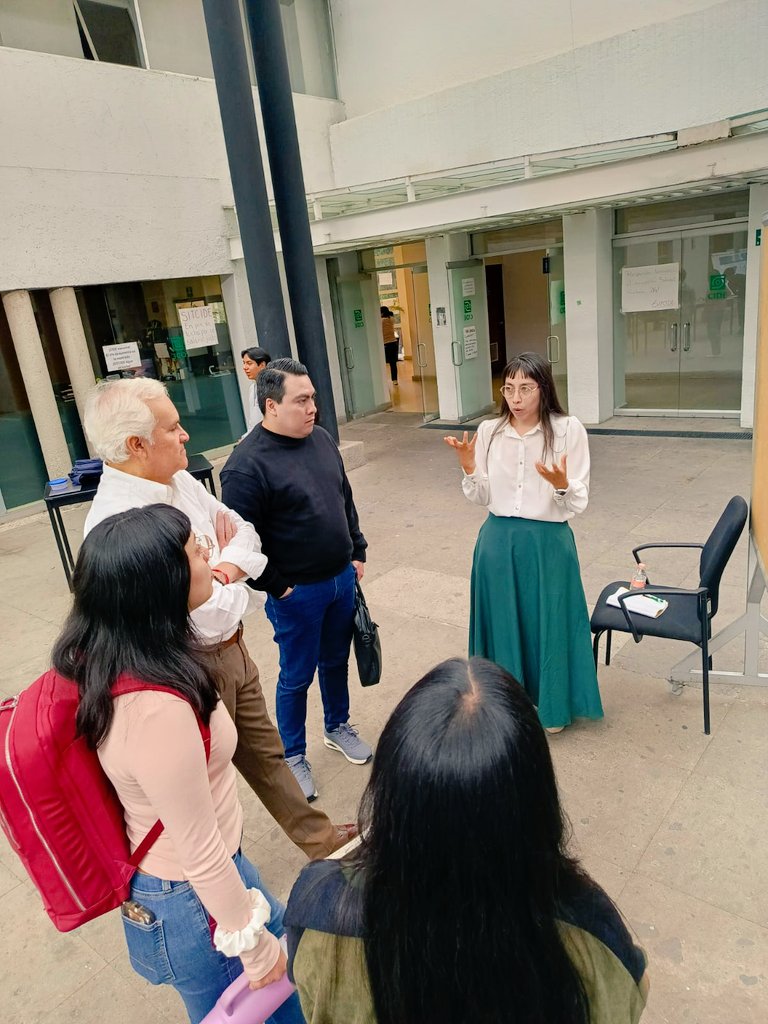
Agradezco mucho al @ICGDE de la Benemérita Universidad Autónoma de Puebla por la invitación a presentar nuestro trabajo y convivir con sus estudiantes y profesores de posgrado en un interesante taller de métodos para la evaluación de impacto. Gran experiencia.
Our paper “Difference-in-Differences Designs: A Practitioner’s Guide” is now published in the Journal of Economic Literature. It took us a while but we are happy!
We put together a lot of material to make the paper useful in practice: https://t.co/30TbAgihlz
Hope you like!
Feliz de presentar mis avances de investigación de la maestría en el @CIDE_MX!
A través de un diseño experimental, analizo cómo el sesgo de género de la figura de autoridad afecta la probabilidad de obediencia.
¡Agradecida por los valiosos comentarios! :)
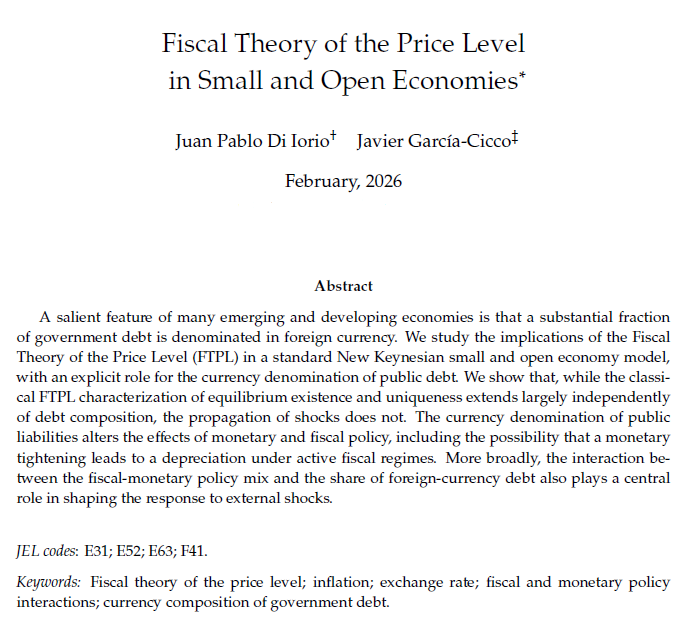
¿Puede una suba de tasas generar una depreciación? Sí.
Si te interesa macro abierta, política monetaria o entender por qué los mercados emergentes se comportan "al revés"… este paper de nuestro profesor @JavierGC14 y @juanpdiiorio (maestría 2022) es para vos.
👉https://t.co/3uGshvIawn
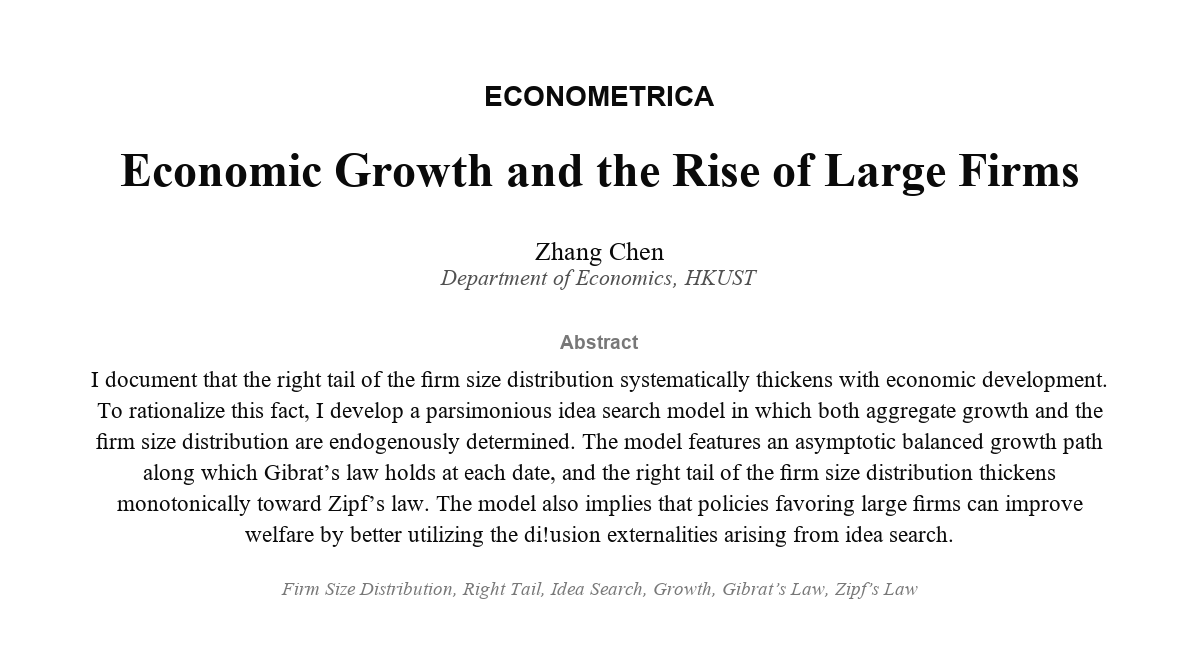
Why do richer economies have more very large firms? This paper shows that the upper tail of the firm size distribution thickens as economies grow. A model of idea search explains why, showing how growth itself can produce rising concentration.
https://t.co/ocOxbeV3Ww
Super interesting!
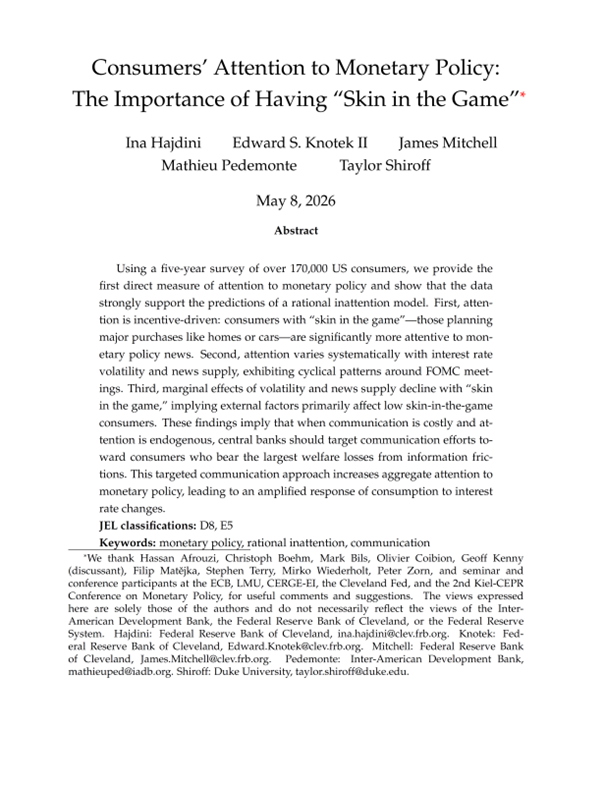
"Consumers’ Attention to Monetary Policy: The Importance of Having 'Skin in the Game' ", by Ina Hajdini, Edward S. Knotek II, James Mitchell, Mathieu Pedemonte, and Taylor Shiroff.
"Using a five-year survey of over 170,000 US consumers, we provide the first direct measure of attention to monetary policy and show that the data strongly support the predictions of a rational inattention model. First, attention is incentive-driven: consumers with “skin in the game”—those planning major purchases like homes or cars—are significantly more attentive to monetary policy news. Second, attention varies systematically with interest rate volatility and news supply, exhibiting cyclical patterns around FOMC meetings. Third, marginal effects of volatility and news supply decline with “skin in the game,” implying external factors primarily affect low skin-in-the-game consumers. These findings imply that when communication is costly and attention is endogenous, central banks should target communication efforts toward consumers who bear the largest welfare losses from information frictions. This targeted communication approach increases aggregate attention to monetary policy, leading to an amplified response of consumption to interest rate changes."
https://t.co/hUopc6jPEy
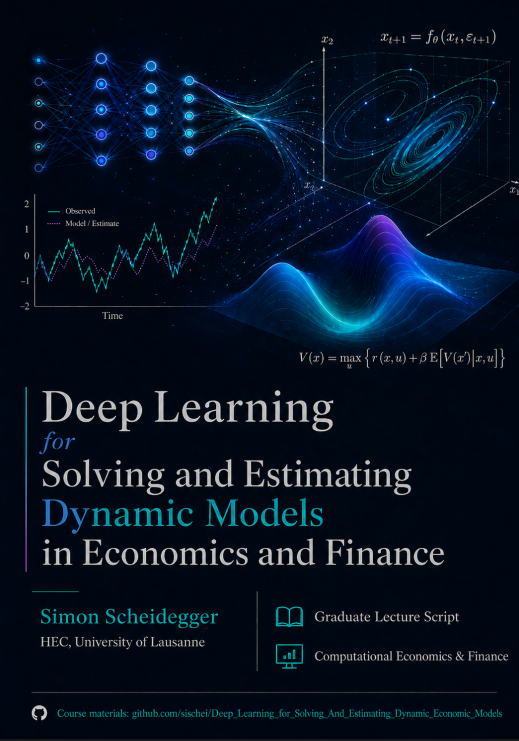
Thrilled to share a project I've been refining: a complete, open-source repository on "Deep Learning for Solving and Estimating Dynamic Models in Economics and Finance."
I've cleaned up the materials from my PhD classes and summer schools into one coherent resource. 🧵 1/6
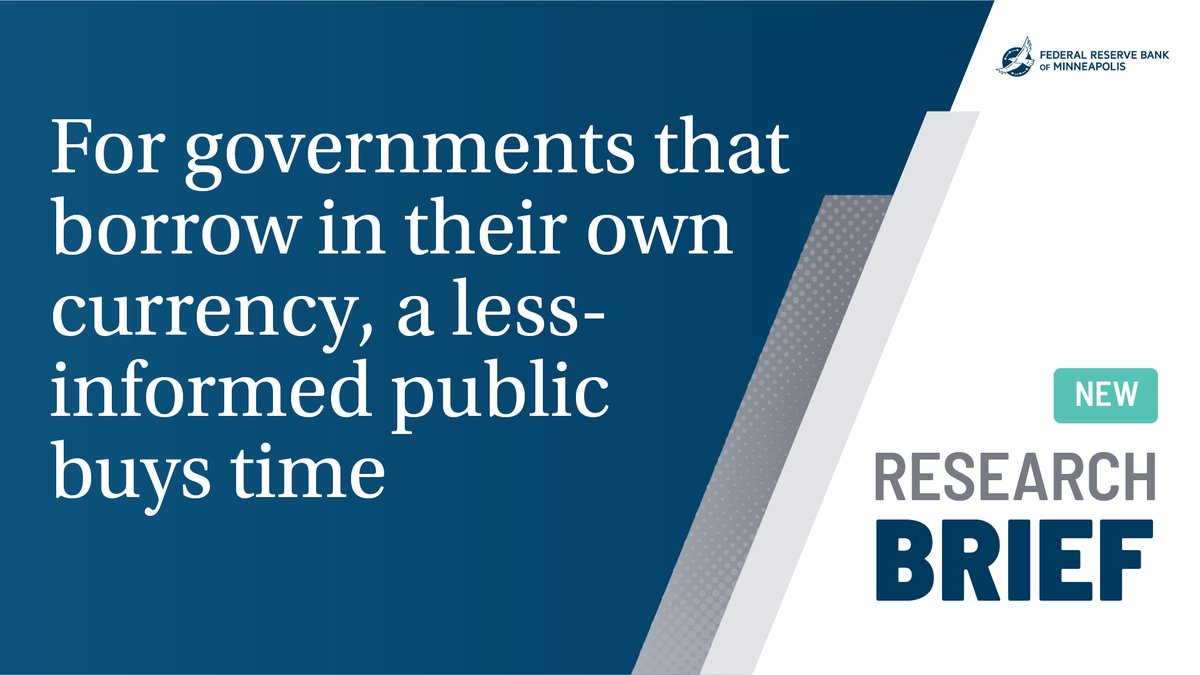
When a government relies on inflation to erode the burden of sovereign debt, why doesn't it suffer the same interest rate consequences as outright default? Answers in new research from our Marco Bassetto & Jason Hall, with @carlogalli6 of @EconomicsUc3m. https://t.co/6hidkTqFHj
#AgendaCIDE | La @CIDE_DAP y el Behavioral Economics Group de @el_BID invitan a participar en la Jornada CIDE-BID: "Behavioral Science para la transformación de las Políticas Públicas".
🗓️ 14 de mayo de 2026 | 10:00 h
📍 Sala de Usos Múltiples
ℹ Jacqueline Hernández Ext.7823
"One lesson is don't over-learn the lessons of history, especially recent history." - Donald Kohn of @BrookingsInst, part of our distinguished panel reflecting on the recent inflation episode and featured in our latest Quarterly Review. https://t.co/SLdCi9ttBo
El próximo jueves participaré en la jornada CIDE-BID sobre cómo utilizar la ciencia del comportamiento para transformar las políticas públicas.
Será de 10 a 16 h en el @CIDE_MX y habrá transmisión en YouTube; les esperamos con mucho gusto.
@CIDE_DAP@CIDEMAPP@DPP_CIDE
Energy price spikes linked to the war in the Middle East may make key euro area imports more expensive and raise uncertainty, hitting real incomes and shaping saving behaviour.
Our #EconomicBulletin explores how this may dampen growth and push up inflation https://t.co/6SWdoOV8Ld
2nd Summer School on Causal Inference
We are pleased to announce that applications for the 2nd Summer School on Causal Inference are now open.
Last date to apply: May 15, 2026
@Sabya_K
For details and application:
https://t.co/HKwvVtftbP
Don’t miss your chance to read the new Cambridge element, Monetary Policy Implementation, by Stephen Williamson! Free access available until 8 May at
https://t.co/rAZtiet1bF
#cambridgeelements#economics
📊 Nueva publicación académica | Inflación y transparencia
Nos complace compartir nuestro más reciente artículo publicado en Applied Economics Letters.
✍️ Autores: Carlos Giraldo, Iader Giraldo Salazar, José Gómez-González y Jorge M. Uribe.
El estudio analiza los determinantes de episodios de inflación persistentemente alta en 180 países (1998–2023), utilizando modelos de duración.
🔎 Hallazgo clave:
La transparencia de los bancos centrales reduce significativamente la duración de estos episodios, al fortalecer la credibilidad y anclar expectativas.
💡 Mensaje central:
Una comunicación clara y consistente es un complemento esencial de la política monetaria, especialmente para mitigar la persistencia inflacionaria.
📄 Más información: https://t.co/TidCJnpstU
#Inflación #PolíticaMonetaria #BancosCentrales #Transparencia #FLAR