@jkpritch@jkpritch - They increased yield from ~14T/ha to 20T/ha. US commercial yields are 50T/ha and 80T/ha is very doable. This is interesting basic biology, but the yield results cannot be trusted until placed in a high yielding variety and replicated trials in more than 3 locations.
Over two decades ago, we mapped the variant making sweet corn sweet—after tremendous effort. PlantCaduceus easily identifies this single base pair causal variant. 🌽
Give it a try—this model paves the way for treating all plants as a single molecular system!
PlantCaduceus - Cross-species modeling of plant genomes
Led by Jingjing Zhai and Aaron Gokaslan, with the Kuleshov lab, we’re having our “ChatGPT moment” with DNA Large Models. PlantCaduceus predicts functional DNA sequences with single base resolution across flowering plants.
What’s remarkable about PlantCaduceus is its ability to be fine-tuned in Arabidopsis and still retain accuracy in distant species like major grass crops, such as corn. 🌱→ 🌽🌾
This class of models are a game changer for plant genomics! https://t.co/jKRzFRBvQZ
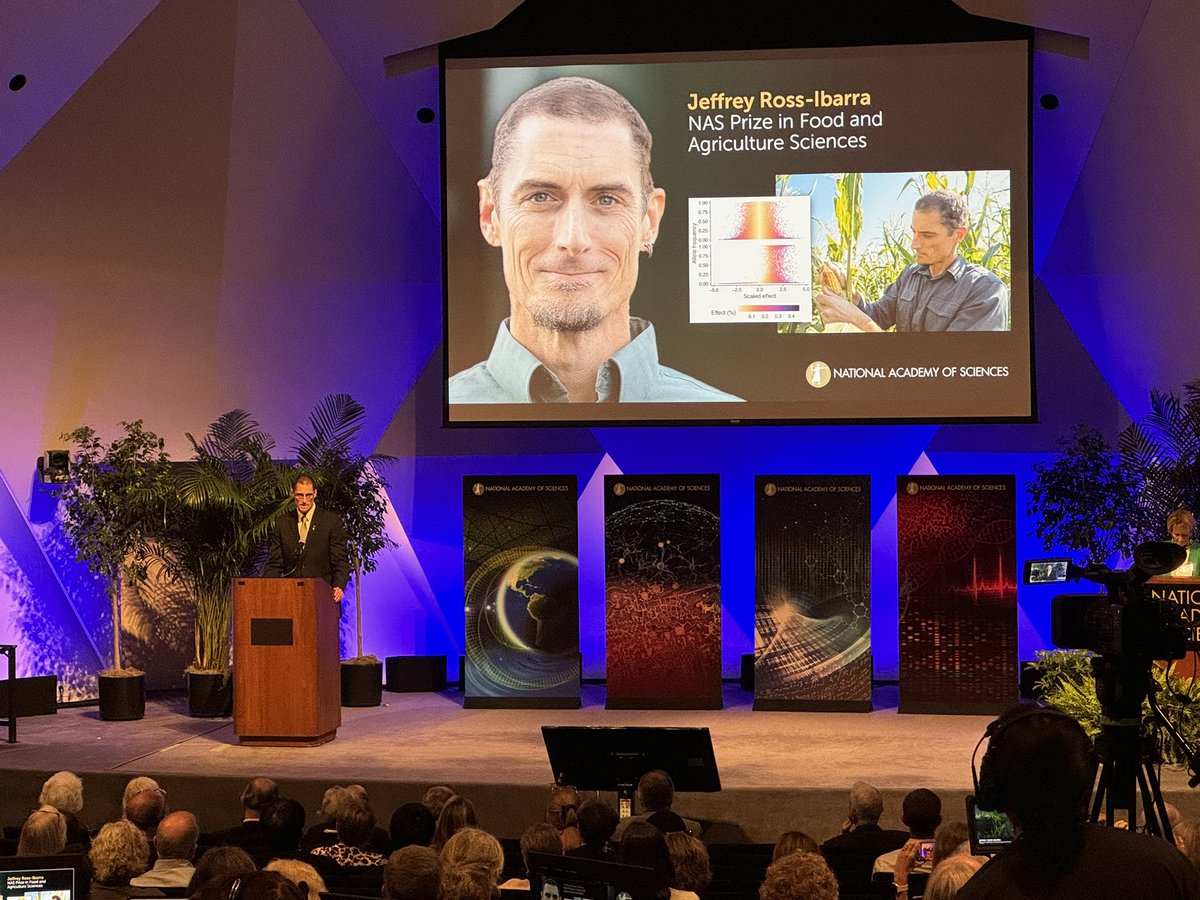
@jrossibarra receives the @theNASciences prize in Food and Agriculture for his amaizing use of evolution to understand where we came from and where we can go!
Comments were made last night at #MGM2023 that were hurtful to members of our community. Discrimination and harassment, even in the absence of malicious intent, is a violation of our code of conduct, and the damage to members of our community is no less real. 1/3
Dr.MariaElena Zavala's talk at #MGM2023 was amazing. Dr. Zavala talked about research, mentors & work to increase the number of historically excluded folks in the academy. The Q&A session however had VERY disparaging comments about Indigenous peoples and I want to tell you why 🧵
@facundoromani @SJB_SynBio @JohnathanNapie1@facundoromani @SJB_SynBio @JohnathanNapie1 - perhaps this is not clear from Europe, but most every US public Ag school (~50) is growing GM trials every year. We have the land and procedures to do this responsibly. Soybean is particularly easy given its selfing nature.
@BioNetworksbyAB@BioNetworksbyAB - there are thousands of public sector plant breeders globally able to run trials at multiple locations with their colleagues. Thousands of articles a year report those results. Yield is about interactions with the environment and needs to be measured there.
My great colleague @LongLab published a neat paper on how plants deal with light, but @MerKhaiBurch is right; yield increases that don’t replicate should not be claimed in abstracts or press releases.
ANOTHER paper in @ScienceMagazine came out claiming a 33% increase in soy yield. Since my last “yield” tweet took off - lets do it again!
From a (wanna be) plant breeder 5 years into my PhD, let me explain how this 33% increase in yield is misleading 🧵https://t.co/iPL1k91Rdg
Modeling chromatin state from sequence across angiosperms using recurrent convolutional neural networks https://t.co/aoxo0lUUgO Congrats Travis Wrightsman and team on the really nice paper!
@Yan_Geneticist@Yan_Geneticist - the big advantage of these genes lies in their ability to stop lodging ONCE you have applied lots of fertilizer. The Green Revolution was driven by fertilizer, and then genetics plays an important stabilizing role.
@Liana_Ace@MerKhaiBurch@ScienceMagazine@Liana_Ace - I think we all agree that this is a really neat physiology paper - but the abstract directly claims 41-68% yield increases. And that is what the press releases focused on.
@MerKhaiBurch@ScienceMagazine@MerKhaiBurch is exactly right. This study has lots of neat biology, but we need to measure genetic impacts on yield in elite varieties across numerous target environments.
The study could easily have just focused on impressive physiology and molecular biology.
A misleading paper in @ScienceMagazine just came out talking about how a single gene can increase rice yield by 41-68%. As a (wanna-be) plant breeder, I’m here to tell you why this study is misleading, and we can’t “solve” yield through single genes 🧵
https://t.co/Myd6DobSV7