Morgan Stanley on memory:
"Memory risk reward starting to look very favorable even with land/power/shell risks. For us, the multiple compression in memory is increasingly offering very compelling upside relative to those risks, and FCF earned during the upturn is being predominantly used to buy back large quantities of stock."
$MU $DRAM $EWY $SKHY $SNDK
Our perspective on today's market crash.
In the era of AI, the biggest technological revolution in human history, people are eager to call the top. That's how disruption works; it disrupts.
Revolutions yield polarity in sentiment and volatility comes with change.
However, if you zoom out, the S&P 500 is still up +9% YTD and +85% since the AI Revolution began, and AI is nowhere near "over."
In fact, it's only just getting started. Corrections are healthy.
Asset owners will continue to win in the long-run.
On today's stock market crash:
As an investor, on days like today, you have to ask yourself one question: What fundamentally changed over the last 24 hours?
The shift in the fundamental backdrop cannot be attributed solely to the Midterm Election results; markets had already largely priced in the outcome.
So, what changed between yesterday and today? What is the fundamental reason for today's decline?
One of the most likely catalysts is growing concern about a potential "ban" on AI, or at the very least, severe regulation of the industry.
Over the last 24 hours, Democratic lawmakers have publicly called for restrictions on advanced AI development, including an outright "ban on artificial superintelligence."
Frankly, an outright ban will not happen.
Such a ban, if even possible to enforce, would effectively mean the US surrendering its position in the global AI race to China.
Does this mean AI is "over" or today's stock market crash marks "the end?" Absolutely not.
Rather, we believe we are witnessing a sudden shift in sentiment colliding with excessive levels of leverage, potentially triggering forced liquidations by several major institutional investors.
Therefore, today's downturn is more technical than fundamental. This is not to discount the concerns around regulation, they are legitimate. But price action right now does not look orderly or rational.
We are in the midst of the biggest technological revolution in human history.
Zoom out and remain calm.
Woah, stellar earnings from and AI market projections...
1. SK Hynix: "Memory supply shortage to persist through 2030".
2. There's the $4.8B operating profit beat ($62.8B vs. ~$58B est)... 80% operating margins.
So you had:
- Revenue: $78.84B vs. $74.02B
- Operating profit: $62.80B vs. $58.00B
- Operating margin: 79.7% vs. 78.3%
With forward projections of
3. "Our DRAM and HBM volumes through 2029 are effectively sold out."
4. Signed LTAs covering 50%+ of 2027–2028 capacity, while retaining pricing flexibility
5. The company intends to fulfill its commitment to return 50%+ of cumulative FCF for 2025-2027
6. "We have included deposits and other practical enforcement mechanisms" (LTAs have actual enforcement)
7. "We expect the profitability gap between HBM and conventional DRAM to narrow significantly" (hello broader memory industry)
8. SK Hynix announced $75B in shareholder returns (dividends/buybacks) for CY2026.
I'm not sure what there isn't to like here?
You have a memory company just printing... demand visibility super high from enforceable commitments... and now they're returning that via dividends/buybacks.
$SKHY reports tonight, US time, and it's being priced like the memory cycle is over 💀
I don’t think it is.
Consensus is about ₩98T in revenue, up 300%+ YoY, at roughly 78% operating margins. TSMC runs at around 60%.
HBM is sold out through 2027, and HBM prices are forecast to rise 121% next year.
12-layer HBM4 is already in mass production and shipping to core customers.
It just finished a ₩40T buyback, and a special dividend funded by the Kioxia stake sale is on the table.
The stock is still about half off its summer highs, at roughly 4x earnings by one estimate.
And Elon says memory is now the limiting factor for the whole AI buildout: supply grows about 20% a year while demand is up about 200%.
So you get record profits, sold-out capacity, cash going back to shareholders, and a price that says the memory cycle is over… I’m not buying it.
This is going higher or the whole AI trade is going lower.
Send it mfs!
Revenue per GPU can increase as token prices decline if per GPU token throughput increases enough.
So both Anthropic revenue *and* margins can go up as token prices go down *if* GPU prices go up less than the product of (token price decline * per GPU throughput increase).
But I have super enjoyed all the commentary to the contrary!
SK Hynix is preparing another large shareholder return. The total for this year could reach about 100 trillion won.
Seoul Economic Daily cites industry sources. The company plans to confirm and announce the package on the 28th with its third-quarter results.
After finishing a 40 trillion won share buyback and cancellation, it is reviewing an additional 50 to 60 trillion won that could include further buybacks and a special dividend.
Brokerages estimate this year’s free cash flow at around 200 trillion won. Under the policy of returning 50% or more of free cash flow, the company is considering 90 to 100 trillion won in total returns for the year.
That would be about seven times last year’s level and the largest in its history. Samsung has already signaled 90 to 110 trillion won in returns this year, so the two companies are competing for the domestic record.
SK Hynix’s shares closed at 1.275 million won, well below the June 22 high of 2.919 million won.
An industry source said the special dividend is expected to be the centerpiece after the large cancellation, though further buybacks are also under review to meet institutional and foreign investor requests.
A planned package is not a completed return.
If SK Hynix is reviewing up to 100 trillion won in returns for this year after already finishing a 40 trillion won buyback, does the next limit come from how much free cash flow actually materializes, or from how the company balances the payout against the capacity it still needs for AI memory?
$SKHY
BofA: We expect Korean memory chipmakers to step up dividends and buybacks in their earnings call, given exceptionally low P/E ratios and strong growth in FCF.
$MU $DRAM $EWY $SKHY
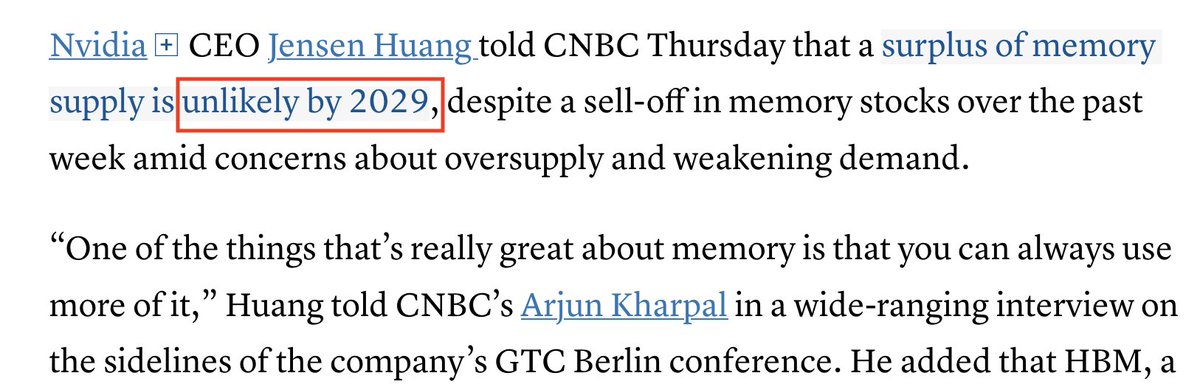
$NVDA Jensen Huang: Surplus of memory supply is unlikely by 2029.
The CNBC question referenced a Korean newspaper opinion on $KOSPI / Samsung / SK Hynix that predicted "new supply will leave the memory sector a red ocean in 2029."
"One of the things that's really great about memory is that you can always use more of it", Jensen said, citing LPDDR usage in DCs. And responded "I don't think so" in terms of possibilities of oversupply in 2029.
Just my personal opinion, Nvidia probably has the most visibility in the entire industry.
Especially around supply procurement and emerging capacity, given they're the ones leading all the architectural shifts.
On durability, you have Samsung already allocated majority of capacity into 2031 from SED and hyperscalers like $GOOGL are already reportedly securing memory LTAs into 2035 from KeyBanc.
Yet there's endless "it's all over" sentiment on memory now. I'd probably trust Jensen's opinion here.
Sometimes I really don't understand how people turn bearish when stocks fall and suddenly become giga bullish when prices go up.
Too many people let price action dictate their conviction instead of looking at the actual business.
If the fundamentals haven't changed, a higher price usually means worse R/R, not a stronger bull case. And the opposite is true when prices fall.
Obviously, this applies to good companies you believe will recover, not every stock that gets beaten down.
Look at $NBIS. I barely see any bullish takes anymore, while half of X is busy talking about an AI financing bubble.
Funny how quickly sentiment changes with the stock price.
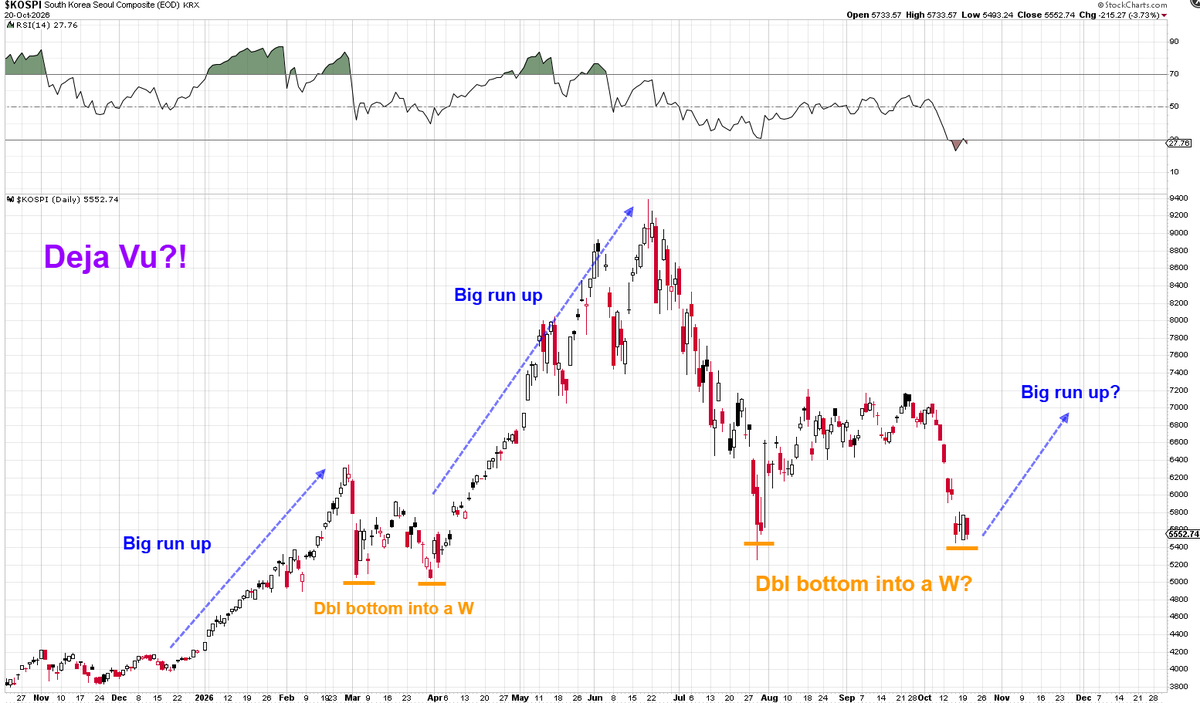
$KOSPI
There's this really good Korean movie that just came out last month called HOPE. Really entertaining and original. Highly recommend.
So I'm going to call this chart below....
HOPE.
$GOOGL is now discussing deals to extend their memory LTAs through 2035 from KeyBanc channel checks.
Samsung already has 70% of their capacity allocated through 2031, and this move would suggest a more durable cycle for $MU, $SKHY, and the others.
They also expect HBM prices up 80% to 100% in the Q1 2027.
Having all your capacity potentially allocated out into 2035 via LTAs would ease a lot of memory durability fears.
Thoughts on memory:
Anyone who thinks compute will stay in shortage while memory slides into oversupply must be smoking something. Compute and memory are destined to tighten together or deflate together. One cannot die while the other survives.
By the same logic, the pods shorting memory and going long HDD are out of their minds. How do you think HDD isn't joined at the hip with memory? You really think HDD stays safe if this cycle rolls over?
In the end, all of this comes down to nobody having conviction about what happens after 2027. Historically, we have watched P peak one to two quarters before supply ramps, then Q expands and the entire profit pool collapses. But everyone forgets that this cycle runs on nonstandard products, unlike PCs, smartphones, and general purpose servers, and that it was triggered by factors different from past cycles.
This is because of the boomers who still see memory as an industry where you make a killing in the upcycle and lose your shirt in the downcycle. These self proclaimed veterans view memory through the lens of their past experience, and since they drive the market and set the stock prices, memory trades at such a low valuation. What I keep saying is that a sharp collapse like in the past is impossible. A gradual decline is possible. But even if Samsung and SK Hynix margins were cut in half from current levels, they would still trade at a P/E in the teens. That is still roughly half of HDD valuations.
Personally, I think that as memory prices fall, other sources of demand will absorb the supply at each step down. In particular, I expect personal AI demand, led by local AI, to emerge. Looked at another way, for local AI to take off, the hyperscaler driven spike in memory prices has to be brought under control. At current memory prices, local AI can never diversify.
Just as mainframes gave way to PCs and the cloud gave way to smartphones, each time carrying the cycle from P into a Q expansion phase, I think this AI cycle will also move from frontier labs to local open source AI. Based on these historical precedents, I believe local AI will take over the memory cycle from the frontier labs and carry memory demand.
I am not saying memory prices will hold for more than a decade. Memory P will fall at some point. But what is different from the past is that new consumer devices and new consumer demand, such as open source driven local AI, will support the floor for memory.
So the market right now keeps discounting these stocks out of fear of a memory peak nobody can time. This discount is being driven by boomer investors who dismiss the idea that AI supports the downside and keep pushing the view that earnings will collapse and the trough will revert to past levels too. My point is that this is completely wrong.
TLDR; we will probably never get another ARR number from Anthropic, which is healthy. Should force the market to move away from extreme focus on Anthropic/OpenAI ARR numbers to hyperscale growth rates, which are a much better metric for AI at this point given they capture Muse, Grok, Gemini and Open-Source.
Anthropic FCF positive in Q3 and reaccelerating in October on Opus 5.5 per third party data. Roadshow in several weeks will happen after this has been widely confirmed. Unit economics much better than expected given positive FCF with 75% of their compute going to training. All per public reporting.
OpenAI continuing to grow at the same pace per Sarah Friar interview after they took share vs. Anthropic in Q3. Means the sum of Anthropic/OpenAI growth is accelerating from the Q3 pace. OpenAI probably hits FCF positive in the next few months.
Open-source growing much faster than either Anthropic or OpenAI. Modal tripled since May and is 15x YoY per yesterday’s announcement. Open-source tokens generate more revenue and profit for the hyperscalers/neoclouds than frontier tokens. *Every* open source inference cloud I am aware of is growing faster both sequentially and YoY than either Anthropic or OpenAI. And their combined compute spend is becoming material.
Third party data pointing to hyperscalers continuing to accelerate in Q3. All report in the next two weeks. Acceleration should continue in Q4 and Q1 as installed base of compute slowly reprices higher closer to spot and new capacity comes online at higher prices. Continued acceleration in hyperscalers should help address external funding concerns.
10 year yield down in a straight line over the last 24 hours.
Some risk of escalation in Iran next few days, but earnings and mid-terms probably outweigh taking an ultra long-term view and looking out 30 days.
Biggest risk imo remains cyber and OpenAI/Anthropic dominating the model layer. Fragmentation, competition and lower margins at the model layer are good for everyone else in the ecosystem and for America.
Slower for longer is much better than an overbuild and an actual bubble.
Your regular reminder that watching every tick of the market probably isn’t helping your returns or your sanity. Days like today are part of the deal. Unless you’re overleveraged or your thesis has changed there’s probably nothing you need to do. Do you still believe this aI driven tech cycle will make the economy dramatically more productive and efficient? If so days like today shouldn’t change much.