Trump’s billionaire allies will now control:
CNN, Fox News, CBS, WaPo, WSJ and NY Post — plus 450 local TV stations, including news, in 95% of U.S. markets.
X, Facebook, Instagram, Threads, WhatsApp, TikTok, Truth and Twitch.
Plus Gemini, ChatGPT and Grok.
They’ll make sure Trump’s lies are legitimized and the truth is always questioned.
BREAKING : Massive SHOCK for Trump given by Iran FM 🇮🇷 Abbas Araghchi 🔥
🇺🇸 Trump at 9:00 AM –– "Iran has unconditionally opened the Strait of Hormuz and they will also hand over enriched uranium to the US"
🇮🇷 Iran at 10:15 AM –– 🔥 "Stop lying, Iran's enriched uranium is as sacred to us as the soil of Iran and will not be transferred anywhere under any circumstance. Secondly, Hormuz is opened under conditions
If US doesn't stop the blockade then Iran will again close it as we did earlier. We are going to keep watch on ceasefire violation"
Not a single day passes without Trump getting caught lying 😭
New analysis from @MeidasTouch details Trump's conflicting claims throughout his war in Iran:
Mar 3: “We won the war.”
Mar 7: “We defeated Iran.”
Mar 9: “We must attack Iran.”
Mar 9: “The war is ending almost completely, and very beautifully.”
Mar 11: “You never like to say too early you won. We won. In the first hour it was over.”
Mar 12: “We did win, but we haven’t won completely yet.”
Mar 13: “We won the war.”
Mar 14: “Please help us.”
Mar 15: “If you don’t help us, I will certainly remember it.”
Mar 16: “Actually, we don’t need any help at all.”
Mar 16: “I was just testing to see who’s listening to me.”
Mar 16: “If NATO doesn’t help, they will suffer something very bad.”
Mar 17: “We neither need nor want NATO’s help.”
Mar 17: “I don’t need Congressional approval to withdraw from NATO.”
Mar 18: “Our allies must cooperate in reopening the Strait of Hormuz.”
Mar 19: “US allies need to get a grip - step up and help open the Strait of Hormuz.”
Mar 20: “NATO are cowards.”
Mar 21: “The Strait of Hormuz must be protected by the countries that use it. We don’t use it, we don’t need to open it.”
Mar 22: “This is the last time. I will give Iran 48 hours. Open the strait”
Mar 22: “Iran is Dead”
Mar 23: “We had very good and productive talks with Iran.”
Mar 24: “We’re making progress.”
Mar 25: “They gave us a present and the present arrived today. And it was a very big present worth a tremendous amount of money. I’m not going to tell you what that present is, but it was a very significant prize.”
Mar 26: “Make a deal, or we’ll just keep blowing them away.”
Mar 27: “We don’t have to be there for NATO.”
Mar 29: Claimed talks were progressing
Mar 30: “Open the Strait of Hormuz immediately, or face devastating consequences.”
Mar 31: Claimed a deal was “very close” and Iran would “do the right thing”
Apr 1: “We’ll see what happens very soon.”
Apr 3: “Something big is going to happen.”
Apr 4: Said Iran must comply “immediately” or face further consequences
Apr 5: “Open the fuckin’ Strait, you crazy bastards, or you’ll be living in Hell - JUST WATCH! Praise be to Allah.”
April 7: "A whole civilization will die tonight, never to be brought back again. I don't want that to happen, but it probably will."
Some very good journalism from MSNBC, reporting on all the fabricated stories that Donald Trump has told over the last year. It’s embarrassing. The guy is either brazenly lying or riddled with dementia—likely both—but either way, that boy ain’t right.
In the spring of 1955, a 67-year-old grandmother from Ohio told her children she was going for a walk.
She didn’t say how far. She didn’t say why. She simply kissed them goodbye, packed a cloth bag with the barest essentials, and vanished into the Georgia wilderness.
Her name was Emma Rowena Gatewood — and she was about to do something no woman had ever done before.
For three decades, Emma had endured unspeakable violence in her Ohio farmhouse. Beatings that broke her ribs, blackened her eyes, and nearly broke her spirit. She had raised eleven children on that farm. She had finally escaped her husband in 1941, but the invisible scars ran deeper than any wound.
Then one quiet afternoon, she read an article in National Geographic about the Appalachian Trail — more than 2,000 miles of rugged paths stretching from Georgia to Maine. The writer made it sound peaceful. Achievable. Beautiful.
Emma thought: If men can walk it, so can I.
But she knew what would happen if she told anyone. Her children would worry. Friends would call her foolish. A grandmother, alone in the wilderness? Impossible. Dangerous. So she kept her plan silent as a prayer.
She sewed a simple denim bag and filled it with the absolute basics: a blanket, a plastic shower curtain, a first-aid kit, bouillon cubes. No tent. No sleeping bag. No proper hiking boots — just a pair of Keds sneakers and a cotton dress.
On May 3, 1955, she boarded a bus to Georgia and began walking north from Mount Oglethorpe. Alone.
The trail was nothing like the magazine promised. It was merciless. Roots caught her feet. Rocks sliced through her thin shoes. Rain turned the path to mud. Insects swarmed relentlessly. At night, she slept on bare ground in abandoned shelters, sometimes shivering too violently to rest.
She got lost. She fell, twisting her ankle so severely she could barely stand. Sitting on that rock, pain shooting through her leg, she wondered if this was where her journey would end. But after catching her breath, she wrapped her ankle tight and kept moving. Always moving.
Hikers who passed her didn’t know what to make of the small, gray-haired woman in a dress and sneakers, carrying a homemade sack. Some thought she was lost. Others assumed she was crazy. A few offered food or shelter. She thanked them graciously, then continued on.
When strangers asked why she was walking, she’d smile softly and say she wanted to see the country. But anyone who looked into her eyes could see something deeper burning there. This wasn’t recreation. This was reclamation. Every mile was a mile farther from the life that had tried to destroy her. Every step was proof she was still here, still strong, still capable of extraordinary things.
Weeks became months. Her feet bled. Her back ached. The sun burned her skin raw. But she never stopped.
On September 25, 1955, Emma Gatewood stood on the summit of Mount Katahdin in Maine. She had walked 2,168 miles in 146 days. She was the first woman to hike the entire Appalachian Trail alone in a single season.
When word spread, reporters flooded in. Newspapers nationwide ran her story. Overnight, she became “Grandma Gatewood,” a household name. Everyone wanted to know how a 67-year-old woman with no training and minimal gear had accomplished what seasoned hikers failed to do.
Emma smiled and said it wasn’t that complicated. She mentioned the trail needed better maintenance — too many rocks, not enough signs. She spoke as casually as if discussing her garden, not surviving one of America’s most grueling challenges.
But she wasn’t finished. In 1957, she walked the trail again. Then in 1964, at 76 years old, she became the first person ever — man or woman — to complete the Appalachian Trail three times. Each journey with almost nothing. Each journey proving that true strength doesn’t come from equipment or training. It comes from refusing to surrender.
Hassett: If the war were to be extended, it wouldn't really disrupt the U.S. economy very much at all. It would hurt consumers, but that's really the last of our concerns right now.
#Iran War Update No. 11 (focus on Iranian strategic narrative):
🔹There are mounting signs that the war may be moving toward a more dangerous maritime phase. Reports that Iran may have begun mining the Strait of Hormuz have fueled growing concern that Tehran is preparing to impose longer-term costs on global energy flows and maritime trade.
🔹At the same time, some Iranian analysts are speculating that the next phase could involve the Houthis more directly in order to increase pressure on a second strategic chokepoint, Bab el-Mandab. The logic is that simultaneous disruption in both Hormuz and the Red Sea corridor would have a much greater impact on global trade and energy markets than pressure on either route alone.
🔹Political signaling from Tehran appears consistent with that possibility. Ali Larijani said the Strait of Hormuz will either remain a route of peace and prosperity for all or become a place of defeat and suffering for those who wage war in the region, reinforcing the sense that Iran is prepared to escalate further at sea.
🔹Donald Trump warned that any Iranian move to fully stop oil flows through the Strait of Hormuz would trigger a decisive American response. Yet later reports suggested that Iran had begun at least limited mining activity, indicating that Tehran may now believe the costs imposed so far have not been sufficient to alter Washington’s calculations.
🔹Iranian calculations appear to be shaped by several factors at once. One is the belief that the United States is unlikely to end the war soon. Another is concern that continued strikes on Iranian missile and naval assets could eventually make Tehran’s strategy of selective disruption of the strait unsustainable, pushing it toward a more direct closure option.
🔹The maritime front is becoming more serious in military terms as well. According to CENTCOM video footage, the United States targeted a Shahid Soleimani class vessel along with several IRGC Navy missile and torpedo boats. The Fateh submarine, Iran’s only operational domestically built semi-heavy submarine, was also reportedly hit.
🔹This comes as Iranian attacks on Gulf neighbors continued, particularly against Qatar and the UAE, while diplomatic channels with some Gulf states remain open. Qatar said communication with Iran is continuing and emphasized that Doha is still focused on de-escalation and diplomacy.
🔹The economic effects of the maritime escalation are becoming more visible. Reports indicate that major oil producers in the region, including Saudi Arabia, the UAE, Iraq, Kuwait, and Bahrain, have already begun reducing production because of the situation in the Strait of Hormuz, with an estimated 6.2 to 6.9 million barrels per day effectively offline.
🔹Iranian officials continue to signal that they do not want a ceasefire under current conditions. Kazem Gharibabadi said a halt in hostilities now would make little sense if Iran could simply be attacked again a few months later, while the government spokesperson said any mediation would only be meaningful after a complete halt to the war and firm guarantees against renewed attacks.
🔹Mohammad Bagher Ghalibaf made Tehran’s position even clearer. He said Iran is certainly not pursuing a ceasefire and instead believes it must deliver a decisive blow that becomes a lasting lesson to the aggressor. In this view, Iran is trying to break what it sees as Israel’s preferred cycle of war, negotiation, ceasefire, and then renewed war.
🔹At the operational level, Iranian officials continue to emphasize the effects of earlier strikes on enemy radar and early warning systems. The Army spokesperson said that after degrading a significant portion of those capabilities, Iranian forces have been able to strike with greater accuracy and effectiveness in recent operations.
🔹Iranian missile strikes on Israel continued during the day, with growing use of cluster-type warheads. According to Iranian analysts, the goal at this stage is not only to hit strategic targets but also to keep Israeli civilians under continuous pressure by forcing them into shelters and sustaining a climate of disruption and anxiety.
🔹Ghalibaf also warned that Iran is now operating under the logic of “an eye for an eye,” saying that if Iranian infrastructure is targeted, Iran will certainly respond by striking enemy infrastructure in return. That suggests the infrastructure war may deepen further in the coming phase.
🔹Israeli and American strikes inside Iran continued to hit infrastructure as well. One of the latest strikes reportedly hit an area along a major highway in Tehran, halting traffic as smoke rose from the strike site. Some Iranian analysts interpret the increasing intensity of such attacks as a sign of impatience in Washington and Tel Aviv over the difficulty of achieving their strategic objectives.
🔹At the same time, the regime is tightening its internal security posture. Additional checkpoints have reportedly been established across Tehran, and the police chief warned that if people take to the streets they will be treated as enemies and security forces will not hesitate to open fire. This suggests that fear of domestic unrest remains high.
🔹The Lebanon front remains highly consequential. Lebanese President Joseph Aoun sharply criticized Hezbollah and called for direct talks with Israel as part of a plan to end the conflict, citing the massive displacement and casualties caused by the war.
🔹The Iraq front may also be heating up again. There were reports of airstrikes targeting several PMF positions in Iraq.
🔹Diplomatically, maneuvering is intensifying on several levels. Gulf countries are reportedly preparing a UN Security Council draft resolution condemning Iranian attacks and calling for an end to Iranian retaliatory strikes, while Russia has circulated its own draft calling on all parties to halt military activities and condemning attacks on civilians and civilian infrastructure.
🔹Russia and China are both continuing de-escalation efforts, though in different ways. Moscow says Putin has put forward several mediation options, while China’s special envoy is traveling to the Middle East and Chinese officials continue to stress the importance of preserving the security and stability of the Strait of Hormuz.
🔹European concern is also becoming more explicit. German Chancellor Friedrich Merz said Germany and Europe have no interest in an endless war or in the dissolution of Iran’s territorial integrity, warning that collapse of the Iranian state could create serious economic and migration consequences for Europe.
🔹Overall, Day 11 suggests that the war is moving toward a sharper confrontation over chokepoints, infrastructure, and endurance. Tehran appears increasingly determined to reject a quick ceasefire, widen the costs of the conflict, and force a new strategic equation.
South Korea's stock market crash just exposed the one thing that could kill the entire AI revolution.
$270 billion wiped out in a single session.
Samsung down 12%. SK Hynix down 10%. The KOSDAQ dropped 14%.
It's their worst crash in 46 YEARS. Worse than 9/11.
This was the hottest market on the planet. Up 75% in the past year. All-time highs above 6,300 just days before.
Then it collapsed.
Everyone blamed the Iran war. Oil prices. Geopolitics.
But they're missing the real thing:
South Korea makes 70% of the world's DRAM chips. 80% of the high-bandwidth memory that powers every single AI data center on Earth.
Every Nvidia Blackwell chip. Every Google TPU. Every hyperscaler expansion. All of it runs on memory manufactured in ONE country.
And that country imports 97% of its energy through the Strait of Hormuz.
The same strait that Iran just shut down.
Ship traffic went from 138 vessels per day to 2. Zero tankers. Maersk, Hapag-Lloyd, CMA CGM all suspended operations.
Insurance companies pulled war risk coverage entirely.
And this isn't "temporary". Trump says the war could last 4-5 weeks. Iran says any ship that enters gets attacked.
Here's what you need to understand about the consequences:
Global DRAM inventory sits at 2-3 weeks. NAND at 3-4 weeks. There is no buffer.
If the Hormuz disruption lasts beyond a month, Korean fabs start running low on the energy needed to operate. Production cuts become unavoidable.
The entire AI buildout timeline slips in ways nobody has modeled.
OpenAI just raised $110 BILLION. Amazon committed $50 billion. Nvidia and SoftBank put in $30 billion each.
All of that money is earmarked for data centers that need memory chips from factories that can't run without Middle Eastern oil.
$195 billion in AI funding was deployed in February alone. The most consequential month in venture finance history.
And all of it depends on Korean semiconductor fabs keeping their lights on.
The memory supercycle was projected to exceed $440 billion in 2026. That projection assumed uninterrupted energy supply to the factories making the chips.
Nobody stress-tested what happens when you cut the power.
Retail investors in Korea were buying Samsung and SK Hynix on margin. Borrowed money at record levels.
When the crash hit, margin calls triggered forced liquidation. The selling fed on itself. Foreign investors dumped $3 billion in a single session.
Brent crude is above $90. Gas prices in the US jumped 14% in one week. Diesel doubled in Europe. Jet fuel tripled in Asia.
And the AI companies burning through billions per quarter on compute infrastructure? Their energy costs just EXPLODED.
Everyone's debating whether AI is a bubble based on software. Whether the models work. Whether the valuations make sense.
But nobody's asking the harder question:
What happens when the entire hardware supply chain runs through a 21-mile-wide strip of ocean currently controlled by a country at war with the United States?
The biggest risk to the AI revolution isn't bad models or overhyped startups...
It's that a $440 billion industry depends on chips made in factories that go dark if one strait stays closed for 30 more days.
This war is moving every market on earth simultaneously and the numbers are historic.
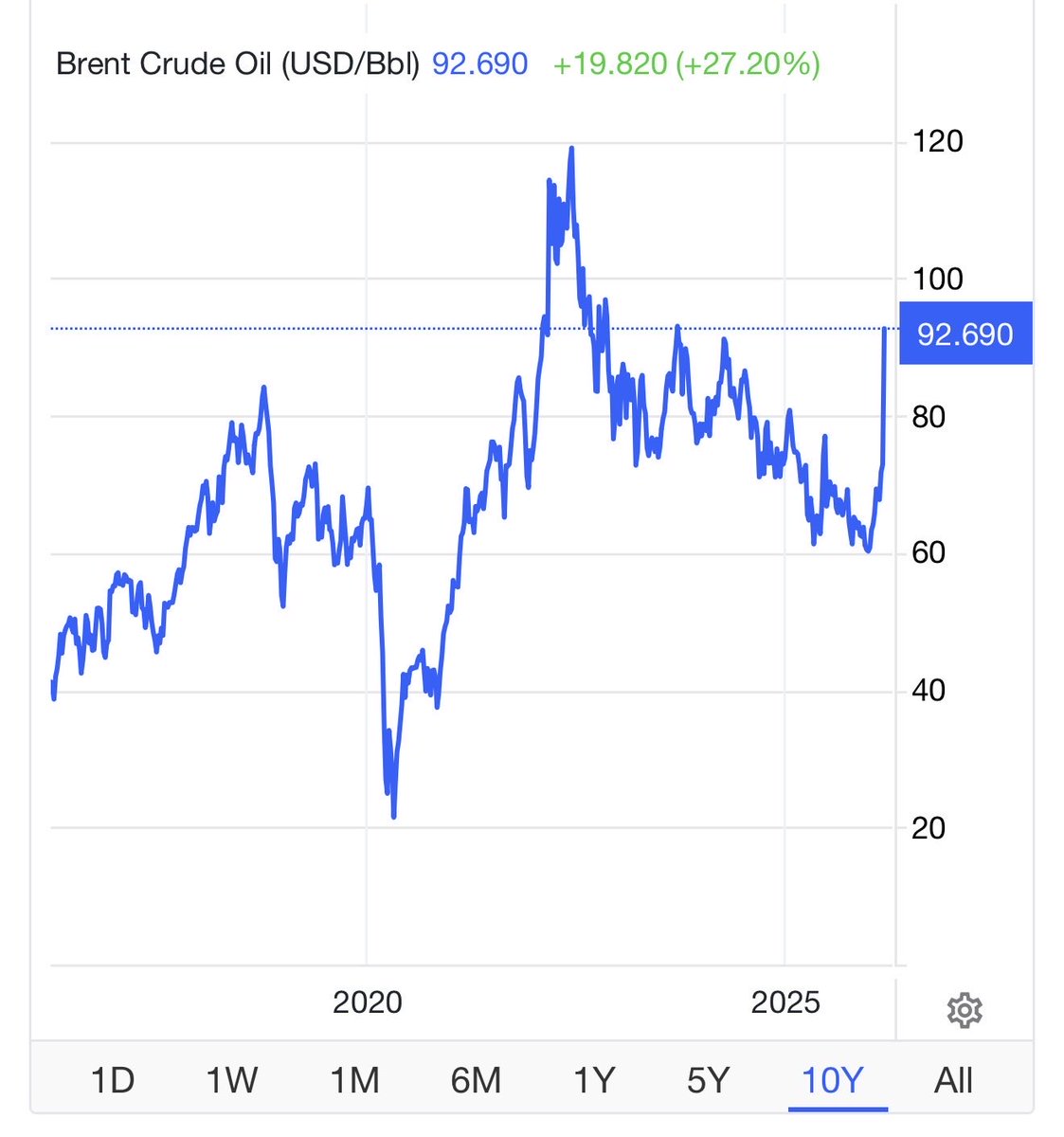
Oil posted its largest weekly gain since 1982. WTI surged 34.5 percent to $90.90. Brent rose 27 percent to $92.69. Those are not price spikes. Those are price discovery events for a world where 90 percent of traffic through the strait carrying 21 percent of global seaborne oil has stopped.
Jet fuel in Asia has surged 140 percent since February 27. European gas prices jumped 76 percent in one week. VLCC tanker rates hit an all time record of $423,736 per day on the Middle East Gulf to China route, more than quadrupling from pre-war levels. LNG carrier rates doubled past $200,000 per day. Brazilian urea futures, the fertilizer benchmark for the developing world, rose 36 percent year to date. Aluminum gained 8.9 percent in a week. Naphtha premiums hit two year highs.
Every one of these markets connects to the same 21 mile wide chokepoint.
The Strait of Hormuz carries 21 percent of global seaborne oil and 20 percent of global LNG trade. Traffic has dropped approximately 90 percent. Seven P&I insurance clubs withdrew war risk coverage. The $20 billion US reinsurance program has not yet restored meaningful traffic. VLCC rates are at records not because demand surged but because supply disappeared.
The alternatives cannot compensate.
Saudi Arabia’s East-West Pipeline to Yanbu has a capacity of 5 to 7 million barrels per day. The UAE’s Fujairah pipeline carries 1.5 million. Combined bypass capacity is 3.5 to 8 million barrels per day against a normal Hormuz flow of 15 to 21 million. The pipelines cover less than 40 percent of lost volume.
The rest is rerouting around the Cape of Good Hope, adding 10 to 20 days per voyage. Cape traffic surged 35 percent in the first week with 94 vessels tracked on March 3 alone. But longer routes reduce effective fleet capacity. Every tanker adding two to three weeks per voyage is unavailable for the next cargo. The global tanker fleet has not grown. The distances have. The arithmetic produces the rates.
Qatar declared force majeure on LNG. Kuwait cut oil production because its storage tanks are full. Iraq cut 1.5 million barrels per day. These are physical consequences of a closed strait measured in barrels that cannot be loaded and fertilizer feedstock that cannot reach the plants that produce the food the world eats.
The 1973 oil embargo is the closest historical parallel. Oil rose from $3.01 to $11.65, a 287 percent increase over months, and produced stagflation that lasted a decade. The current disruption is repricing faster across more commodities, with higher global interdependence. Modern buffers exist that 1973 lacked: US shale production, bypass pipelines, Cape rerouting technology. Those buffers should shorten the duration. They cannot eliminate the shock, because the chokepoint closure affects not just oil but gas, petrochemicals, fertilizer, and the shipping lanes that connect Asian manufacturing to every other continent.
The war is ten days old. The commodity repricing has only begun.
https://t.co/ULBgEzZ3A8
The Strait of Hormuz has been closed for 8 days. Everyone thinks this is about oil. This is about what oil becomes. 92% of the world's sulfur comes from refining oil and gas. Close the Strait of Hormuz and you don't just lose 20 million barrels of crude per day. You lose the feedstock for sulfuric acid, the single most produced chemical on Earth. Sulfuric acid is how we extract copper. It's how we extract cobalt. Without it, you can't make transformers, EV batteries, or the substrates inside every data center on the planet. One chemical, made from one feedstock, shipped through one chokepoint. The cascade goes further: Qatar ships 30% of Taiwan's liquefied natural gas through Hormuz. Taiwan has 11 days of reserves left. TSMC, the company that makes 90% of the world's advanced chips, draws 8.9% of Taiwan's total electricity. No gas, no power, no chips. Then food. 33% of the world's nitrogen fertilizer feedstock moves through the Strait. Half of all humans alive today exist because of synthetic nitrogen. Sulfur, semiconductors, food. That makes three supply chains, one 21-nautical-mile chokepoint, and zero domestic alternatives at scale.
Rear view mirror: February posted 92,000 net job loss. Looking ahead: Inflation fears rise as oil spikes, gas tops $3.32 a gallon national average. For @NBCNews
Rep. Raskin to Noem: While you make a daily mockery of our courts and our Constitution, you are treating the billions of dollars our colleagues showered on your department like a personal slush fund