Gemini 3 has a capability most people don't even know exists.
it's not the 1M tokens.
it's not the multimodal processing.
it's something else entirely.
And it's the reason I built 3,000+ prompts specifically for Gemini 3.
Everyone talks about Gemini's specs:
→ 1 million token context
→ Native multimodal inputs
→ Deep Think mode
→ Agentic workflows
But they're missing what happens when you combine these features.
The secret is persistent systems thinking.
Gemini 3 doesn't just process large contexts.
It maintains coherent reasoning ACROSS those contexts while simultaneously:
- Analyzing images
- Reading documents
- Planning multi-step workflows
- Adapting based on previous outputs
This creates emergent capabilities that don't exist in other models.
I built 3,000+ prompts that exploit this.
Each prompt is built around this core insight:
Gemini 3's real power isn't WHAT it can process.
It's HOW it connects everything together.
The library includes:
✓ 3,000+ production-ready prompts
✓ Organized by difficulty (beginner → advanced)
✓ Real use cases for each prompt
Like, RT + reply "GEMINI" and I'll DM you the guide.
(Must be following so I can DM)
Skip this and keep wondering why your Gemini results feel the same as ChatGPT.
Or grab the library and start using the capability everyone's missing.
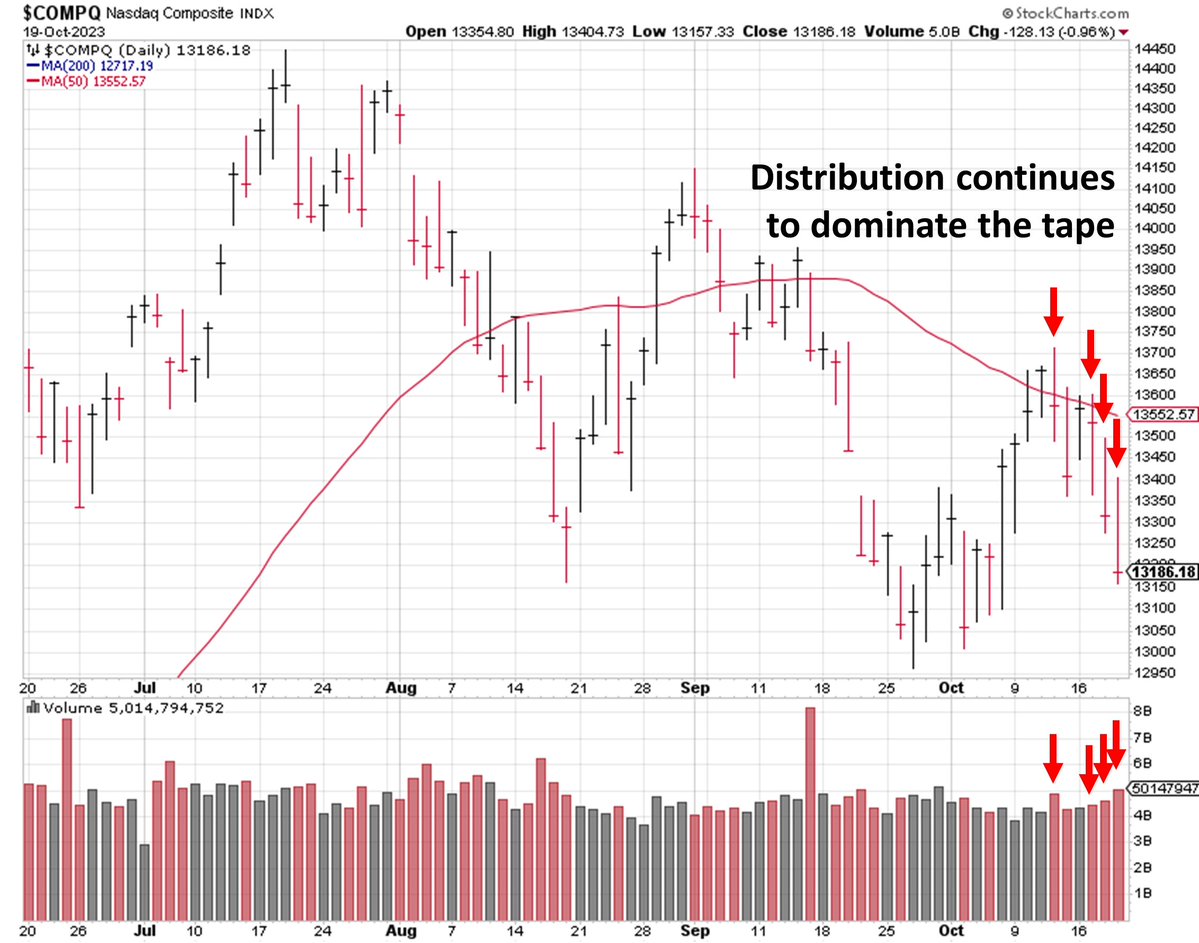
After running up to the 50-day line from a deeply oversold condition, the Nasdaq Composite experienced churning and several back to back distribution days. Yesterday 642 stocks made relative strength new lows while only 82 made RS new highs. After a VERY brief flight to quality rally in bonds, rates turned up yesterday reversing the recent pullback. 2 and 10-year yields made new highs. The market came under selling pressure and the VIX made a new high.
Even more noteworthy is the action coming from recent breakout names. Many have either failed during base-building or have experienced fairly significant pivot "leakage." We are looking for signs of a bottom, but signals have been mixed at best.
Historically, a Q4 rally often follows a down Q3. When the S&P 500 Index gained at least 10% in the first half, gains continued in the second half, albeit at a slower pace. Add an additional criterion: a down third quarter, and since 1926, the S&P 500 has risen eight out of 10 times by an average of 6.8% in Q4 versus a mean of 2.8% for all fourth quarters.
We recently added some positions very selectively, but we have not yet raised overall exposure or position sizing beyond "toe in the water" levels.
Throughout the correction, our long term SPY model has held its January 13, 2023 buy signals, but I don't expect it to hold for long if the market weakens much from here. Our stock only STEM model has maintained its maximum caution level since 8/3, and based on recent action coming from individual stocks, that's exactly where it should be.
The U.S. economy appears to be on a path towards a soft landing, but we can’t underestimate the risk of a recession, and we certainly will not allow a macro case influence us to ignore the feedback from the market itself, namely the action in individual stocks.
With distribution dominating the tape and little traction coming from new commitments, there is no intelligent reason to be heavy in stocks right now. Cash is king!
https://t.co/JXzFFTmMtn
POWELL SPEECH SUMMARY⚠️
1. The majority of Fed members expect there to be another rate hike this year.
2. A soft landing is not the Fed’s baseline forecast.
• Powell did emphasise that this is what they hope for
3. Policy is restrictive but Powell not confident that policy is restrictive enough. Priority one is to return price stability. Powell said it would be miserable if the Fed don’t get inflation under control and they are forced to keep hiking again and again with resurging inflation. He acknowledged the risk of recession with hiking rates.
4. Inflation remains well above goal of 2%. The Fed are committed to this target. He said there is still a long way to go prior to achieving this.
5. Powell expects the time for the Federal Reserve to cut will come next year at some point. He emphasised that he doesn’t know when this time will come and doesn’t want us to speculate on timing from what he says because the Fed don’t even know.
6. Real interest rates (interest rates minus inflation) are now meaningfully positive and above neutral policy rate estimates.
• Neutral policy rate is the estimate of where rates need to be to not be too tight or too loose for the economy to remain stable. He's saying rates are tighter than this, so expects economic headwinds as result of current monetary policy.
7. Powell said that the Summary of Economic Projections is not a plan but the median of an accumulation of forecasts. He also stated that economic forecasting is very difficult and comes with a significant degree of uncertainty.
8. Economic activity continues to advance at a solid pace. Median GDP growth estimate is 2.1% for 2023 falling to 1.5% in 2024. Below trend growth is needed to achieve targets. If economic activity continues to outperform expectations then the Fed will likely have to do more with interest rates.
• Powell basically said if the economy continues to outperform then rates will go higher.
9. Last three core inflation readings have been promising. The Fed tend to look through short term fluctuations in energy prices by focussing on core inflation
• This was in response to a question relating to recent oil price increases.
10. Powell stated that many people are locked into low mortgages and even if they want to move they often can’t because the new mortgage would be so expensive.
• He acknowledged the golden handcuff effect.
11. Measures of distress in consumer credit are rising from a very low post-pandemic level to a more normal level. Powell currently unconcerned by rising levels of distress in credit.
12. The Fed will continue to reduce their securities holdings – quantitative tightening
13. Softening of labor market required; demand still outstripping supply but coming into better balance. Softening so far has been in the form of falling job vacancies father than significantly up trending unemployment.
14. Powell stated people most hurt by inflation are those on a fixed income. They spend on basics. If prices rise then they are in trouble right away. He also acknowledged the effect that hiking has upon lower income Americans.
• This was in response to a question pointing out that people with savings and a low rate mortgages aren't suffering as much at the hand of inflation as people with lower incomes and relying on credit cards.
15. The full effects of tightening so far are yet to be felt and monetary policy lags are uncertain.
THIS WEEK'S HIGHLIGHTS ⚠️
1. Core PCE, the Federal Reserve's preferred measure of inflation, INCREASED in line with expectations to 4.2% from 4.1%. Headline PCE came in higher at 3.3% YoY (Exp. 3.3%, Prev. 3%).
• Core PCE MoM remained unchanged at +0.2% in-line with expectations, 1 month annualized to around 2.4%, essentially compatible with the Fed’s target. 3 month annualized clocks in at 2.9%.
• However, what is notable is that the Fed’s most closely followed measure within PCE – core services ex-housing advanced 0.5% MoM, which annualizes to 6.17%. However, this is said to have been largely down to temporary advances in portfolio management services and is likely to cool in the coming months.
• Powell likes core-services ex-housing as it represents less interest rate sensitive areas of the economy and better examines underlying inflation trends.
2. ISM Manufacturing rebounded from the prior month coming in better than expected at 47.6 (Exp. 47, Prev. 46.4%). This is the highest reading since February, suggesting manufacturing contracted more slowly in August. This still signifies the 9th consecutive month of contraction in US manufacturing.
• New orders fell to 46.8 from 47.3 (contracting faster), Production increased to 50 (stagnation) from 48.3, Employment rebounded to 48.5 from 44.4 (contracting slower), Prices 48.4 from 42.6 (falling slower).
3. Non-farm payrolls came in above expectations. 187,000 jobs were added to the US economy in August (Exp. 170K, Prev. 157K). However, most are wondering what can actually be taken from these figures because almost all of the releases this year have been revised down heavily.
• More notably, unemployment rate in the US increased from 3.5% to 3.8%.
• U-6 unemployment, which includes people that have given up looking for a job but do want to work and people that are working part-time because they can't find a full time job, rose to 7.1% in August from 6.7% (Exp. 6.8%).
• This is touted by many as a more realistic unemployment release as it provides a wider array of people who are seeking work but were/are unable to find what the work they were looking for.
4. US Job openings in the Job Openings and Labor Turnover Survey (JOLTs) fell significantly more than expected to 8.827 million (Est. 9.5 million Prev. 9.165 million) in July.
• The Fed will be relieved. The ratio of jobs to unemployed fell to 1.51 - lowest since March 2021.
• JOLTs hires rate fell to 3.7%, the lowest level since April 2020. Businesses are hiring less new staff.
• Quits rate fell to 2.3%, the lowest since January 2021
Quits represents the number of people leaving their job voluntarily. People tend to leave of their own accord when they have a better offer/another job lined up. Decreasing quits suggest that people are finding it harder to find new/better jobs.
5. The Challenger job cut report for August 23 reported a 217% increase from July and a 267% increase from August 22 coming in well above expected at 75,151 (Prev. 23.69K, Exp. 26K).
• 83.3% of the industries in the Challenger report have increased planned layoffs this year
• Yellow Corp bankruptcy contributed significantly to the figures but this year companies have announced plans to cut 210% more people than the previous year
6. US CB consumer Confidence fell to 106.1 from 117 (Exp. 116) well below expected. This is the biggest fall in US consumer confidence in 2 years.
• as previously mentioned, consumer confidence is a leading indicator of consumer spending behaviour, which accounts for almost 70% of GDP generation in the US economy.
7. The Dallas Fed Manufacturing Index saw a slight uptick to -17.2 from -20 better than expected (-21.6). Manufacturing in Texas is still in contraction and some of the comments from this were pretty damning.
• e.g. 'Customer orders came to a sudden halt. The overall volume dropped 51 percent year over year.', ‘The phone is not ringing. Our sales team is working harder with less results.’, some went for the kill ‘Our industry is in a technical recession.'
• Texas accounts for around 10% of US manufacturing output
8. The Nationwide house price index in the UK suggested prices in August alone fell 0.8%. This is a -9.3% annualized rate. House prices according to the index are now down YoY -5.3% (Exp. 3.9%, Prev. -3.8%).
• People in the UK don't have 30Y fixed rates like in the US. There are no long-term golden handcuffs. People will be forced to sell or renegotiate at current interest rates. The standard fixed rate period in the UK tends to be 2-5 years.
9. German Gfk consumer confidence declined to -25.5 (Exp.- 24.3, Prev. -24.6). German consumer confidence throughout the year has generally improved and done so since October 2022 but the trend appears to be reversing/topping out. With the poor economic data coming out of Germany it is likely that consumer confidence will deteriorate in the coming months.
• Although Germany has exited technical recession seen earlier in the year, recent economic releases are not painting the picture of the idyllic path toward recovery.
• Germany is the fourth largest economy in the world and the largest in Europe. Where the German economy goes, so too goes the Eurozone (typically).
10. To further rub salt in the wounds German retail sales declined by 0.8% in July. This is worse than consensus expectation of +0.3% and follows a decline of 0.2% in the month prior.
11. House prices in the 20 largest US cities increased by 0.9% in June (Exp. 0.6%, Prev. 1.5%) according to the S&P Case-Shiller. This is the 4th straight month of increases as house prices are propped up by record low inventory despite historically extremely low mortgage activity. According to the National Home Price Index, house prices are essentially flat YoY.
12. Eurozone economic sentiment deteriorated for the fourth consecutive month coming in at 93.3(Exp. 93.7, Prev. 94.5). This is the lowest since 2020.
• Eurozone economic sentiment gauges sentiment in a composite index which collates responses from services (30%), manufacturers (40%) as well as consumers (20%), construction (5%) and retail (5%) to garner a rounded overview of sentiment.
13. Eurozone core inflation rate came in at 5.3% YoY down from 5.5% the month prior and in line with expectations. Headline remained at 5.3% from the prior month, higher than the expected 5.1%. MoM headline inflation rate came in at 0.6%, which annualizes to around 7.4%.
• This is the last inflation report that the ECB will have before their next meeting on September 14th. Whether they hike again or not hangs in the balance. There will likely be split opinions in the ECB as core inflation ticks down but headline re-accelerates. Supporting the case for a potential last hike, Spanish and French inflation picked up again in the most recent releases this week.
14. Japanese industrial production also fell 2% in July (Exp. -1.4%, Prev. +2%)
15. China's NBS manufacturing PMI index increased to 49.7 from 49.3 (Exp. 49.4). Non-manufacturing decreased to 51 from 51.5 (Exp. 51.1). Caixin Manufacturing PMI ticked up into expansionary territory at 51 (Exp. 49.3, Prev. 49.3).
16. People’s Bank of China (PBoC) cut the foreign-exchange reserve requirement from 6% to 4%, meaning banks in China will need to hold less of their foreign-exchange deposits in reserve (stored away).
This releases liquidity that banks otherwise had to keep tucked away. This is an effort to support the Yuan and provide dollar liquidity domestically. The move follows the Yuan falling to the weakest level vs USD since 2007.
• On Thursday we saw the PBoC reduce required down payments on mortgages in an effort to stimulate the trembling housing market as well as reducing mortgage rates for existing mortgages to the loan prime rate -0.2%.
• It is clear that the PBoC are increasingly considering how to best try and stimulate the economy while the economic picture remains weak and worries surrounding the real estate market continue to deteriorate.
17. Country Garden, Chinese homebuilding giant, extended its repayment period on a bond worth $540 million after a vote from creditors enabled it to avoid default. The extension allows Country Garden to repay the bond over the next 3 years. It had been supposed to pay this off by Saturday.
18. Italian GDP fell by 0.4% in the second quarter, worse than the expected -0.3% and down from +0.6% in Q1.
19. Canadian GDP came in at -0.2% annualized; this is well below the 1.2% expected. QoQ Canadian GDP stagnated, below the expected 0.3% growth.
-
The UK housing market is feeling the heat with the fastest decline in house prices since the GFC. The Eurozone is seeing persistent inflation and deteriorating economic outlook, a headache for the ECB as they mull over whether to implement a final hike.
In China, the PBoC continue to take action to try and stimulate the economy as economic worries persist and the real estate market seemingly perches on the brink. The last time the PBoC asked banks to lower mortgage rates the way they did this week was during the Great Financial Crisis.
This week we saw the distorted world that has become modern day sentiment as markets raced higher on *checks notes* rising unemployment, falling job openings and *rubs eyes* the biggest MoM decline in consumer confidence in years.
The US labor market is showing clear signs of cooling alongside inflation. Markets are pricing in a 93% chance of a Fed pause at their next meeting.
China Over The Last Month:
1. Unexpectedly cut rates by most since 2020
2. Removed 50% of their stock trade tax for the first time since 2008
3. Considered making it illegal to short stocks
4. Lowering rates on $5.3 trillion of mortgages for the first time since 2008
5. HY real estate index down 82% in 2 years
6. Banks cutting deposit rates for the 3rd time this year
7. Evergrande files Chapter 15 bankruptcy
What is happening in China?
SUMMARY OF NVIDIA, $NVDA, EARNINGS:
1. Record revenue of $13.5 billion, up 101% YoY
2. Adj. earnings per share of $2.70, up 429% YoY
3. Record data center revenue of $10.3 billion
4. Announced a massive $25 billion stock buyback
5. Sees Q3 revenue of $16 billion, 28% above expectations
6. Beat all headline expectations AND raised guidance
The stock is now up 250% YTD and the best performer in the S&P 500.
Simply incredible.
After Nvidia, $NVDA, earnings today:
1. Nvidia is now worth 8.8x more than Intel
2. Nvidia is now worth 6.9x more than AMD
3. Nvidia is now the 5th most valuable public company
4. Nvidia expects $183 million in revenue per DAY in Q3
5. EPS increased by nearly 900% since last year
6. Short sellers have now lost nearly $10 BILLION this year
What's next in this historic run?
BREAKING: Average interest rate on a 30-year mortgage rises to 7.24%, the highest since 2000.
In some states, the average rate on a 30-year mortgage is already above 8%.
Meanwhile, inventory is a massive 46% below the historical average.
Buying a home has become a luxury.
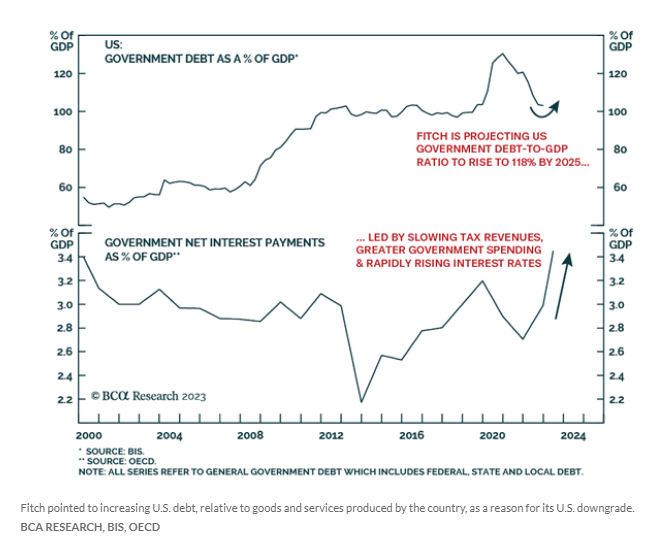
Here is a chart that explains why Fitch downgraded the U.S. credit rating from AAA to AA+. The top shows U.S. debt as a % of GDP which is projected to rise to 118% by 2025. The bottom shows the steep rise in interest payment expense.
This is noteworthy.
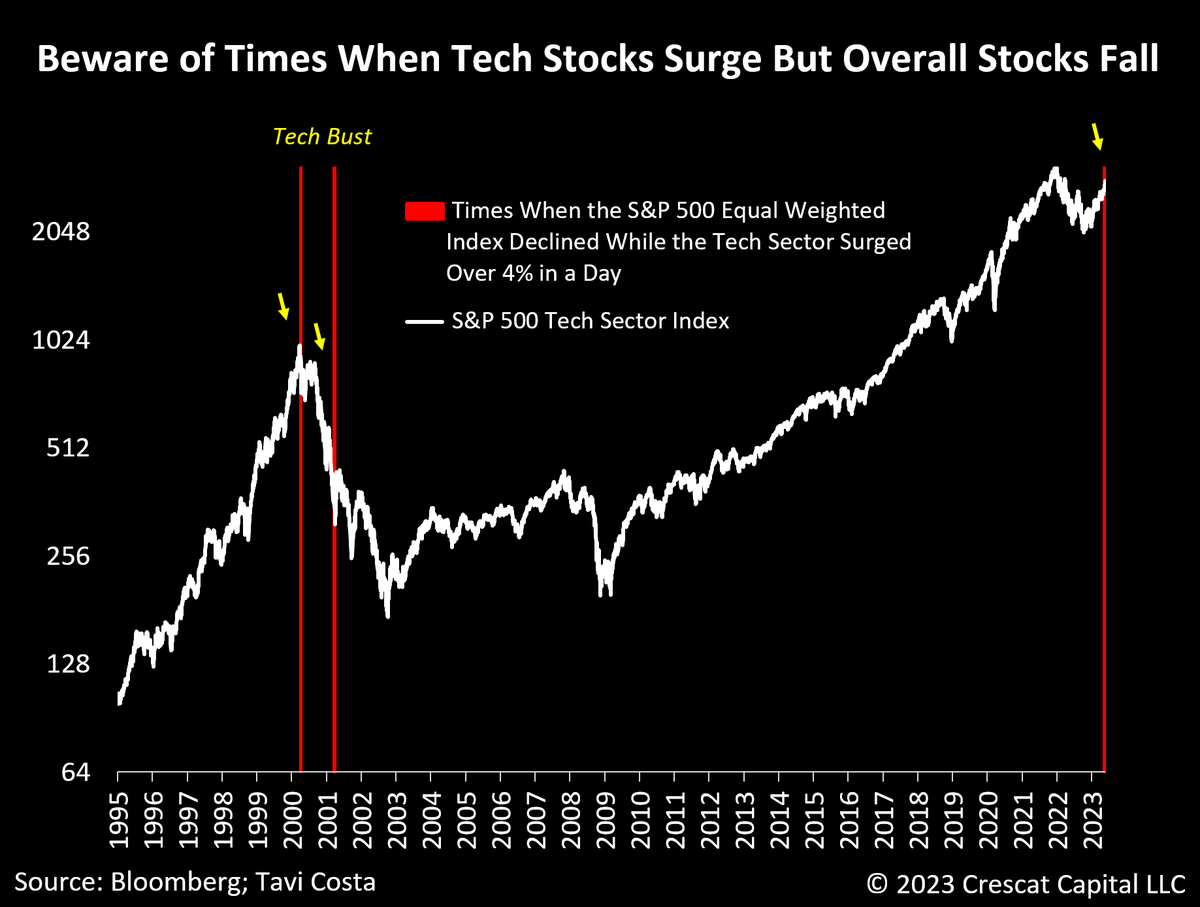
The only other times when the tech sector surged over 4% while overall stocks declined were at the onset and in the middle of the Tech Bust.
April 2000 and March 2001.
My 2 cents:
Watch for times when the generals lead but the soldiers don’t follow.
US Stocks Industry Groups Relative Strength (RS) Rankings
The purpose of the RS tables is to track the short, medium and long term RS changes of the individual groups to find the new leadership earlier than the crowd...
#stocks#trading#investing#money
https://t.co/lDmQdUKMsQ
Weak breadth and sentiment, the Great Rotation, earnings season, commercial real estate, lending conditions, the dollar, and copper supplies.
The latest Mayhem in the Markets is now available!
Check it out and share it if you enjoy my content.
https://t.co/Wwo1B2jVri