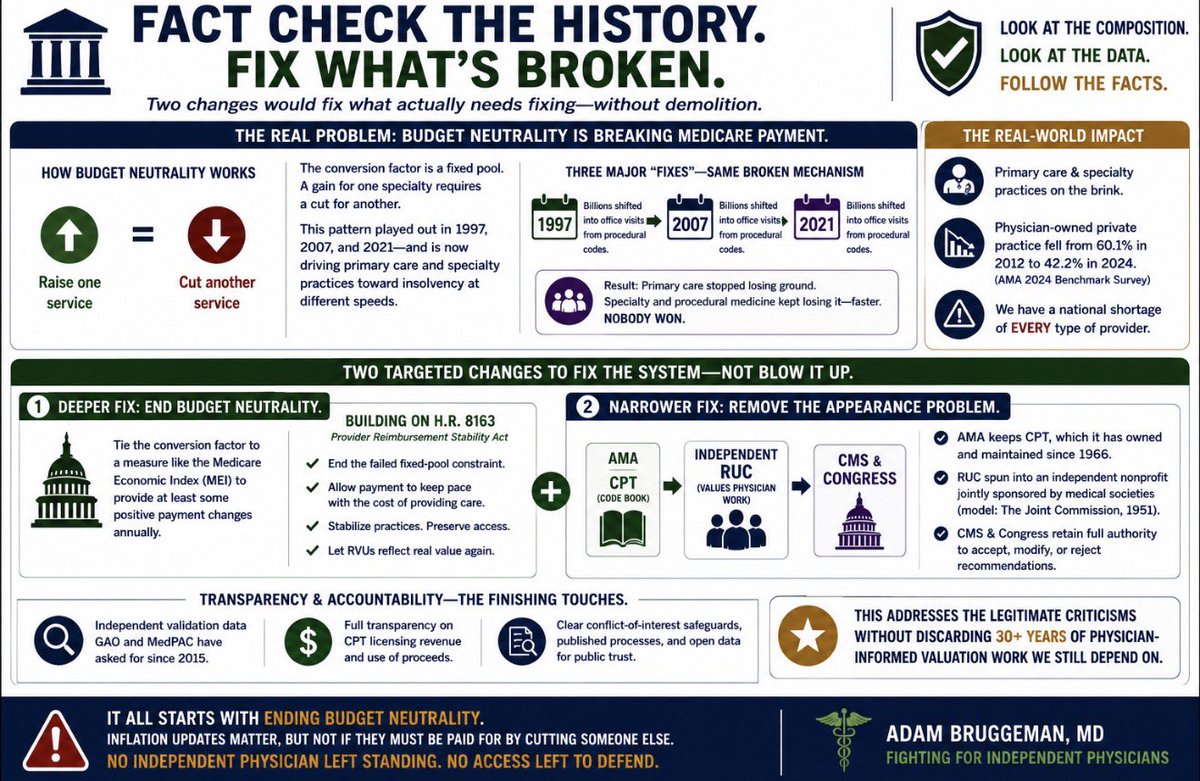
Fact checking this week's history does not mean the current system is fine as it stands. A few changes would fix what actually needs fixing, without the demolition CMS and some in Congress are now openly discussing.
The deeper fix is budget neutrality itself. As long as the conversion factor is a fixed pool, correcting one specialty's valuation requires cutting another's, the pattern that played out in 1997, 2007, and 2021, and that is now driving primary care and specialty practices toward insolvency at different speeds. Legislative discussions underway building on the framework in H.R. 8163, the Provider Reimbursement Stability Act, would tie the conversion factor to a measure like the Medicare Economic Index, providing at least some positive payment changes annually.
The narrower fix answers the legitimate part of the conflict of interest critique directly. The AMA should keep CPT, which it has owned and maintained since 1966. But the RUC, the committee that recommends how much physician work is worth, should be spun into its own independent nonprofit, jointly sponsored by medical societies the way the Joint Commission was created in 1951 by the American College of Surgeons, the American College of Physicians, the American Hospital Association, and the AMA together, and has operated independently of all of them since. CMS and Congress would keep exactly the authority they have today to accept, modify, or reject its recommendations. What changes is that no single organization holds both the code book and the price tag, which removes the appearance problem without removing physician expertise from the process.
Combine that with the independent validation data GAO and MedPAC have asked for since 2015, full transparency on CPT licensing revenue, and the legitimate criticisms of this system are addressed without discarding thirty years of physician-informed valuation work that primary care and specialty medicine both still depend on.
But none of this matters without fixing budget neutrality. That single problem has created relative value units that are no longer relative and do not represent the value each physician brings. Whether or not you agree with the original decision to create RVUs and the initially established amounts, the system we have today has been modified beyond recognition due to artificial constraints. The physician community can continue the fight over inflationary updates, which is a valuable endeavor, but it must turn its efforts to budget neutrality before no independent physician is left standing to fight.
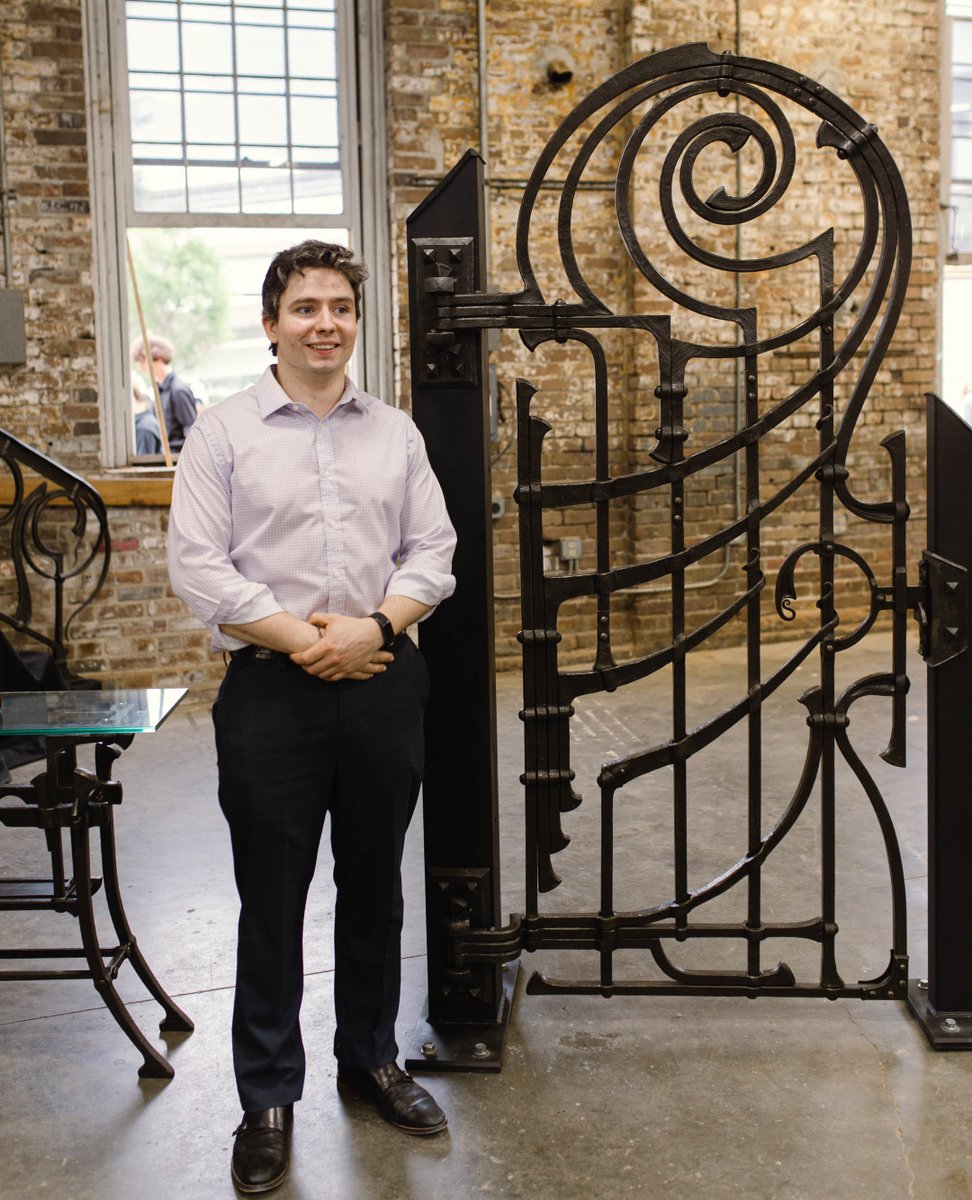
Blacksmith graduate Paul Reilly created this masterful 7 foot tall door with a Roman arch inspired by Bottaro for his capstone project. Truly a capstone for the ACBA record books, Paul's composition and articulation of shape and curve are displays of his dynamic drafting skills and technical expertise. Paul, we can't wait to see the work you produce in the coming years!
Much of the current outrage treats CPT as if the AMA invented it to game Medicare, but the facts does not support that assertion. The AMA published the first edition of CPT in 1966, the same year Medicare and Medicaid launched, and that first edition was almost entirely surgical procedures aimed at standardizing operative documentation. There was no RUC, no RBRVS, and no federal payment system built around it yet.
It was the federal government that came to CPT, not the other way around. HCFA adopted CPT for Medicare Part B billing in 1983 and extended it to Medicaid outpatient surgical billing in 1986, choosing to build on an existing, functioning private standard rather than create a new one from scratch. The Health Insurance Portability and Accountability Act of 1996 went further, directing HHS to name national standards for electronic health transactions, and HHS designated CPT as that standard in 2000. Three separate federal decisions, spanning administrations of both parties, chose to keep using CPT.
The governance and makeup of the committees are also designed to ensure a fair process. The CPT Editorial Panel, which writes and revises the codes themselves, and the RUC, which values the physician work behind those codes, are two different committees with two different memberships. The Editorial Panel's physician seats are nominated by national medical specialty societies, and its other seats go to the Blue Cross Blue Shield Association, America's Health Insurance Plans, the American Hospital Association, and CMS itself, none of whom are part of the AMA. RUC members, separately, operate under AMA structure and function rules that require them to exercise independent judgment rather than advocate for their own specialty's financial interest when a code comes up for review. No matter your opinions on the ultimate output of the committees, the claim that one trade association secretly runs both the code book and the price tag with no outside check does not match how these two committees are actually built.
💬 Viewpoint by @drjohnwhyte, MD, MPH, Chief Executive Officer and Executive Vice President of the @AmerMedicalAssn:
Under the US Food and Drug Administration January 2026 guidance, many low-risk #DigitalHealth tools fall outside medical device oversight, but some may still influence health decisions without clear evidence standards.
https://t.co/hjku25Rtxr
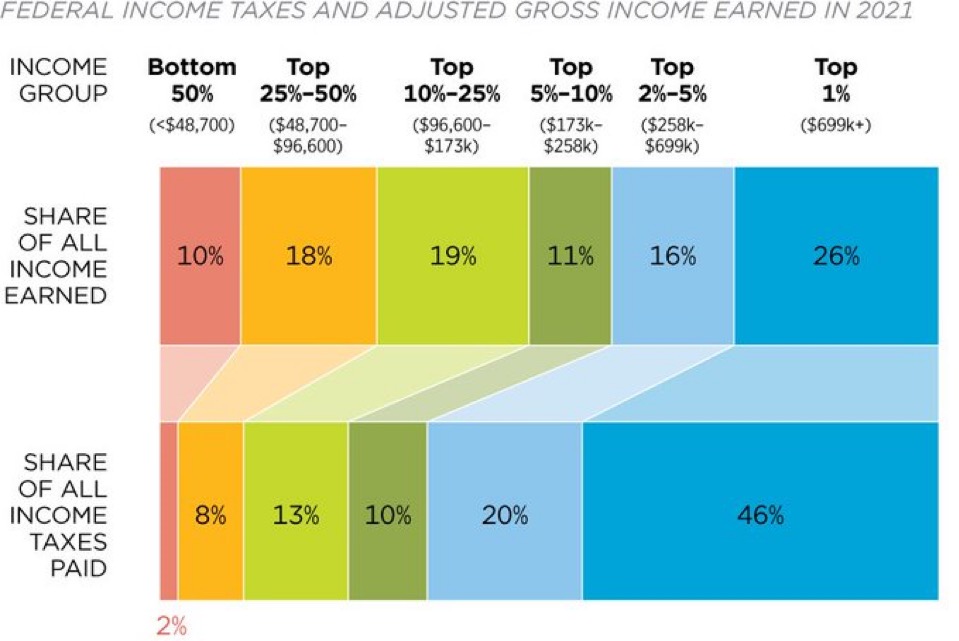
The US has one of the most progressive tax schemes ever devised in human history.
The top 1% pay for 46% of ALL taxes collected.
The bottom 50% pay only 2%.
When socialists complain about our tax system, they are either stupid, lying, or both.
Let’s talk about physician payment for a minute and why that AMA graph just doesn’t feel like it tells the whole story. Here’s why…
Let’s start with how the AMA calculates its graphic. They work on the specified update, which is what Congress set out to do that year… but that’s only half the story
Each year, the conversion factor (CF) is recalculated by multiplying the prior year CF by the statutory update by the budget-neutrality adjustment. When you only go on the statutory update, you miss a big potential gain or loss due to budget neutrality.
@anish_koka has explained why budget neutrality has doomed the physician fee schedule permanently. The AMA has provided Congress with years of bad data that ignores the massive financial trouble that budget neutrality has caused and created a far rosier picture.
When you look at the AMA graph, it appears doctors have seen a 10% increase since 2000. The 2000 CF was $36.6137. The 2027 proposed CF is $32.84. That’s over 10% in the negative direction.
We need truth in advertising. I begged the specialty societies and the AMA to fix their graphs. I spent 3 years asking for it. No one listened.
So, I did what I had to do and I pulled the data together. Below is the work product of that venture and a graph that I think (visually) shows the much more striking reason why doctors are leaving medicine or selling their practices.
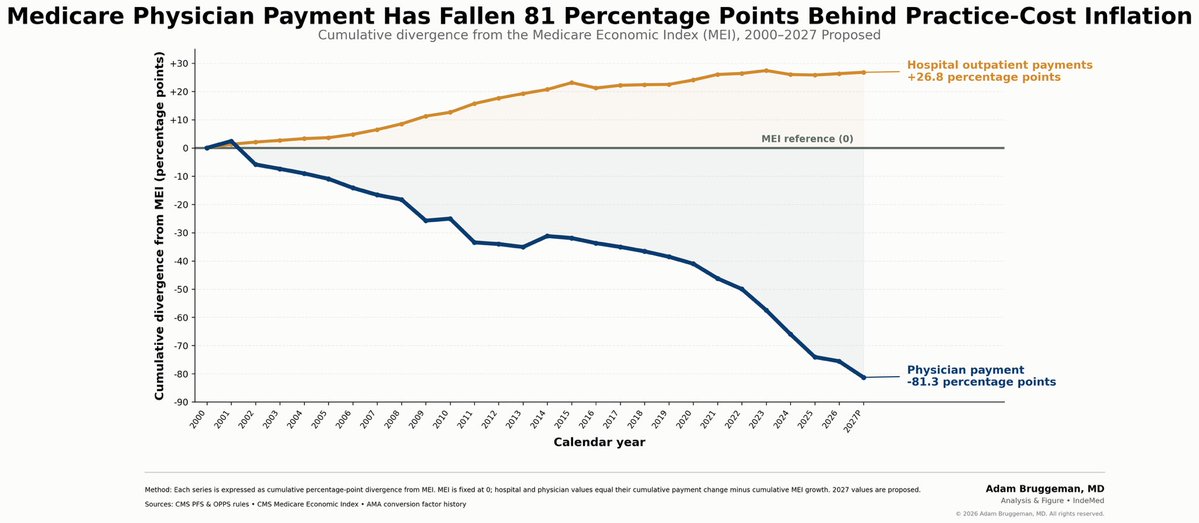
The first graph looks at things from the perspective of the 2000 CF. If we just compare how much doctors and hospitals are paid, we see that physician pay via CF has declined 10.3% while hospital pay has increased 97% and inflation (MEI) has increased 71%. That seems pretty stark but I think the second graph uses the same numbers but in a more effective way.
The second graph assumes that MEI is the baseline. In other words, what if doctors just got what they were paid in 2000, updated for the cost of inflation. Now we see what really has happened. Doctors are 81.3% behind inflation while hospitals are 26.8% above inflation. No wonder hospitals are buyers and doctors are sellers in this market.
It’s time for truth in advertising. It’s time Congress and CMS heard the real numbers. 81% behind inflation over 25 years and even worse when compared to HOPDs. Our government created this crisis and they will need to understand the issues they created to get us out. Follow us at @IndeMedAction as we shine the light on issues critical to independent physicians.
The WNBA posted a video of Angel Reese and Paige Bueckers betting $400 on which woman’s team would win. Then deleted it after realizing this violates league rules. This entire league is run by morons.
Must-Read in @tabletmag explaining @NYCMayor ‘s planned industrial scale real estate seizures in New York, which will serve as a massive war chest for DSA candidates nationwide and a consolidation of DSA power indefinitely. https://t.co/re1r776sgj
We were told a few years ago that this was a "conspiracy theory." Now Massachusetts is poised to legalize abortion up to the moment of birth for any reason. All you need is a doctor willing to do it. With the endorsement of the state medical society. https://t.co/HrVaVHWDp1
Most people know about the guillotine, King Louis XVI, and Marie Antoinette. But few realize that the French Revolution was also one of the most intense periods of anti-Catholic persecution in European history.
When the radical government demanded that all priests swear an oath of absolute loyalty to the state over the Pope, thousands refused. They were labeled "refractory priests"—traitors to the Republic—and the consequences were brutal.
About 2000-3000 priests, nuns, and religious brothers were executed, massacred, or died in horrific prison conditions. 1,000+ were officially sent to the guillotine. 25,000+ were forced to flee France into exile just to survive. 16 Carmelite nuns who refused to abandon their vows. As they walked up the steps to the guillotine, they didn't scream—they sang hymns of praise (Veni Creator Spiritus), forgiving their executioners until the blade fell on the last sister.
A paranoid mob stormed Paris prisons, hacking 191 clergy members—including an archbishop and two bishops—to death in a matter of days. Hundreds of bound priests were packed onto barges and deliberately sunk into the Loire River, which executioners mockingly called the "national bathtub."
The violence finally stopped when the Reign of Terror collapsed and Napoleon Bonaparte took power. Realizing he couldn't govern a country whose people deeply loved their faith, Napoleon signed the Concordat of 1801 with the Pope, reopening churches and allowing exiled priests to return home. Today, many of these brave souls are recognized as Saints and Blessed Martyrs. Their story is a powerful reminder of what happens when people choose faith over political convenience.
From the viewpoint of Catholic theology, tragedy of the French Revolution is viewed through the lenses of ecclesiology (theology of the Church), martyrology, and the Paschal Mystery. It was not merely a political clash, but a profound spiritual battle regarding the sovereignty of God versus the total authority of the human state. In Catholic theology, a martyr is not a passive victim of political misfortune, but a supreme witness (martys) to Truth of Christ. To be formally recognized as a martyr, a person must die in odium fidei (in hatred of the faith).
The revolutionaries claimed they were killing priests for "treason" against the state. However, Catholic theology argues that the reason for this accusation was the clergy's refusal to compromise their spiritual allegiance to Christ and His Vicar, the Pope. By refusing the Civil Constitution of the Clergy, these men and women chose the Libertas Ecclesiae (the freedom of the Church) over state-controlled religion. They recognized that giving Caesar what belongs to God is a form of idolatry.
The death of these religious figures is understood as an extension of Christ’s own sacrifice on Calvary. Catholic theology views the suffering of the church as intimately joined to the Paschal Mystery—the passion, death, and resurrection of Jesus.
The Martyrs of Compiègne provide a perfect example of this. The Carmelite nuns did not view their execution as a secular punishment, but as a literal liturgy. They renewed their baptismal and religious vows at the foot of the scaffold. By singing hymns, they transformed a place of state execution into an altar of sacrifice, viewing their deaths as an offering for the peace of France and the preservation of the faith.
#archaeohistories
Charles Carroll was the only Catholic signer of the Declaration.
He was the wealthiest colonist and so was serious when pledging their "lives, fortune, and sacred honor."
His cousin John was America's first bishop.
His statue in the Capitol reminds us of our Christian origins.
In America I was taken to a warehouse called Costco.
At the door, a woman checked my friend's membership card.
At last, I thought. A checkpoint. A travel pass. Finally, this country has proper gate protocol.
Inside, the ceiling was so high that weather felt possible.
They sell mayonnaise in containers I would describe as architectural. Forty-eight eggs at once. Trousers next to televisions next to a kayak.
Old women stood at small stations, handing out free food on toothpicks.
I asked my friend when the festival ends.
He said, "It's Tuesday."
The festival does not end. The festival is the store.
Then he bought me a hot dog and a soda.
It cost one dollar and fifty cents.
I assumed I misheard. I checked the receipt.
One dollar. Fifty cents. The price has not changed since 1985.
I was alive in 1985. Everything I have purchased since then has betrayed me at least once.
Gasoline. Rent. Rice. All of them broke their word.
The hot dog did not.
I asked how this is possible, and I received a story I did not believe until I confirmed it.
The founder, before he stepped down, told the next chief what would happen if he ever raised the price of the hot dog.
He said, and this is recorded history: "If you raise the price, I will kill you."
Scholars believe he was joking.
The price has not moved in forty years.
I leave the conclusion to you.
At the exit, a man checked our receipt and drew one line across it with a highlighter.
A seal. A magistrate's signature, approving safe passage.
I bowed to him slightly.
He said, "Have a good one," which I now understand can refer to a day, a life, or a hot dog, depending on need.
In my country, we honor merchants who keep the same price for generations. There is a shop in Kyoto four hundred years old. We treat it as a national treasure.
Costco is forty years old and sells tires.
Give it time.
Empires fell. Currencies died.
The hot dog holds.
A nation is its promises.
I paid one dollar and fifty cents.
The promise held.
Residual angina after PCI is common. The explanation depends on the interaction between microvascular dysfunction and the epicardial disease pattern
🎯 Focal CAD: successful PCI unmasks coexisting CMD.
〰️ Diffuse CAD: persistent epicardial resistance remains the dominant cause.
Impact of Coronary Microvascular Dysfunction on Patient-Reported Symptoms After PCI | https://t.co/EYxfNAQNi4
@crfheart@PCRonline@AbbottNews@bouissetfred #PCI #CoronaryPhysiology #CMD #PPG