Worked with a woman years ago. Smart. Efficient. Sometimes a pain in the ass. But every single person in the building, CEO, warehouse guys, IT, absolutely loved her.
Made no sense, She wasn't fake, She didn't suck up, She'd push back when she disagreed with you. But people still lit up when she walked in.
I finally asked her what the hell her secret was.
She said: "At the end of every conversation, no matter what, I say something positive about the other person. Even if we just argued, Especially if we just argued."
I didn't believe it at first, Sounded like corporate yoga nonsense.
Then I started watching.
Meeting ends, Disagreement about budgets, Before walking out, she'd say: "By the way, really sharp point you made about Q3. I'm stealing that for my deck."
Email thread gets tense. Final reply from her: "Appreciate you taking the time to walk through this. Helps a lot."
Loading dock dispute over delivery schedules. Ends with: "You guys deal with way more chaos than anyone realizes. Thank you."
It wasn't scripted, It was deliberate.
People didn't remember the argument. They remembered that she noticed them.
Simple trick. Hard to do consistently. Worth it.
Ladies and gentlemen, The Boys... 🔴⚫️
NB: viewers discretion is advised, content is saturated with high levels of aura x immense glamour 🔞
#BeyondTheHill#DwenHweKan#MOBA16
Dostoevsky was right; “Every self-betrayal is a sin. Whenever you go against your nature, your body reminds you.”
If you spend enough time with anything, you start liking it, even sadness. So let’s choose people and spaces that truly elevate us. Your peace is worth it.
Don't be ashamed to abuse your unfair advantage
- if you’re a beautiful girl or a handsome man → your reach will always be higher. use it.
- if you have rich parents → take bigger risks while others worry about rent
- if you have powerful friends → open doors others can’t even knock on
- if you have a scary / dominant presence → people will hesitate to challenge you
None of this is "fair".
Trying to play "fair" in an unfair system is just handicapping yourself.
No one at the top reached there by playing fair.
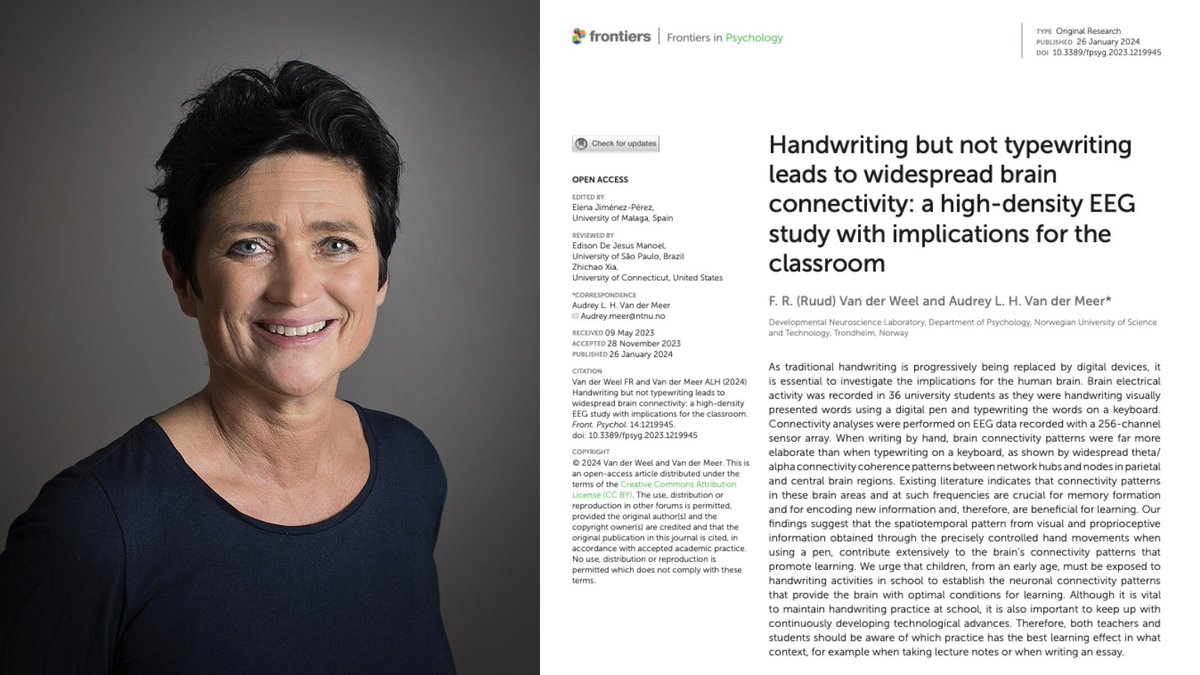
A Norwegian neuroscientist spent 20 years proving that the act of writing by hand changes the human brain in ways typing physically cannot, and almost nobody outside her field has read the paper.
Her name is Audrey van der Meer.
She runs a brain research lab in Trondheim, and the paper that closed the argument was published in 2024 in a journal called Frontiers in Psychology. The finding is brutal enough that it should have changed every classroom on Earth.
The experiment was simple. She recruited 36 university students and put each one in a cap with 256 sensors pressed against their scalp to record brain activity. Words flashed on a screen one at a time.
Sometimes the students wrote the word by hand on a touchscreen using a digital pen, and sometimes they typed the same word on a keyboard. Every neural response was recorded for the full five seconds the word stayed on screen.
Then her team looked at the part of the data most researchers had ignored for years, which is how different parts of the brain were communicating with each other during the task.
When the students wrote by hand, the brain lit up everywhere at once.
The regions responsible for memory, sensory integration, and the encoding of new information were all firing together in a coordinated pattern that spread across the entire cortex. The whole network was awake and connected.
When the same students typed the same word, that pattern collapsed almost completely.
Most of the brain went quiet, and the connections between regions that had been alive seconds earlier were nowhere to be found on the EEG.
Same word, same brain, same person, and two completely different neurological events.
The reason turned out to be something nobody had really paid attention to before her work. Writing by hand is not one motion but a sequence of thousands of tiny micro-movements coordinated with your eyes in real time, where each letter is a different shape that requires the brain to solve a slightly different spatial problem.
Your fingers, wrist, vision, and the parts of your brain that track position in space are all working together to produce one letter, then the next, then the next.
Typing throws all of that away. Every key on a keyboard requires the exact same finger motion regardless of which letter you are pressing, which means the brain has almost nothing to integrate and almost no problem to solve.
Van der Meer said it plainly in her interviews.
Pressing the same key with the same finger over and over does not stimulate the brain in any meaningful way, and she pointed out something that should scare every parent who handed their kid an iPad.
Children who learn to read and write on tablets often cannot tell letters like b and d apart, because they have never physically felt with their bodies what it takes to actually produce those letters on a page.
A decade before her, two researchers at Princeton ran the same fight using a completely different method and ended up at the same answer. Pam Mueller and Daniel Oppenheimer tested 327 students across three experiments, where half took notes on laptops with the internet disabled and half took notes by hand, before testing everyone on what they actually understood from the lectures they had watched.
The handwriting group won by a wide margin on every question that required real understanding rather than surface recall.
The reason was hiding in the transcripts of what the two groups had actually written down.
The laptop students typed almost word for word, capturing more total content but processing almost none of it as they went, while the handwriting students physically could not write fast enough to transcribe a lecture in real time, which forced them to listen carefully, decide what actually mattered, and put it in their own words on the page.
That single act of choosing what to keep was the learning itself, and the keyboard had quietly skipped the choosing and skipped the learning along with it.
Two studies. Two countries. Same answer.
Handwriting makes the brain work. Typing lets it coast.
Every note you have ever typed instead of written went into your brain through a thinner pipe. Every meeting, every book highlight, every idea you captured on your phone instead of on paper was processed at half depth.
You did not forget those things because your memory is bad. You forgot them because typing never woke the part of the brain that would have made them stick.
The fix is the thing your grandmother already knew.
Pick up a pen. Write the thing down. The slower road is the faster one.
Hi my loves♥️ So my phone went off and my charger burnt out but Wahalurrrr for the devil cos i found other means to post this HA! May you be blessed and may you be more cautious in this life cos.......
Good morning🌿☀️☕🕊️
Good or bad, nothing lasts forever. One day you're winning, on top of the world.
The next, everything feels like it's falling apart. That's life. It moves in seasons.
The mistake most people make? They panic when its hard, and get lazy when it's easy.
When life's good, be present. Soak it in. Build momentum.
When it's bad, don't quit. The pain won't last forever, but your discipline will. Everything changes.
That's the beauty of it. So stay focused. Stay grounded. And keep moving.
Growth is a daily choice. 🌿☀️
Worth a read! 😍
My mom wanted to send me homemade pickles. But I said ‘no’.
I was 27, living in New York, working on Wall Street. I didn't need pickles shipped across the world. The shipping would cost more than buying them here.
Three years later, I read the psychologist take on what I'd actually done. When you reject someone's offer to help, you're not just declining assistance. You're declining their need to matter to you!
Benjamin Franklin figured this out in 1736. He had a rival in the Pennsylvania legislature who hated him. Instead of trying to win him over with favors, Franklin asked the rival to lend him a rare book.
The rival agreed. They became lifelong friends. It's called the Ben Franklin effect.When people do something for you, they convince themselves they must like you. Otherwise, why would they help?
My mom didn't want to send pickles because I needed them.
She wanted to send them because SHE needed to feel useful to me. To feel like despite the ocean between us, she still had a role in my life.
Every time I said "I'll manage," I was taking that away from her. Here's what I learned after a decade of living away from home:
→ Accepting small favors isn't about you needing help.
It's about letting people you love feel needed.
Your dad wants to transfer ₹5000 even though you earn well?
Let him.
Your friend wants to pick you up from the airport even though Uber exists?
Say yes.
Your partner wants to make you tea even though you can make it yourself?
Accept it.
The people who love you don't want to solve your big problems. They want to matter in your small moments.
Let them. #lifelesson
The plot twist of all plot twists is that your life gets exponentially better as soon as you stop giving a fuck. And not in the cold, heartless, not giving a fuck way. But in the way that you remain so unattached to the outcome that nothing can shake you. You are going to be good no matter what happens. It’s this sort of peace that surpasses understanding that can only be found via unshakable faith. This applies to every aspect of your life. Love career relationships money health. You give it your best shot. You try your damn hardest. You leave everything on the table. But you stay unattached. Whatever happens, happens. You flow through life and life flows through you.
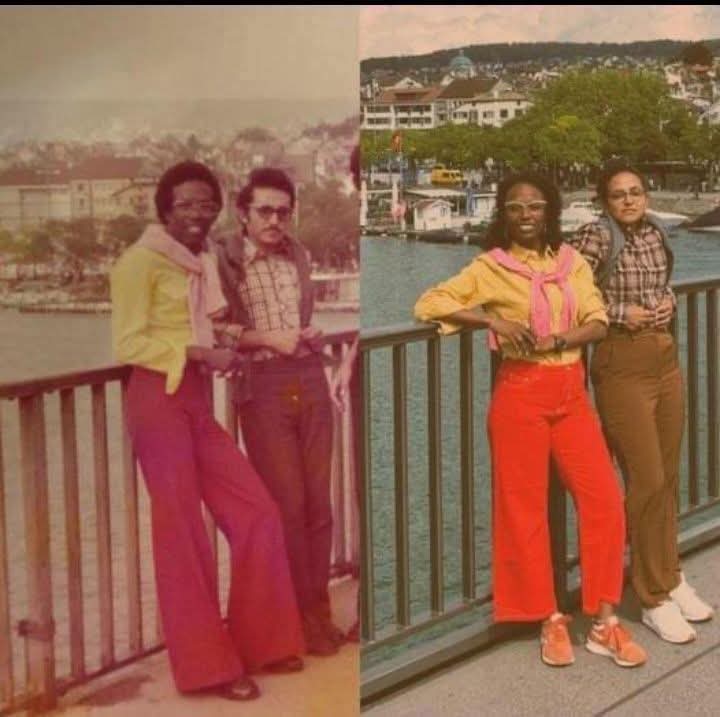
“When my father passed away, his best friend of over 50 years sent me a picture of them both on a bridge in Zurich. It was from when they were young university graduates, travelling to Europe for the first time together. A year after my father’s passing, his friend’s daughter (who is like a sister to me) and I met in Venice. We decided to take a train to Zurich, buy clothes similar to what they wore in 1974, and try to recreate the same photo on Quaibrucke.”
I lived in Japan for a year. Most of my experiences were exhausting in ways I’d rather not get into, but this one still makes me laugh.
I was on the train in Osaka, minding my own business, when I noticed a group of school kids a few seats down. They were whispering, glancing at me, then whispering again. They kept passing a folded piece of paper between them as if they were planning something top secret.
I watched this go on for two stops.
Finally, one of the kids was pushed forward by the others. He walked over to me slowly, like he was approaching a wild animal that might bite. He stopped right in front of me, bowed politely, and held out the folded paper with both hands.
I opened it.
Inside was a handwritten note in careful English: “Hello. We think you are a very cool person. We are practicing our English. We hope this note is correct. Please give us a score.”
At the bottom, they had drawn a literal grading box, out of ten.
I looked up. Seven pairs of eyes were staring at me as if their entire semester depended on my response.
I pulled out a pen, wrote “10/10” in the box, and added a note: “Perfect English. Well done.”
The boy carried it back to the group. They read it together… and absolutely lost their minds. High-fives, jumping, and one kid even pumped his fist in the air.
Their teacher, who had been pretending not to watch from the end of the car, was biting her lip, trying hard not to smile.
I rode the rest of the journey grinning to myself.
That’s the Japan I always remember.
I noticed something about environment. When you are surrounded by broke people, it starts to feel like everyone is struggling, like the economy is collapsing and no one has money, and even if you do, you start thinking you might lose it. When you are around entrepreneurs and people who are building things, it feels like money and opportunities are everywhere, even when you personally have less. Your environment shapes what you believe is possible.
A parasite that has been eating people for 3,500 years is about to be wiped off the planet. It infected 3.5 million people in 1986. Last year, it infected 10. And I have not seen it make a single front page.
It is called Guinea worm. You drink contaminated water from a pond in a poor village. A year later, a worm up to three feet long starts coming out of your leg through a burning blister. There is no pill that stops it and no surgery that works. You wrap the worm around a stick and pull it out slowly, over days or weeks, inch by inch. If you rush, the worm breaks inside you and causes a fresh infection.
Guinea worm is ancient. Preserved worms have been pulled out of Egyptian mummies from around 1000 BCE. The Ebers Papyrus, an Egyptian medical scroll from 1550 BCE, describes pulling the worm out with a stick. For three and a half thousand years, that was the best humans could do.
Then in 1986, public health workers decided to kill the parasite off. They had no vaccine and no drug. What they had was cheap cloth water filters and a small army of volunteers willing to walk from village to village for decades.
The plan was simple. Give everyone who drinks from a pond a cloth filter to strain out the tiny water fleas that spread the parasite. Then send volunteers walking house to house, year after year, teaching people how to use the filters and keeping anyone with an emerging worm out of the water.
It worked. From 3.5 million cases a year to 10. Four were in Chad, four in Ethiopia, two in South Sudan. The other four countries where the worm used to be common, Angola, Cameroon, the Central African Republic, and Mali, had zero human cases for the second year in a row. The World Health Organization has already certified 200 countries as Guinea worm free. Six are left.
The last hurdle is dogs. Cameroon had 445 infected animals last year and Chad had 147, so a lot of the remaining work is on animals, not humans. Strays get leashed, and crews treat ponds to kill any remaining worms. The campaign keeps watching until the number hits zero.
When Guinea worm hits zero, it becomes the second human disease ever erased from the planet. The first was smallpox. It will also be the first parasite humans have ever wiped out, and the first disease ever ended without a single dose of medicine. Volunteers walked village to village with cloth filters for 40 years. Now a plague from the age of the pharaohs is about to be gone.