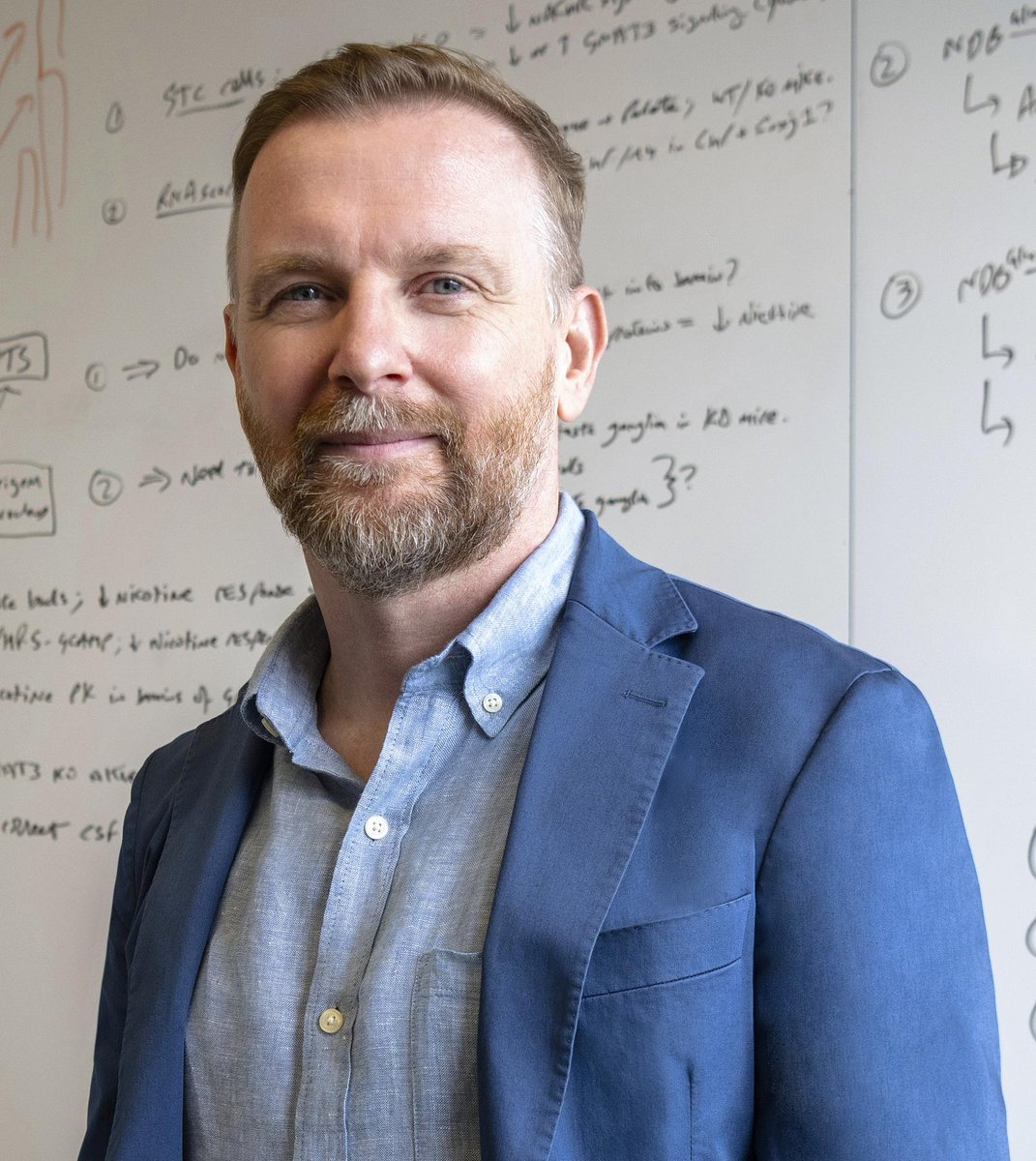
We are thrilled to see @PaulKennyPhD and Anne Schaeffer elected to the National Academy of Medicine. Both are world leaders in neuroscience research whose work has direct implications for better understanding and treating several brain disorders. @SinaiBrain@IcahnMountSinai
We're proud to share that Dr. Ross Levine, Chief Scientific Officer at MSK and Dr. @dana_peer, Chair of the Computational and Systems Biology Program at the Sloan Kettering Institute (SKI) at MSK, have been elected to the @theNAMedicine.
With these latest appointments, 30 MSK faculty members have now received this prestigious honor.
Learn more about these two elections: https://t.co/P9lKgWhuS7
A couple days ago, @AnthropicAI published this interesting post, and I just got a chance to read it. It focuses on what AI did to their own hiring. Junior hires fell 3x & their managers now hire for autonomy and judgment (agents cover execution). https://t.co/et9NIg1qbj
Our AM-3 paper is out in Cell. Opioids are critical drugs, but have severe side effects. Because they are administered systemically, it is hard to dissect how they work, and to separate side effects. So we built one you can switch on and off with light. https://t.co/9sb9TRvA2Q
Today, RFdiffusion3 is out in @ScienceMagazine!
https://t.co/hITqU9p4Ot
We have many exciting updates to share! We're also releasing Chaperone, an agent harness for general bio-molecular design. 1/n
Graduate Student Nishanth Chinnadurai, MS will present "Virtual T cell Modeling to Uncover Exhaustion-reversing Genetic Perturbations in T cells within
Preinvasive Lung #Adenocarcinoma," Friday at 11 am!
Unbiased analysis across 101,243 patients reveals that cardiovascular and psychiatric diseases were less prevalent in people with BAT. Higher BAT activity is associated with lower odds of cardiometabolic diseases and healthier white fat distribution. Angiotensin receptor blocker use was positively associated with BAT presence. Congrats @ngomezbanoy !!! https://t.co/UqIeBw6Wjs
Don't miss tomorrow's @WCMEnglanderIPM#PrecisionMedicine Research Conference at 11 AM, “Germline Susceptibility in Biliary Tract Cancer: The Unresolved Significance of Uncertain Variant" by Andrea Perra, M.D., Ph.D.!
In case you missed it, @WCMEnglanderIPM Member Dr. Howard Fine spoke with colleagues from @nyphospital about how a "Cerebral #Organoid Model Transforms #Glioblastoma Research."
https://t.co/wc5II1RgLj
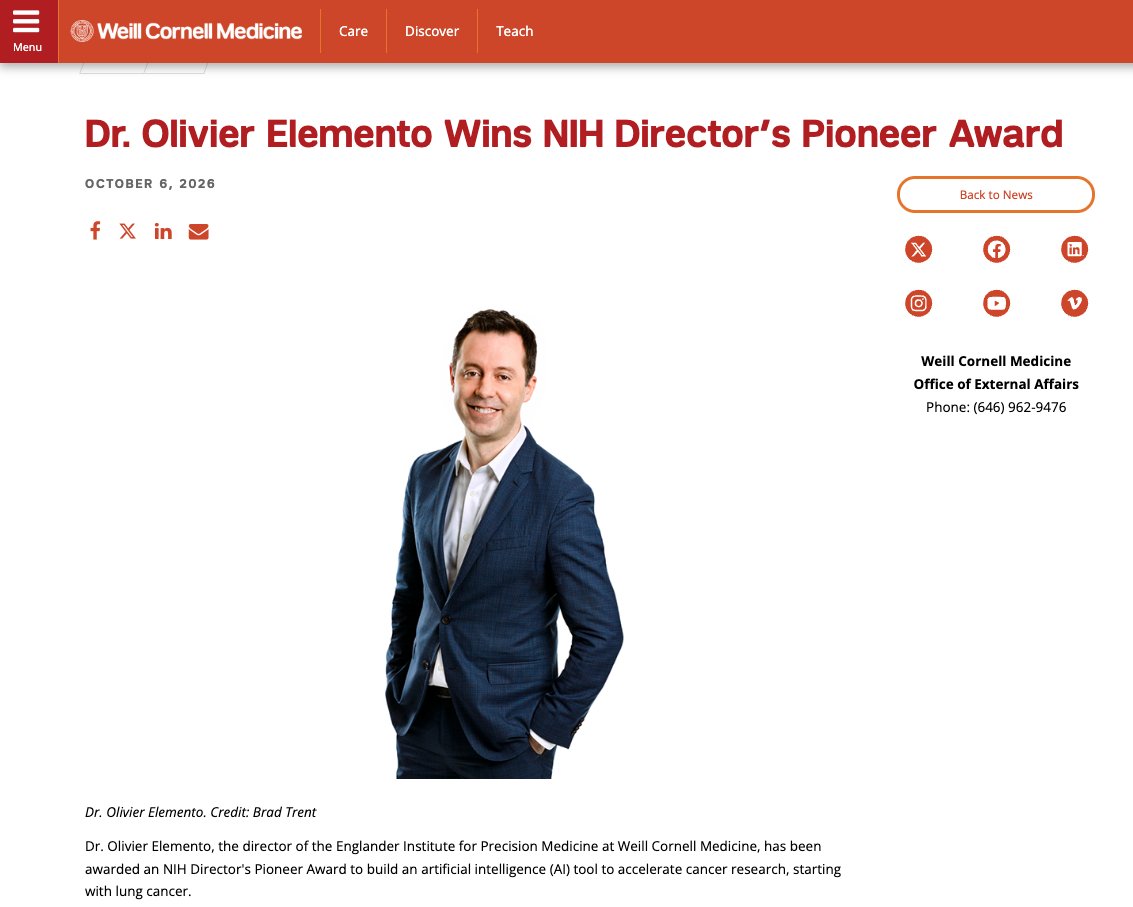
Please join us in congratulating our @WCMEnglanderIPM Director Olivier Elemento, PhD (@ElementoLab) on earning the @NIH Director's Pioneer Award to build an artificial intelligence tool to accelerate cancer research! #AI#CommonFund#HighRiskHighReward
https://t.co/z8rRO3tTKb
We are pleased to welcome Dr. Olivier Elemento @ElementoLab as our #GrandRounds speaker today, presenting "AI for Precision Oncology: From Genomes to Tissues to Drugs." Join us at 12pm in Smilow Auditorium or online via Zoom: https://t.co/Uz4EcGCOa5.
@SmilowCancer@WCMEnglanderIPM@WCMC_CTSC
WATCH: For decades, RAS was considered one of cancer research’s most difficult targets. This new Your NCI video tells the story of how sustained @theNCI investment, strong science, and collaboration helped change what was possible for patients.
Weill Cornell Medicine - Olivier Elemento Awarded the National Institutes of Health Director’s Pioneer Award
@WeillCornell@ElementoLab
https://t.co/CGMwOQqgv3
Big news today: I am deeply honored to receive the NIH Director's Pioneer Award, one of only seven given this year across all fields! We will build an AI engine that generates cancer hypotheses from human data and tests them with robots in tumor organoids https://t.co/n4rqtssmYB
A universal predictive model of the cell would dramatically accelerate science, allowing biologists to perform experiments digitally. Today we’re announcing a major partnership with the DOE and NIH. The goal of this partnership is to generate the data that will be needed to build an accurate model of the cell with artificial intelligence.
Isomorphic, Google DeepMind, and Meta are joining us as founding partners in the Virtual Biology Initiative. This is the beginning of a large scale coordinated effort to map cellular biology to power the development of digital models of life. Other leading scientific institutions and consortia including the Allen Institute, Broad Institute, Gladstone Institutes, the Human Cell Atlas, the Human Protein Atlas, the Wellcome Sanger Institute, as well as NVIDIA, are working together as part of this international scientific project.
Creating a predictive model of the cell is one of the most important challenges for the next decade of science. The insights that come from this could unlock a far greater understanding of disease, and open new paths for cures.
We invite the worldwide scientific community and other funders to join us in this effort.