@rasmus1610@DSPyOSS Now I see your reply on discord to my question makes complete sense.
I was doing multistep classification and you helped me with a suggestion, now this module is going to make it 100% fault tolerant. Thanks!
I love this @DSPyOSS pattern for keeping a RAG pipeline faithful.
This way you *engineer* your system to spit out "I don't know" if the context doesn't contain the necessary information.
No need to threaten the LLM's grandma.
I can’t believe I’m recommending a totally random AI summary I came across online but…
This 6-min NotebookLM video is an excellent summary of my perspective on the bitter lesson and what it means for AI engineers.
Link below.
✌️New blog post
We'll look at @DSPyOSS SIMBA optimizer and how it works.
It's a great start for understanding self-introspective prompt optimization and DSPy's newest optimizer GEPA, which will come out soon.
(link in first response)
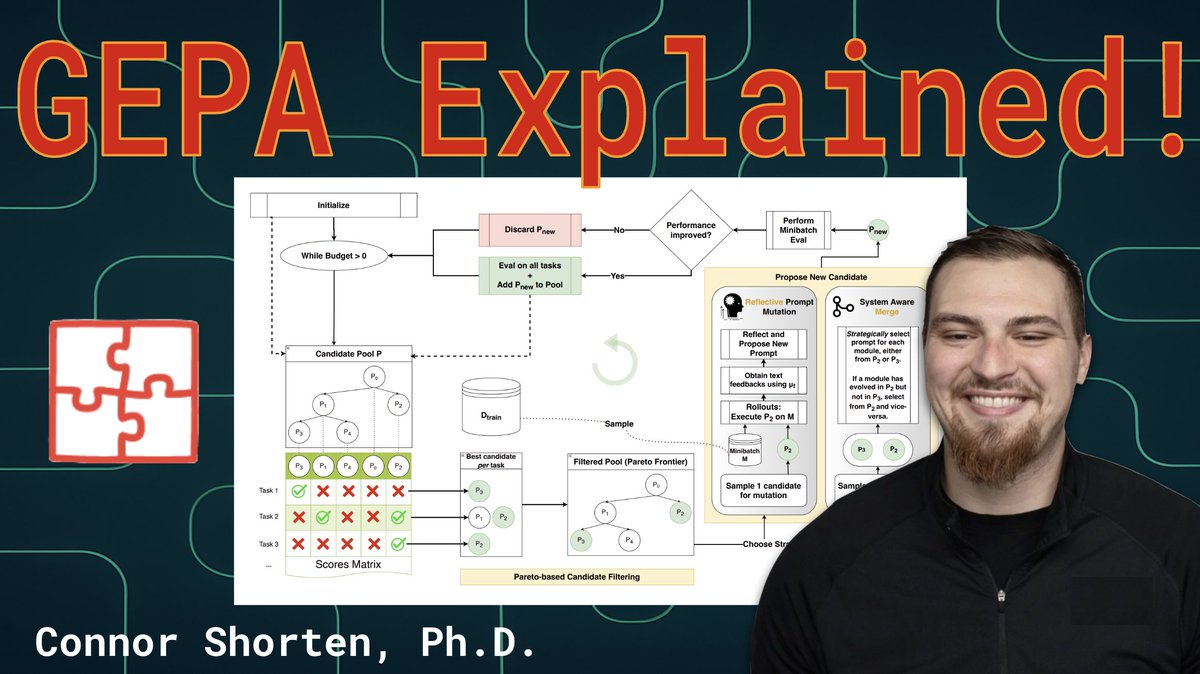
GEPA is a SUPER exciting advancement for @DSPyOSS and a new generation of optimization algorithms re-imagined with LLMs! 🧩🚀
Starting with the title of the paper, the authors find that Reflective Prompt Evolution can outperform Reinforcement Learning!! 🤯
Using LLMs to write and refine prompts (for another LLM to complete a task) is outperforming (!!) highly targeted gradient descent updates using cutting-edge RL algorithms! ⚖️
GEPA makes three key innovations on how exactly we use LLMs to propose prompts for LLMs -- (1) Pareto Optimal Candidate Selection, (2) Reflective Prompt Mutation, and (3) System-Aware Merging for optimizing Compound AI Systems. 🧠🧠
The authors further present how GEPA can be used for training at test-time, one of the most exciting directions AI is evolving in! 🚀
Here is my review of the paper! I hope you find it useful! 🎙️
We heard that y'all want visuals.
OK. Here's a (rather hideous!) visual with our philosophy on where you should invest in AI systems.
Our job is to give you the top block as composable pieces, so you can iterate fast on engineering the three foundational layers below it.
@MaximeRivest Wow, that's amazing! Can you share some details like how many classes were there in your task? Were they quite diverse or had overlaps in between them etc.
99% consistency is amazing!
✨ Low Numerical Precision in PyTorch ✨
Most DL models are single-precision floats by default.
Lower numerical precision - while reasonably maintaining accuracy - reduces:
a) model size
b) memory required
c) power consumed
Thread about lower precision DL in PyTorch ->
1/11
Starting 01 Mar, 2023 I’ll be going back to blogging 1 post a week every Monday at 9am AEST.
These blogs will be about AI research, new technologies, updates, frameworks, Kaggle competitions and more.
If you have a topic that you’d like me to cover, please let me know. :)
🤗Datasets 2.10 🔥 is out and faster than ever for shuffled datasets:
⚡️Speed x2 with a @PyTorch DataLoader
⚡️Speed x100 for saving/loading on disk
How ?
See how we did that, as well as 6 amazing new features 🧵👇
The future of ML is being built on W&B.
Come find out how at our MLOps conference, Fully Connected on March 15!
🐝 Register at https://t.co/X9Q19TeBsY
Featuring speakers from @StabilityAI, @Spotify, @NVIDIAAI, Openai; people like @jeremyphoward, @sh_reya, @HamelHusain & more!
📢 New #ChatGPT extension!
`ChatGPT Writer` is a Chrome extension for Gmail that uses ChatGPT to generate emails or replies based on your prompt! 🤯
See my demo video below 👇
Get it here:
🔗 https://t.co/iHz628k4Du
🌐 https://t.co/V2V1PeVJGN
@LinkedIn/@Outlook coming soon!