Thrilled to share that our new paper on subjective well-being in Afghanistan is out in @ScienceAdvances! It sheds light on the enduring psychological toll of war—reminding us that the human cost of conflict often persists long after the fighting stops.
My first article is out, with @phyllis_lun, @meiyang2025, @KenithChan, & @felixckc (@pwb_lab). We examine wellbeing in Afghanistan during the final stages of the Afghan War and find it dropped to the lowest ever recorded after the war ended.
Read here: https://t.co/u2o0tPydqF
The McGill-UofT Wellbeing Seminar is back! Join us monthly for online talks with researchers on key well-being topics. Each 3-month mini-series features two perspectives, followed by a panel discussion. Talks are at noon EST on select Tuesdays. 📷
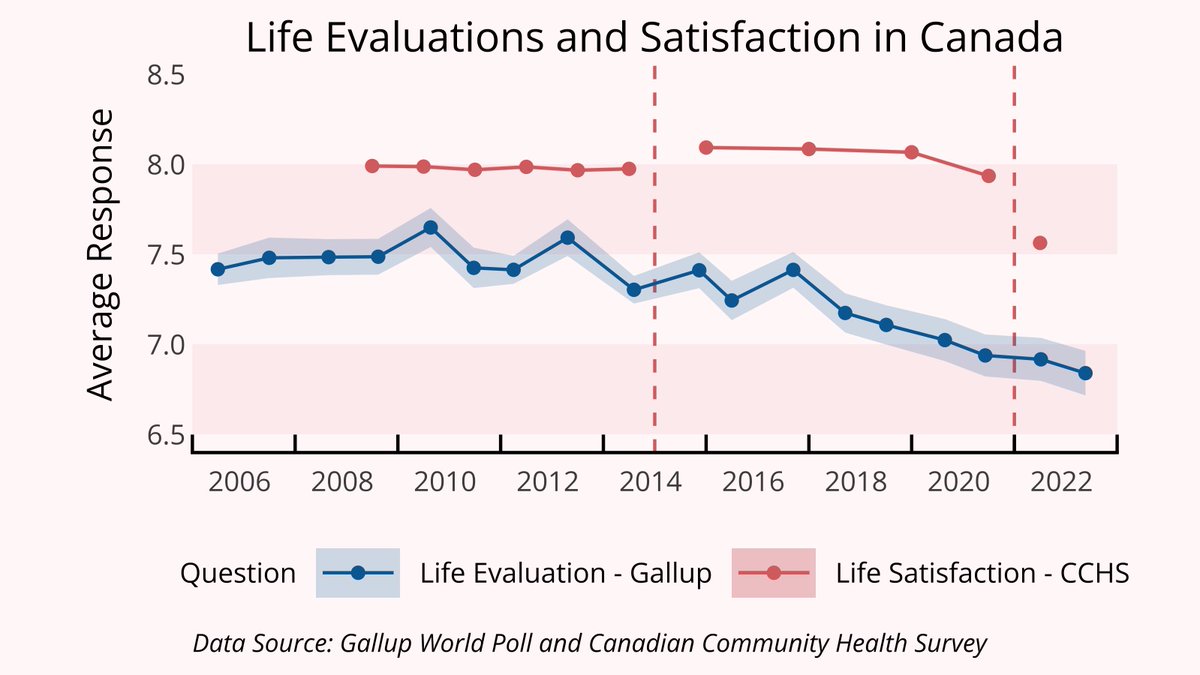
Today the @pwb_lab and I publish the 2024 Canadian Happiness Report! Confirming the findings of @HappinessRpt, Canadians do feel that the quality of their lives are declining, however they remain very satisfied with these lives (especially before the pandemic)! 🧵
1/10
Three years ago, during my undergrad, @felixckc shared an article by Ed Diener, @Shige_Oishi, and @rlucas11 (2015) that I had the opportunity to cover in this journal club. I discuss how well-being science can benefit from a population angle and interdisciplinary collaboration.
The McGill-UofT Wellbeing Seminar hosts a series of open online talks and discussions with leading researchers in the realm of wellbeing across a variety of disciplines. This seminar series, held at noon on the first (or occasionally second) Monday of every month.
Applications for SPRINT 2023 are now officially open!
If you are an Ontarian high school student interested in psychology and research, this is the perfect opportunity for you 🥼💖
Click the link in our bio to learn more and apply to the program by May 31, 2023!
How should we measure the inequality of wellbeing within a society? Today, we released a report arguing that the most democratic way is simple: just report the entire distribution. https://t.co/kv0Y5xoeV9 1/9
New post! Are representative samples redundant at best? @dingding_peng investigates 3 scenarios: estimating a prevalence, estimating a causal effect in an experiment, and estimating a causal effect (or a correlation!) in an observational study. https://t.co/x9uvA596NA
Our lab will be presenting a symposium titled "Social and Personality Psychology at Times of War and Conflict" at the 2023 International Convention of Psychological Science on Friday, March 10 from 5:30-6:50 PM, chaired by @felixckc. (1/6)
In conjunction with @IntAdaptInt, we are running an adaptive experiment testing social interventions to improve short-term well-being. We are interested in crowdsourcing creative interventions from both seasoned and early career researchers. (1/2)
There’s a HUGE gap in personality development research–it's focused on the Big 5, but personality is hierarchical! So we know little about processes at higher-order (metatrait) or lower-order (facet) levels.
So we studied it! & the results are SO COOL! https://t.co/FN4EoAUjcZ
I’m incredibly grateful to @felixckc, Ralph Ma, Kenith Chan, @anthonymccanny for their guidance and to members of the @pwb_lab for their support. Feel free to get in touch if you’d like to chat about compositional data analysis, time use, or anything well-being-related!
First time chairing a symposium “Promoting well-being through awe, mindfulness, intergenerational connections, and time use” at #SPSP2023. Wonderful to share the podium with @jdproulx, Maria Monroy, and @pbeloborodova.
Super exciting to present research on time use that started as my undergraduate thesis with @felixckc. We are pioneering compositional data analysis to account for the inherent opportunity cost involved in time use and examine how reallocating our limited time affects well-being.