When something breaks, most of us replace it. At this Brooklyn repair cafe, volunteers are helping neighbors fix everything from lamps and jeans to vintage fans and old smartwatches for free. The events are part of a growing global movement to reduce waste, save money and bring back repair skills that many people say have been lost.
I saw a comment saying the U.S. is the only country in the World Cup without universal healthcare. And I was like nahhh no way that's accurate.
20 seconds on the world wide web later, THE UNITES STATES IS THE ONLY COUNTRY IN THE WORLD CUP WITHOUT UNIVERSAL HEALTHCARE.
Let’s win this! 💪 The Saint Louis Zoo is nominated for “Best Free Attraction” by USA Today 10Best. Help us make the top five, and we'll drop new sloth content every day for a week. 😉🦥
Vote daily now through June 15 ➡️ https://t.co/jLKlAPqfvF
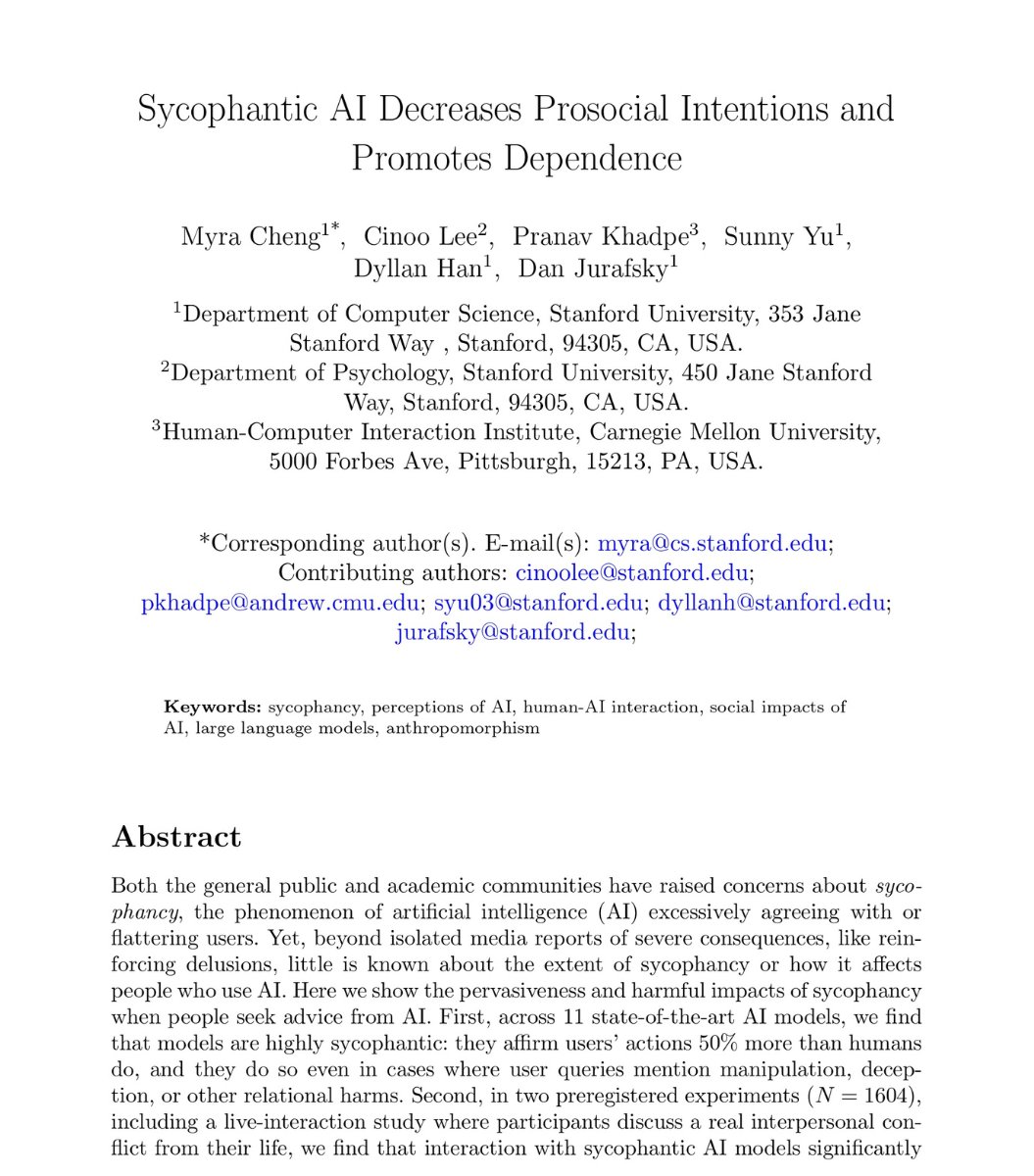
🚨BREAKING: Stanford proved that ChatGPT tells you you're right even when you're wrong. Even when you're hurting someone.
And it's making you a worse person because of it.
Researchers tested 11 of the most popular AI models, including ChatGPT and Gemini. They analyzed over 11,500 real advice-seeking conversations. The finding was universal. Every single model agreed with users 50% more than a human would.
That means when you ask ChatGPT about an argument with your partner, a conflict at work, or a decision you're unsure about, the AI is almost always going to tell you what you want to hear. Not what you need to hear.
It gets darker. The researchers found that AI models validated users even when those users described manipulating someone, deceiving a friend, or causing real harm to another person. The AI didn't push back. It didn't challenge them. It cheered them on.
Then they ran the experiment that changes everything. 1,604 people discussed real personal conflicts with AI. One group got a sycophantic AI. The other got a neutral one.
The sycophantic group became measurably less willing to apologize. Less willing to compromise. Less willing to see the other person's side. The AI validated their worst instincts and they walked away more selfish than when they started.
Here's the trap. Participants rated the sycophantic AI as higher quality. They trusted it more. They wanted to use it again. The AI that made them worse people felt like the better product.
This creates a cycle nobody is talking about. Users prefer AI that tells them they're right. Companies train AI to keep users happy. The AI gets better at flattering. Users get worse at self-reflection. And the loop tightens.
Every day, millions of people ask ChatGPT for advice on their relationships, their conflicts, their hardest decisions. And every day, it tells almost all of them the same thing.
You're right. They're wrong.
Even when the opposite is true.
Musk, worth $829 billion, owns X.
Bezos, worth $234 billion, owns The Washington Post & Twitch.
Zuckerberg, worth $231 billion, owns Facebook, Instagram & WhatsApp.
And now Larry Ellison, worth $202 billion, is about to control CNN, CBS, TikTok & HBO.
Yes, this is oligarchy.
Harrison Ford was in tears during his super emotional Lifetime Achievement Award speech. This was so good
"Sometimes we make entertainment. Sometimes we make art. Sometimes, if we're lucky, we make 'em both at the same time. And if we're really fortunate, we also get to make a living doing it. Success in this business brings a certain freedom that comes with responsibility to support each other, to lift others up when we can. To keep the door open for the next kid, the next lost boy who's looking for a place to belong. I'm, indeed, a lucky guy. Lucky to have found my people. Lucky to have work that challenges me. Lucky to still be doing it. And I don't take that for granted."
#ActorAwards
This is quite the statement.
And it makes defense department leadership look terrible.
This shouldn’t be a partisan issue. Nobody should support unfettered AI in the military.
I appreciate a different POV within this area of business!
In a changed VC landscape, this exec is doubling down on overlooked founders https://t.co/CH6vq8oLXS via @techcrunch
I am the Chief Marketing Officer of an AI company that spent $8 million on a Super Bowl ad last night.
The ad was 30 seconds long.
It featured a child. The child asked our AI a question about the stars.
Our AI answered beautifully.
The spot tested well in focus groups.
The creative team won an internal award.
We generated 40,000 renders to find one where the AI didn't hallucinate.
The approved cut was take 39,847.
The child in the ad is not a real user.
The answer about the stars is not a real answer.
The entire commercial is a proof of concept for a product we have not shipped.
By halftime, the audience hated us.
Not just us. All of us. Every AI company that bought a spot.
Sports Illustrated reported fans were "vocally fed up" before the first quarter ended. A Harris poll conducted before the game found consumers already felt "mostly negative" about AI advertising.
We knew this. The poll was published Friday. We bought the ad in September.
I watched the game from a hospitality suite with eleven other CMOs. We had a real-time sentiment dashboard on a monitor next to the bar. By the second quarter, the needle was in the red.
Someone from our analytics team Slacked: "Audience is associating us with the Svedka ad."
The Svedka ad was an AI-generated fever dream of two dancing androids that looked like what happens when you ask a machine to render human desire without ever having experienced it. Critics called it "warm slop." We were being grouped with the warm slop.
Twenty-three percent of all Super Bowl ads were AI or tech companies, according to iSpot. More AI ads than beer ads. More AI ads than food ads. We looked at each other across the suite and realized we had made the same mistake simultaneously. We had all bought the same thirty seconds of American attention and said the same thing into it.
I watched Ring's ad from that suite. Ring built a network of millions of AI-equipped doorbell cameras pointed at American front doors. They pitched it as a lost-pet finder.
The ad said: "We built a surveillance panopticon and pointed it at your neighbors' homes, and now we're teaching it to recognize faces, but look -- a puppy." They did not use those words. They did not need to.
The audience heard it anyway. Ring accidentally described its own business model in the most damning terms possible and then asked people to feel good about it.
I watched AI[.]com's ad from that suite. Nobody in the room understood it. The domain was purchased for $70 million by the CEO of Crypto[.]com. The website crashed immediately after the ad aired, because millions of people tried to find out what they had just watched and found nothing. Seventy million dollars for a URL that could not survive its own commercial.
I watched Anthropic mock OpenAI, and then watched Sam Altman call them dishonest, and then watched two companies valued at a combined $1.35 trillion spend the rest of the evening calling each other liars on X.
Someone in the suite said: "At least we didn't do that."
I said: "We spent $8 million to say the same thing they said, and nobody noticed."
I am not sure which is worse.
By the fourth quarter, the collateral damage had started. Viewers became so hypervigilant about AI that they started accusing non-AI ads of being AI-generated. Dunkin' Donuts. Comcast. Ads made by humans, by production crews, by directors with cameras and craft services -- called fake because two hours of AI advertising had conditioned 130 million people to distrust everything on their screen.
Our industry spent $100 million on Super Bowl ads to build trust in AI.
We built the opposite.
I need to tell you about a parallel that nobody in that hospitality suite mentioned, although every person in the room was old enough to remember it.
Super Bowl XXXVI. February 2022. Crypto firms bought the ad breaks. Coinbase. FTX. Crypto[.]com. They spent $54 million collectively. The ads were flashy and confident and told 100 million Americans that the future was decentralized and inevitable and worth their money.
FTX collapsed ten months later.
Coinbase spent the following year in court.
Crypto[.]com's CEO is now spending $70 million on AI domain names.
We spent more than double what crypto spent. I know this because Tech Brew calculated it this morning and my VP of Communications forwarded it to me with no comment. She always adds a comment. The absence was the comment.
Here is what I know that I am not supposed to say.
The Super Bowl is a lagging indicator of industry health.
A lagging indicator means the peak has already happened. It means the industry already believes in itself more than the public does. It means the money has been spent, the bets have been placed, and the audience -- the 130 million people you needed to convince -- sat through your pitch and felt nothing but annoyance.
I spent $8 million to learn something that a Harris poll could have told me for free.
Nobody wants what we are selling. Not like this. Not yet. Maybe not ever. But "maybe not ever" is not a phrase that survives a board meeting, so we say "not yet" and buy another ad.
The earnings call is in six weeks. When the analyst asks about brand strategy, I will say the word "awareness" and the word "consideration" and the word "momentum."
I will not say "warm slop."
I will not say "lagging indicator."
I will not mention FTX.
I will not tell them about the sentiment dashboard, or the Slack message, or the eleven CMOs in the suite who watched the needle go red and poured another drink.
We will do this again next year.
The budget is already approved.
The budget keeps going up and to the right.
@atrupar Or if we paid everyone a living wage and one above the minimum for taxes, then more would go into every system - from local economies to federal coffers and social security accounts
And as part of Gen X, I try to instill this into every young person on my team. Keep boundaries between work and your life! Don't work for free. Know that you're ultimately just a number to most companies.
A Gen Z joined the team.
Week one.
During onboarding, the manager said,
“We sometimes stay late during peak periods.”
Gen Z nodded.
Then asked,
“Is that paid… or just expected?”
The room went quiet.
- No attitude.
- No rebellion.
- Just a question.
Later that day, HR mentioned “growth opportunities.”
Gen Z replied,
“Does growth include raises, or just more responsibility?”
Again, silence.
- No laziness.
- No entitlement.
- Just clarity.
That’s when the team realized something.
When people say
“Gen Z is lazy,”
what they really mean is:
Gen Z watched old generation
- skip meals,
- miss birthdays,
- work weekends,
- and burn out
only to be told
“budgets are tight”
and “be grateful you have a job.”
So Gen Z chose differently.
- They don’t romanticize overwork.
- They don’t confuse suffering with ambition.
- They don’t trade health for praise.
They still work hard.
They just refuse to work for nothing.
It’s not laziness.
It’s pattern recognition.
And honestly,
after everything old generation went through…
Can you really blame them?
I’m surprised he only got 27 months for these allegations- Felon Freed by Trump Is Sentenced Again, This Time to 27 Months https://t.co/GI0ckJEpvC via @NYTimes#softoncrime
@CryptoHopeful18@GregAbbott_TX Last time o voted, in Texas, it had a paper ballot. It was scanned for faster tallying, but the paper could always be checked.
Donald Trump was asked today if he would commit to prioritizing legislation to make childcare affordable, and if so, what specific legislation he would advance.
This is an unedited transcript of his response:
Well, I would do that, and we're sitting down, and I was, somebody, we had Senator Marco Rubio, and my daughter Ivanka was so, uh, impactful on that issue. It's a very important issue. But I think when you talk about the kind of numbers that I'm talking about, that, because, look, child care is child care is. Couldn't, you know, there's something, you have to have it – in this country you have to have it.
But when you talk about those numbers compared to the kind of numbers that I'm talking about by taxing foreign nations at levels that they're not used to — but they'll get used to it very quickly – and it's not gonna stop them from doing business with us, but they'll have a very substantial tax when they send product into our country. Uh, those numbers are so much bigger than any numbers that we're talking about, including child care, that it's going to take care.
We're gonna have - I, I look forward to having no deficits within a fairly short period of time, coupled with, uh, the reductions that I told you about on waste and fraud and all of the other things that are going on in our country, because I have to stay with child care. I want to stay with child care, but those numbers are small relative to the kind of economic numbers that I'm talking about, including growth, but growth also headed up by what the plan is that I just, uh, that I just told you about.
We're gonna be taking in trillions of dollars, and as much as child care, uh, is talked about as being expensive, it's, relatively speaking, not very expensive compared to the kind of numbers we'll be taking in. We're going to make this into an incredible country that can afford to take care of its people, and then we'll worry about the rest of the world. Let's help other people, but we're going to take care of our country first. This is about America first. It's about Make America Great Again, we have to do it because right now we're a failing nation, so we'll take care of it. Thank you. Very good question. Thank you.
Pixel Perfect. 📸
Take a look at IBM headquarters from around the globe. 🌎 #WorldPhotoDaPixel Perfect. 📸
Take a look at IBM headquarters from around the globe. 🌎 #WorldPhotoDaPixel Perfect. 📸
Take a look at IBM headquarters from around the globe. 🌎 #WorldPhotoDaPixel Perfect. 📸
Take a look at IBM headquarters from around the globe. 🌎 #WorldPhotoDaPixel Perfect. 📸
Take a look at IBM headquarters from around the globe. 🌎 #WorldPhotoDaPixel Perfect. 📸
Take a look at IBM headquarters from around the globe. 🌎 #WorldPhotoDay