La Maison-Blanche vient de forcer Anthropic à couper ses modèles avancés à tous les étrangers—qu’il soient ou non sur le sol américain.
Les effets géopolitiques de cette décision historique sont massifs.
Analyse à chaud @victorstorchan, très conseillée.
https://t.co/mA1SjScLtb
Dans vingt-cinq ans, l’Europe pourrait être puissante, pacifique et prospère.
Mais pour cela, il faut arrêter d’appuyer sur «snooze».
Une pièce de doctrine signée @ojblanchard1, Pascal Lamy, @EnricoLetta et @bweder.
À lire absolument—à discuter.
https://t.co/LFPlhXUBCI
Jürgen Habermas, le philosophe allemand le plus traduit au monde vient de s'éteindre à Starnberg, en Bavière.
Nous publions aujourd'hui la version inédite de l'un de ses derniers grands entretiens—une défense sans illusions des Lumières et de l’Europe.
https://t.co/332UzHIScZ
I do believe the 1991 Iraq comparison is valid, but with an important caveat: the first Gulf War happened right at the unipolar moment. The Soviet Union was disintegrating, China was not yet a great power, and there was no one Iraq could count on to rebuild what was destroyed. But a post-war option for the Islamic Republic - and I already see signs of it - is to go all-in on partnership with China. If that happens, it would produce the exact opposite long-term effect of what Trump has apparently hoped to achieve in this war.
J’avais presque oublié ce que cela faisait d’entendre une discussion de qualité sur le conflit au Moyen-Orient. Merci à @FRANCE24 et à @karimbitar de remettre de l’expertise dans le débat médiatique, souvent dominé par les slogans et la médiocrité. 🙏
Day 6 of Iran vs. U.S./Israel conflict (focus on Iranian strategic narrative):
🔹Gulf states appear to be reassessing their exposure. The Financial Times reports that Saudi Arabia, the UAE, Kuwait, and Qatar are considering reviewing or reducing some overseas investments (including in the U.S.) as war-related financial pressures mount.
🔹Late evening, Iran resumed missile attacks toward Israel while also launching missiles toward a U.S. base in Kuwait, with reports indicating damage to U.S. facilities.
🔹Trump’s explicit endorsement of Kurdish insurgent action against Tehran is being used by Iranian official to encourage a “rally around the flag” effect, reinforcing official narratives that the war is about partition and internal collapse, not just regime change.
🔹This framing is now echoed across political camps. The Iranian Reformist Front issued a statement warning about civil war/partition dynamics while simultaneously urging an end to the war and hinting that succession should open space for political change.
🔹Civil defense is becoming a visible problem. Tehran authorities say dozens of metro stations have been prepared as shelters, highlighting how limited Iran’s purpose-built civilian shelter infrastructure is amid expanding strikes on urban areas.
🔹Iranian military messaging is increasingly explicit about an attritional strategy. A senior army (Artesh) commander claimed U.S. interceptor stockpiles could be depleted within days, reinforcing the logic that Iran is targeting U.S./GCC defensive layers to reduce protection for Israel later.
🔹A new wave of Iranian strikes on Israel included apparent use of cluster munitions again, and footage showing missiles reaching targets rather “easily” has fueled speculation about interceptor depletion or degradation of defensive performance.
🔹The Houthis continue to signal readiness while remaining held in reserve. Abdelmalek al-Houthi framed support for Iran as part of a broader “ummah” struggle, implying they may be kept for a later escalation stage.
🔹Leadership politics remain unresolved. The interim leadership council held its fourth session, with Larijani presenting a war report and discussions continuing on how to prepare the Assembly of Experts for selecting the next Supreme Leader.
🔹Importantly, the interim council was reportedly granted expanded authorities, including appointing/dismissing senior military officials and declaring war/peace, suggesting the succession process may still be contested rather than imminent.
🔹Rumors about Mojtaba Khamenei’s succession persist, but the very need to expand interim authorities points to continued disagreement among power brokers, including within security and IRGC circles.
🔹Iran’s strikes against Kurdish insurgent positions in Iraqi Kurdistan continued, while Kurdish groups reportedly increased preparedness. The border/insurgent dimension is becoming one of the war’s most dangerous escalation pathways.
🔹Trump publicly said he would support a Kurdish insurgent offensive, escalating Tehran’s anxieties and prompting Pezeshkian to order provincial authorities and commanders to confront any “separatist” move forcefully.
🔹KRG leaders are visibly trying to avoid entrapment. Both Nechirvan and Massoud Barzani publicly emphasized Iraqi Kurdistan will not be part of escalation, reflecting fear of becoming a battlefield between Iran, U.S. forces, and insurgent groups.
🔹Iran’s Intelligence Ministry claims it conducted a “preemptive” joint operation with the IRGC to disrupt attempted infiltration by separatist groups – another indicator Tehran is treating this as a red line.
🔹Regional air-defense strain is increasingly acknowledged in Western reporting. CBS reports Gulf states are struggling with interceptor depletion and have asked the U.S. to accelerate resupply.
🔹In Iranian commentary, the operational center of gravity is increasingly attributed to a small set of senior commanders shaping a “no red lines” approach, suggesting Tehran may become more offensively inclined as the war stretches.
🔹Iranian official figures claim ~500 missiles and 2,000 drones launched since the war began, with a stated majority directed at U.S. targets rather than Israel, reinforcing the argument that Washington is Tehran’s primary priority in this phase.
🔹Iran continues to pressure early warning networks. Reports claim additional THAAD-associated radar systems were targeted, including a reported strike in Jordan, expanding Iran’s attempt to blind the regional defensive architecture.
🔹Lebanon is trying to contain spillover: the Lebanese government imposed visa requirements for Iranian citizens, likely aimed at limiting movement of Iranian personnel linked to Hezbollah.
🔹Energy warfare continues to broaden. There are estimates that prolonged Hormuz closure could halt Iraqi exports within days and severely disrupt Kuwaiti exports soon after – exactly the pressure Iran appears to be banking on.
🔹Saudi Arabia is reportedly increasing exports via Red Sea routes, but the Houthi factor remains the key variable. If Iran seeks a comprehensive blockade effect, Red Sea routes may not remain insulated.
🔹Satellite imagery reportedly shows substantial damage at Bandar Abbas naval facilities, including fires and damage to major platforms, suggesting continued U.S./Israeli focus on degrading Iran’s maritime capacity underpinning Hormuz pressure.
🔹Human displacement is accelerating. UNHCR reports roughly 100,000 people have left Tehran since the start of the war.
🔹Iran claims first use of Khorramshahr-4 hypersonic missiles with a 1,000 kg warhead, a qualitative escalation even as overall launch tempo appears lower.
🔹The drone challenge is now openly acknowledged. Reports indicate U.S. officials admitted Iranian suicide drones are difficult to fully intercept, pushing the U.S. and Gulf states toward negotiations over Ukrainian-made counter-drone interceptors.
🔹Mediation signals are multiplying (China/Oman/Russia), but there’s little sign of traction.
🔹China increases diplomatic activities. Beijing says it is mediating, while reports suggest it is adjusting refinery export amid supply uncertainty, showing that energy escalation pressures China as well as the U.S.
🔹After a missile was intercepted over Turkey in a recent episode, and after drone attacks in Azerbaijan’s Nakhchivan, Iranian armed forces joint chief of staff issued unusually direct denials stressing respect for Turkish and Azerbaijani sovereignty. The need for high-level military denials signals how seriously Tehran views the risk of accidental spillover with Turkey and with Azerbaijan.
🔹The core concern is command-and-control. If parts of Iran’s launch and drone activity are being executed under decentralized wartime conditions, the probability of uncoordinated strikes or navigation errors increases, creating pathways to unintended escalation.
🔹Overall, Iran is still trying to expand costs across U.S. regional infrastructure and energy flows while managing internal fragility and border threats. The U.S./Israel side is apparently preparing for a longer campaign rather than a quick decisive outcome.
Ce que fait Israël dans Beyrouth sud est un nouveau crime de guerre inqualifiable. 400 000 personnes obligées de tout laisser et tout perdre et une banlieue entière d'une capitale qui va être rasée... De quel droit ?
The Islamic Republic can absorb the loss of several key leaders (it is deeply institutionalized and has extensive succession plans). It can also likely survive days of air strikes. But if it does fall, what next? We may wish for a secular democracy to replace it swiftly, but there are two hard realities to contend with: there is no alternative, democratic or otherwise, ready to take over; and the US record at engineering regime change is very poor.
The Islamic Republic is brutally repressive and a major source of regional instability. But what may come next risks being very difficult. And there is zero reason to trust the Trump administration to be smart about the eventual transition.
Et c'est parti, sur tous les médias, on nous parle de la chute du régime...
L'Iran n'est pas la Syrie ou la Libye.
C'est une dictature à la fois militaire ET religieuse ET idéologique. Avec une administration et des institutions régulièrement renouvelées. 1/
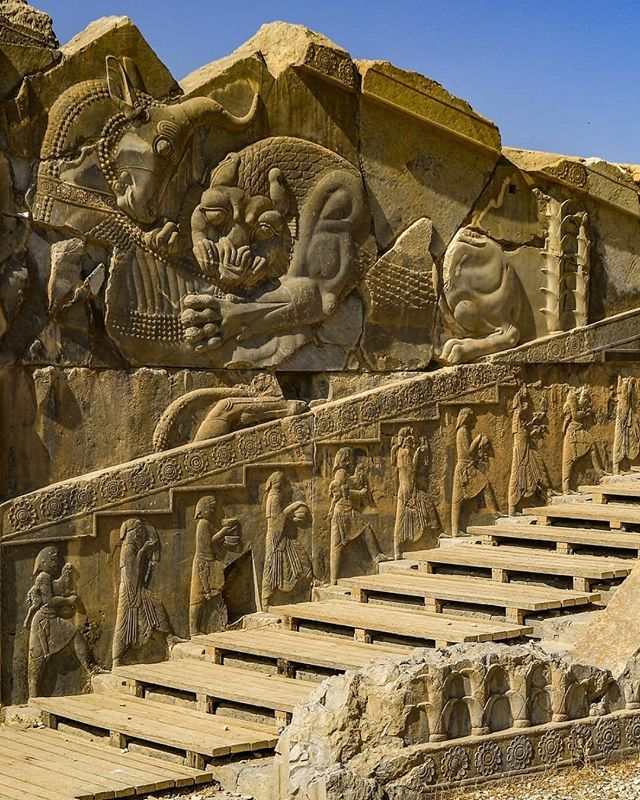
Iran is often reduced to headlines about politics.
But behind them stands one of the oldest continuous civilizations on Earth, where architecture, poetry, and faith shaped beauty for over 2,500 years.
Here’s a journey through Iran’s architectural splendor. 🧵
What about condemning an illegal military attack, without even the pretence of seeking UN approval, making a mockery of diplomacy? In what ways does all this advance European interests?
Le siècle de Carl Schmitt a-t-il commencé ?
De J. D. Vance au Parti communiste chinois, le Kronjurist du IIIe Reich n’a jamais été aussi influent.
Un entretien fleuve avec l’un de ses principaux spécialistes, Jean-François Kervégan.
Très conseillé.
https://t.co/b9PqP1Enkp
Si Guillaume Kasbarian réfléchit vraiment à partir des mécanismes de marché comme il aime le dire, alors il est un pyromane.
La vérité est que la fonction publique d'Etat en France coûte globalement moins cher qu'elle ne coûterait si ses missions étaient assurées par le secteur privé.
En voulant durcir la pénalité financière subie par le fonctionnaire malade, il rend la mission d'intérêt général encore moins attractive qu'elle ne l'est déjà. Je peux entendre une insatisfaction du public quant à la qualité du service rendu, mais il faut bien comprendre que ce que propose Kasbarian ici aura pour effet de davantage diriger les médecins hors de l'hôpital public. Sa position aurait pour conséquence que les jeunes intellectuels envisagent encore moins de devenir professeur. Il fait en sorte que nos juristes soient davantage avocats et moins magistrats. Et ainsi de suite.
On a une crise de vocation. On constate que l'externalisation coûte plus cher à l'Etat, à compétences égales. Et donc on recrute des personnes moins qualifiées ; c'est flagrant à l'école. On voit que la santé quand elle est privée n'est pas toujours le choix économique rationnel, en comparant avec l'étranger.
Mon avis est que Kasbarian se positionne politiquement avant de réfléchir aux conséquences sur le travail réalisé. Les idéologues tronçonnent en faisant des dégâts graves. Notre intérêt à tous mérite de partir d'observations ancrées dans le réel. Et franchement, il faut être sacrément déconnecté pour croire que l'école publique, par exemple, est un espace de privilèges.
Vous avez toujours rêvé d'être ministre des finances et de construire votre propre budget pour la France? ou bien vous vous inquiétez de voir la dette exploser dans quelques années?
Construisez votre propre programme de finances publiques en sélectionnant les mesures économiques ou budgétaires (dépenses ou recettes) pour stabiliser la dette publique en % du PIB.
Super initiative de @CAEinfo
lien : https://t.co/hjAymOzubV
La Terre vient d’enfanter ce qu’elle sait faire de pire. Depuis les satellites, on a probablement sous les yeux l’une des pires catastrophes météorologiques modernes.
Le cyclone #Melissa (cat. 5), souffle avec des rafales mesurées à 387 km/h à 216 m d’altitude par une sonde de la NOAA. Nan, mais j'ai bien écrit, oui, oui, 387 km/h ! C’est tout simplement le cyclone le plus violent jamais observé dans l’Atlantique.
Dans quelques minutes, la Jamaïque va être engloutie sous :
➡️une surcote de 3 à 4 mètres,
➡️et jusqu’à 750 mm de pluie,
➡️…le tout sur une population extrêmement vulnérable, avec un cyclone extrênement lent, donc destructeur plus longtemps et des reliefs favorisant les inondations.
C'est un scénario digne de Hollywood, on ne peut pas faire pire.
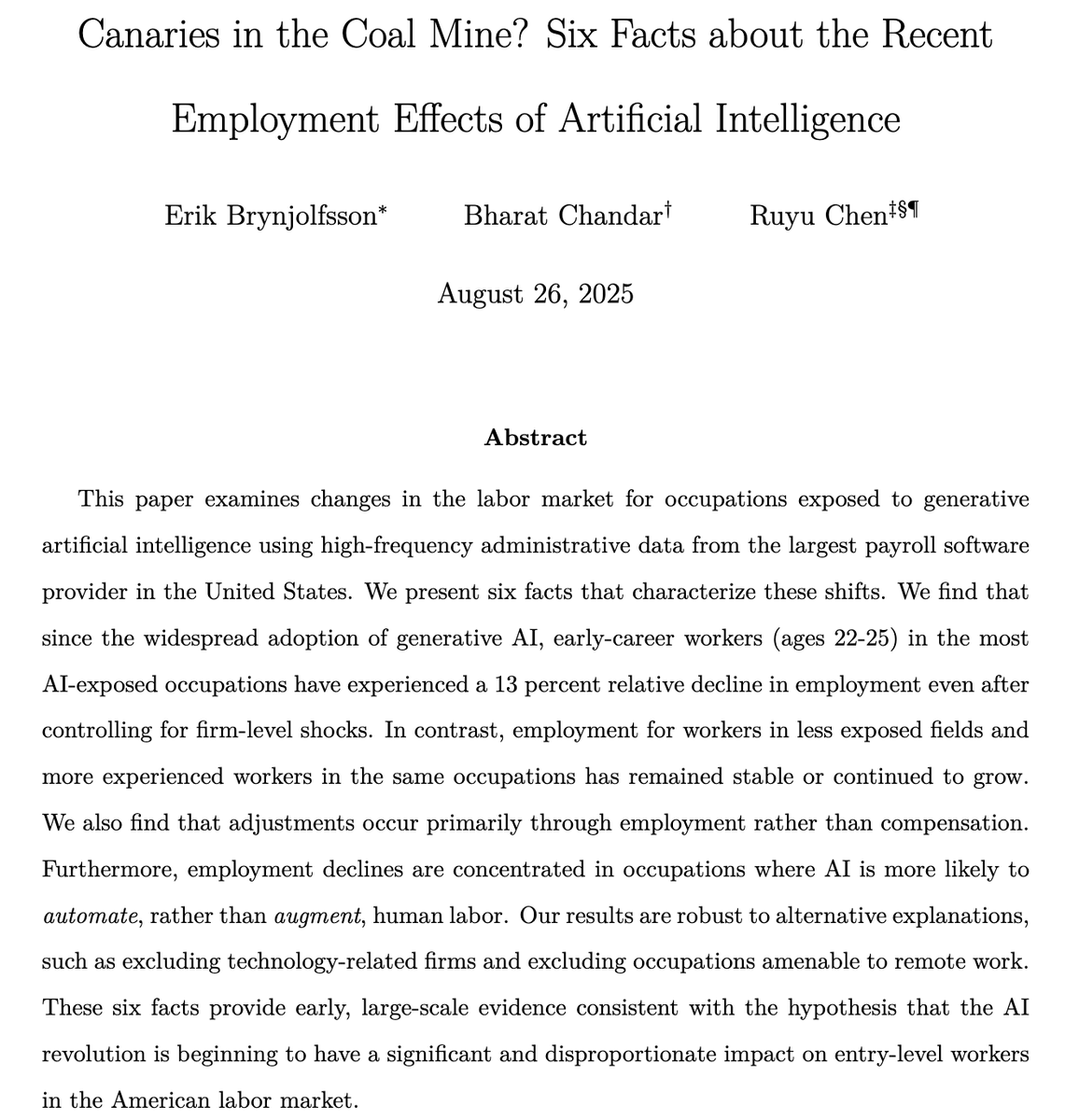
Is AI already impacting the job market?
A new paper from me, @erikbryn, and @RuyuChen at @DigEconLab digs into data from ADP.
We find some of the ***first large-scale evidence of employment declines for entry-level workers in AI-exposed jobs.***
A thread on our paper:
À voir ce documentaire de @ARTEfr sur l'histoire de la minorité d'extrême droite suprémaciste qui contrôle la politique israélienne avec le Likoud de Netanyahu. Des fanatiques racistes et extrêmement violents
https://t.co/oBX7oBqj5T