Here is an App for Parents who have children in daycare centers. Daycare link is designed to give childcare providers a way to keep track of kids' needs -- and parents peace of mind while keeping them informed throughout the day.
[ICYMI] PetroSA is fighting for its survival after a former business partner, Nako Energy, applied to have the struggling state-owned petroleum company liquidated over R606-million in unpaid fuel bills.
But court papers filed in October reveal another side to the dispute: Nako itself owes PetroSA R833-million for a cargo of diesel it bought and never paid for. If the two debts were offset, Nako would actually owe PetroSA R227-million.
So why did PetroSA spend 18 months doing seemingly nothing to recover the money? And why did it continue awarding business to Nako, even after Nako's financiers began demanding payment?
The dispute stems from a controversial fuel deal that left PetroSA struggling to sell petrol containing the chemical additive N-methylaniline (NMA). After motorists complained that the fuel was staining their vehicles, major fuel companies refused to buy more of the product.
PetroSA's own court papers acknowledge that the deal damaged its reputation and cost it customers.
Yet despite these problems, PetroSA continued trying to do business with Nako. In October 2025, it requested another petrol delivery. In December, it appointed Nako to supply diesel in Durban, even though lawyers representing Nako's financiers had already demanded payment of PetroSA's outstanding debt.
It was only after Nako launched liquidation proceedings that PetroSA indicated it would consider taking steps to recover the R833-million it was owed.
And all of this is happening against the backdrop of a deepening financial crisis at PetroSA, which owes SARS R5.1-billion and, by amaBhungane's estimate, could owe creditors around R10-billion in total.
In this analysis, we examine the increasingly bitter dispute and the extraordinary lengths PetroSA went to accommodate its former partner, even as it failed to recover hundreds of millions of rands while facing mounting pressure from its own creditors.
Read @SAJournalist’s latest analysis: https://t.co/GPrlFgmLQN
We are deeply sorry for the disruption this incident has caused our customers and partners. We know the trust they place in our services and take that responsibility extremely seriously. We are seeing broad recovery and stability across our services.
This was a technical issue not related to cyber or AI / agents. The incident was introduced by an issue during an earlier network capacity upgrade that surfaced following a recent network change. We have addressed the underlying issue and continue to restore service to remaining customers and regions.
Given the scale of demand, we restored services gradually, validating stability at each stage. While this took longer, it helped ensure a stable restoration.
We will provide a full post-incident report once our review is complete.
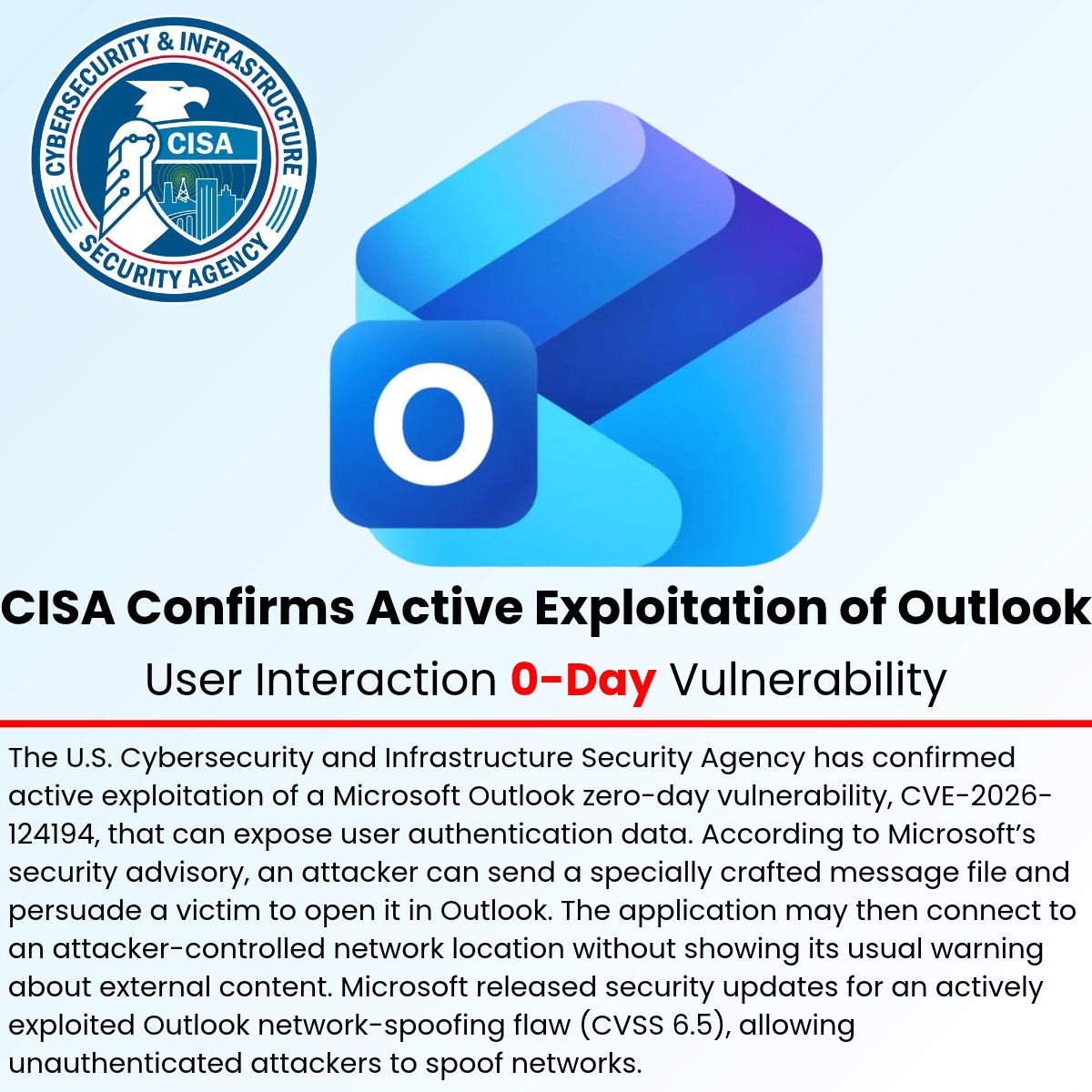
‼️ CISA Confirms Active Exploitation of Outlook User Interaction 0-Day Vulnerability
Details: https://t.co/9hqn7XHeqI
The U.S. Cybersecurity and Infrastructure Security Agency has confirmed active exploitation of a Microsoft Outlook zero-day vulnerability, CVE-2026-124194, that can expose user authentication data.
According to Microsoft’s security advisory, an attacker can send a specially crafted message file and persuade a victim to open it in Outlook.
The application may then connect to an attacker-controlled network location without showing its usual warning about external content. Microsoft released security updates for an actively exploited Outlook network-spoofing flaw (CVSS 6.5) that allows unauthenticated attackers to spoof networks.
#CybersecurityNews
CEO of the Year has a nice ring to it.
Congratulations to AMD Chair and CEO @LisaSu on this well-deserved recognition from @YahooFinance! 👏
https://t.co/t8dQGksoxp