MD, endocrinologist, striving to improve & save lives. working in pharma. Born and raised in Lisbon Portugal, in love with Asia and living in Switzerland!
📢 New Research Alert: Does Baseline Cardiovascular Risk Influence the Benefit of LDL-C Lowering in Primary Prevention?
A new systematic review and meta-analysis challenges conventional thinking about LDL-C lowering in primary prevention, demonstrating that the relative benefit of pharmacologic LDL-C reduction may actually be greater in lower-risk populations.
Key findings:
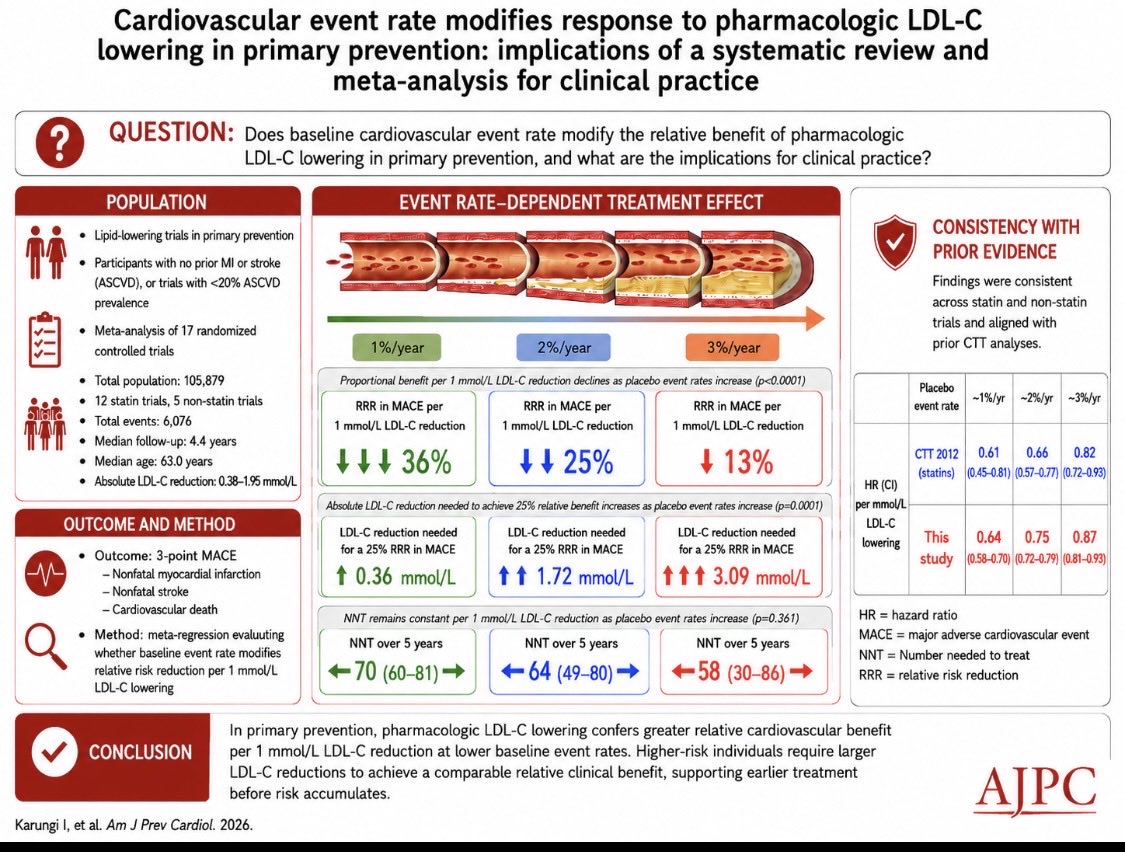
🔹 Analysis of 17 randomized trials involving more than 105,000 participants found that the relative risk reduction (RRR) associated with each 1 mmol/L reduction in LDL-C was substantially greater in lower-risk populations than in higher-risk populations.
🔹 At an annual cardiovascular event rate of 1%, a 1 mmol/L LDL-C reduction was associated with an estimated 36% reduction in major adverse cardiovascular events, compared with 13% at a 3% annual event rate.
🔹 Higher-risk populations required substantially larger absolute LDL-C reductions to achieve comparable relative benefits.
🔹 The findings support consideration of earlier LDL-C lowering strategies before cardiovascular risk becomes established.
These results add to the growing body of evidence that cumulative LDL-C exposure matters—and that earlier intervention may yield meaningful long-term cardiovascular benefits.
📖 Read the article: https://t.co/Jt5y1QGfqa
#PreventiveCardiology #LDLCholesterol #PrimaryPrevention #ASCVD #LipidManagement #CardiovascularPrevention #CardiologyResearch #Cholesterol #HeartHealth #EvidenceBasedMedicine
Open Letter
To the President of the Russian Federation
From the President of Ukraine
When you came to power in Russia more than 26 years ago, many people in Ukraine viewed you positively. That is how it was. But that is now in the past.
Now, the overwhelming majority of Ukrainians view it positively that our long-range drones paid a visit to the opening of your forum in St. Petersburg, covering a distance of more than 1,000 kilometers. As you know very well, that distance is not the limit of our capabilities.
⚡️'Enough of the war' — Zelensky throws down gauntlet to Putin in open letter.
"Almost half of your 26 years of power in Russia you have spent in the war against Ukraine...This war is your personal choice...This is how history will remember it."
https://t.co/c8fyr2xuJE
Can Earlier LDL-C Lowering Change the Trajectory of Cardiovascular Disease?
https://t.co/eVDmXuZrsT
A thought-provoking simultaneous publication new @ProfKausikRay published in @AJPCardio presented at @society_eas yesterday revisits one of the central questions in prevention:
Are we intervening too late?
Using data from 17 randomized lipid-lowering trials involving more than 105,000 participants, Karungi and colleagues examined how the relative cardiovascular benefit of LDL-C lowering changes across different baseline risk levels.
The findings are intriguing.
1. Contrary to the traditional assumption that lower-risk individuals derive only modest benefit, the investigators observed that relative risk reduction per 1 mmol/L LDL-C lowering was actually greater in lower-risk primary prevention populations.
2. In trial populations with annualized event rates around 1% per year, each mmol/L LDL-C reduction was associated with roughly a 36% relative reduction in events, compared with approximately 13% in populations with event rates near 3% per year.
The paper bring to light an important conceptual framework.
1. As atherosclerosis advances, larger LDL-C reductions may be required to achieve the same proportional benefit.
2. In lower-risk and presumably earlier-stage disease, even modest LDL-C reductions may yield meaningful relative risk reduction.
This shifts the discussion from simply “who is high risk today?” toward a broader life-course perspective:
1. Are we waiting long before intervening?
2. Can modest but earlier LDL-C lowering alter cumulative vascular exposure before disease becomes biologically irreversible?
3. Should early primary prevention become more central to our prevention frameworks?
I think the implications extend beyond statins alone. For the future we need to think around long-duration therapies, , AI-guided risk prediction, imaging-guided prevention, and cumulative LDL exposure increasingly points toward a future where prevention may begin earlier, become more personalized, and focus more on preserving vascular health before advanced disease develops.
@ASPCardio@rblument1
“The higher the risk, the greater the LDL-C reduction required.”
Excellent presentation by Kausik Ray at the NLA–EAS Joint Session on Primary Prevention.
A key message: while the relative benefit of LDL-C lowering may attenuate as baseline risk increases, achieving meaningful absolute risk reduction requires progressively larger LDL-C reductions.
🔹 Earlier intervention
🔹 Lower LDL-C levels
🔹 Combination therapy when needed
🔹 Better implementation of guideline recommendations
In lipid management, intensity should match risk.
@society_eas@ProfKausikRay@nationallipid
Trial evidence from 17 trials in people without ASCVD including statins and non statins in 105 000 individuals about why you get a bigger benefit from starting prevention early . AJPC open access
Since last night, first responders and all necessary services have been working wherever needed. As of now, at least 83 people have been confirmed injured since midnight. Tragically, there are fatalities. My condolences to the families and loved ones.
It was a heavy attack – 90 missiles of various types, many of them ballistic missiles – 36 in total. There were 600 drones. Unfortunately, not all of the ballistic missiles were intercepted – the largest number of hits was in Kyiv. Kyiv was the primary target of this Russian attack.
Putin can’t even pronounce the word “hurrah” clearly anymore – slurs and mumbles – yet he is still vanquishing residential buildings with his missiles. Launched three Russian missiles against a water supply facility. Burned down a market. Damaged dozens of residential buildings. Hit several ordinary schools. Launched his “Oreshnik” against Bila Tserkva. They really are unhinged.
It is important that this does not pass without consequences for Russia. Today, everyone in the world who will not stay silent and chooses to help Ukraine is a defender of life. It is critically important to continue working to secure air defense for Ukraine, especially anti-ballistic capabilities.
We are doing our best to achieve peace and protect people – everything. It is important that Ukraine is not alone. Decisions are needed – from the United States, from Europe and others – to make that old “Oreshnik” in Moscow finally utter the word “peace.”
Hungary has chosen Europe.
Europe has always chosen Hungary.
A country reclaims its European path.
The Union grows stronger.
Magyarország Európát választotta.
Európa mindig Magyarországot választotta.
Egy ország visszatér az európai útjára.
Az Unió erősebbé válik.
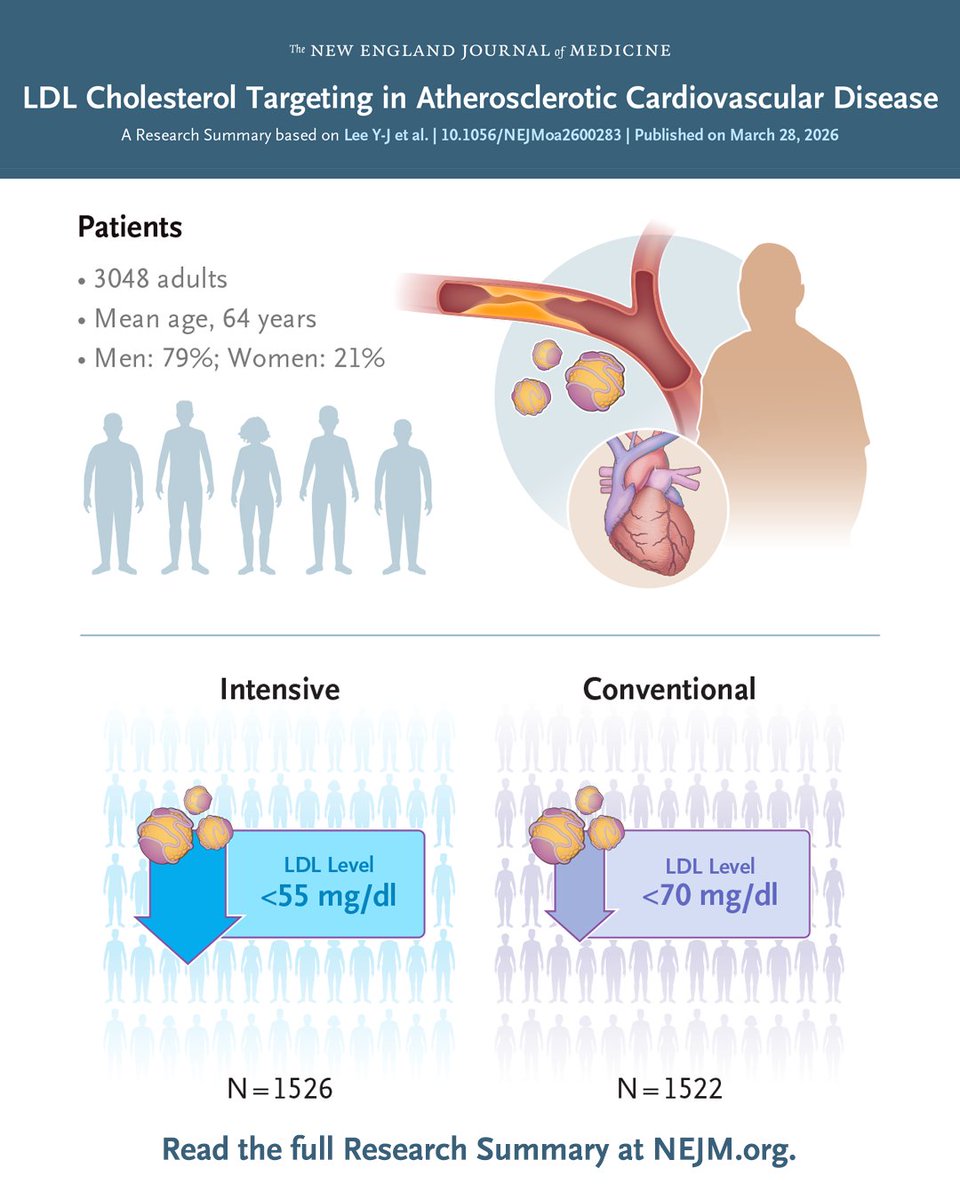
Among patients with atherosclerotic cardiovascular disease, targeting an LDL cholesterol level below 55 mg per deciliter led to a lower 3-year risk of cardiovascular events than targeting a level below 70 mg per deciliter. Full Ez-PAVE trial results and Research Summary: https://t.co/q0vNdAoJJL
When the whole world learned about Bucha. About Ukrainians butchered in the streets of Bucha by Russian occupiers. About our people tortured in basements. About those shot on the roads. About adults and children whose bodies were found in graves in Bucha. Everyone saw the horror that Russia and its aggression bring. They saw what Ukraine is really defending itself against.
Today, on the fourth anniversary of Bucha’s liberation from Russian occupiers, we honored the memory of Ukrainians who were killed and tortured there. We remember and will never forget what the enemy did. Every Russian murderer, executioner, and terrorist must be held accountable for every crime against our people.
Blessed be the memory of everyone whose lives were taken by Russia – to all who were killed in Bucha and across Ukraine at the hands of Russian occupiers.
Our latest video in our partnership with @DGlaucomflecken summarizes the CORALreef Lipids trial, which assessed the efficacy of the oral PCSK9 inhibitor enlicitide in reducing LDL cholesterol levels over a 52-week period. Read the full study for free: https://t.co/gdOma6MC6H
#cardiology
Implementation science is complicated and not all ideas pass the test. I predict that @AnnMarieNavar’s country/rap song will have the greatest efficacy for implementation ever! I just can’t stop watching it 😊🫀💪❤️
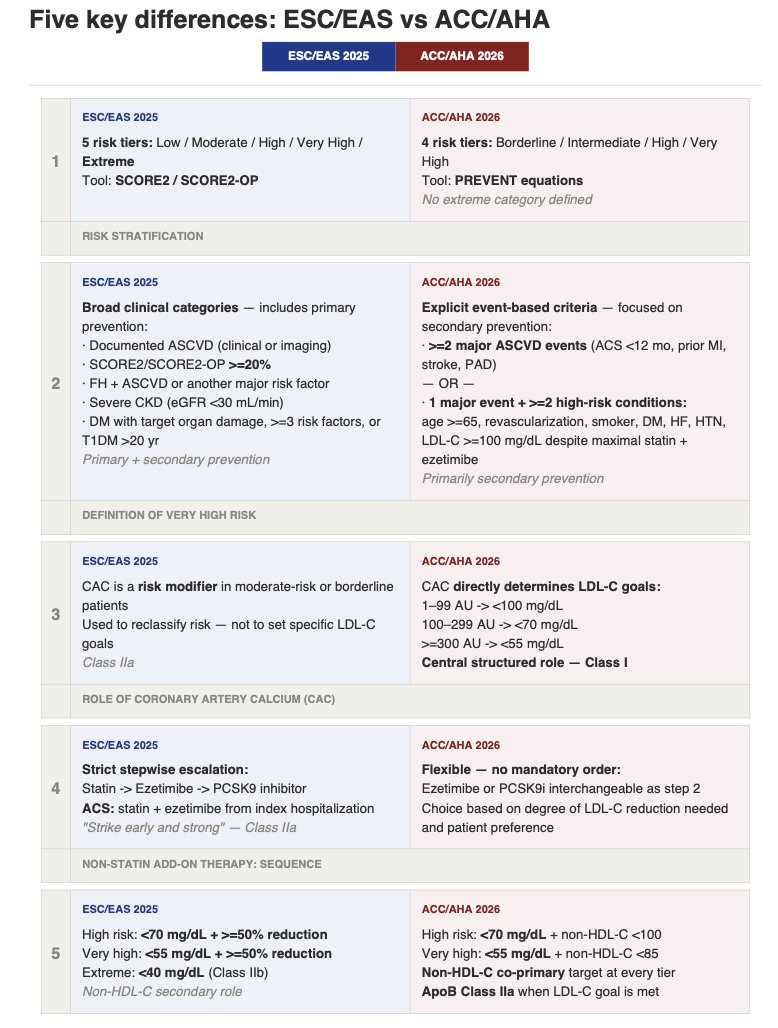
We got new guidelines baby!
🇪🇺ESC/EAS (2025) vs 🇺🇲ACC/AHA (2026):
👉 Where They Differ—and Where They Converge
1️⃣ Risk stratification
2️⃣ Definition of very high risk
3️⃣ Role of coronary artery calcium (CAC)
4️⃣ Non-statin add-on therapy
5️⃣ LDL-C treatment goals
@society_eas@escardio@LipidJournal@ATHjournal@ACCinTouch@American_Heart
Want to know my most important takeaways from the new 2026 Cholesterol Guidelines? Set to music, of course. @AHAScience@ACCinTouch@ASPCardio
Clip here- Full song at the link-
https://t.co/DaYl6rZs7B
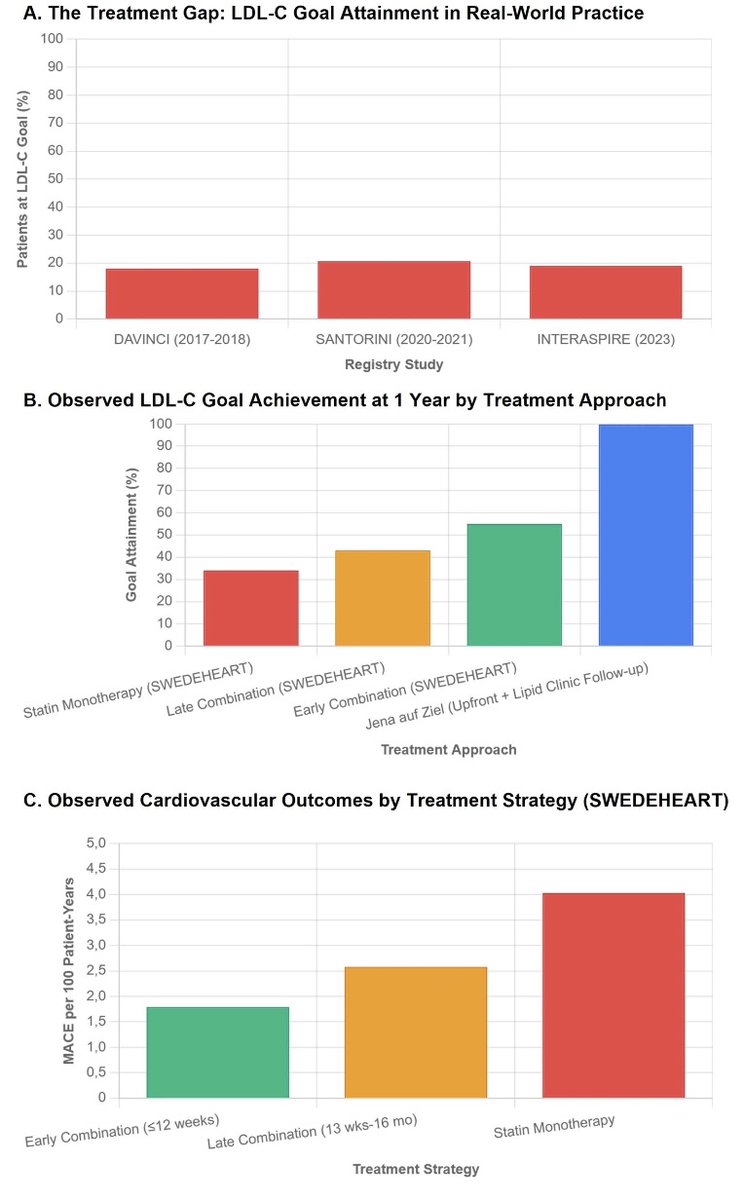
👉 Combination Lipid-Lowering Therapy After ACS: Should this be the New Standard of Care?
👆 LDL-C reduction after ACS shows a log-linear relationship with CV risk reduction, regardless of the drug used. Lower is better. Earlier is better.
👆 Guidelines have moved: ESC/EAS and ACC/AHA now endorse earlier and deeper LDL-C lowering, including upfront combination therapy in selected (or many) patients.
👆 Real life hasn’t caught up: <20% of post-ACS patients reach LDL-C <55 mg/dL. The stepwise “wait-and-see” model fails—predictably.
📍 Evidence is consistent:
IMPROVE-IT, RACING, LODESTAR → combination therapy works, is safe, and improves goal attainment.
ODYSSEY OUTCOMES, FOURIER → add PCSK9 inhibition and events drop further, especially when started early.
📍 Imaging doesn’t lie: PACMAN-AMI and HUYGENS show faster plaque regression and fibrous-cap thickening with early intensive therapy.
📍 Registries (SWEDEHEART, INTERASPIRE): early statin + ezetimibe beats late intensification or statin alone—both for LDL-C targets and hard outcomes.
👆 Fear of “too low LDL-C” is obsolete: benefits persist down to ~20 mg/dL, with no signal for harm. Cholesterol biology is robust; atherosclerosis is not.
📍 Bottom line:
After ACS, default early combination therapy (high-intensity statin + ezetimibe) is not aggressive—it’s rational. Precision medicine is great, but undertreatment kills first.
🔗 Open Access https://t.co/AkTlEYCnyg
@society_eas