“Our politics, religion, news, athletics, education and commerce have been transformed into congenial adjuncts of show business, largely without protest or even much popular notice. The result is that we are a people on the verge of amusing ourselves to death.”
Neil Postman.
The FIRE flywheel lit up. Fees started flowing.
Next: the engine gets calibrated — to reward the people who hold it together.
The final phase of setup is almost here☀️
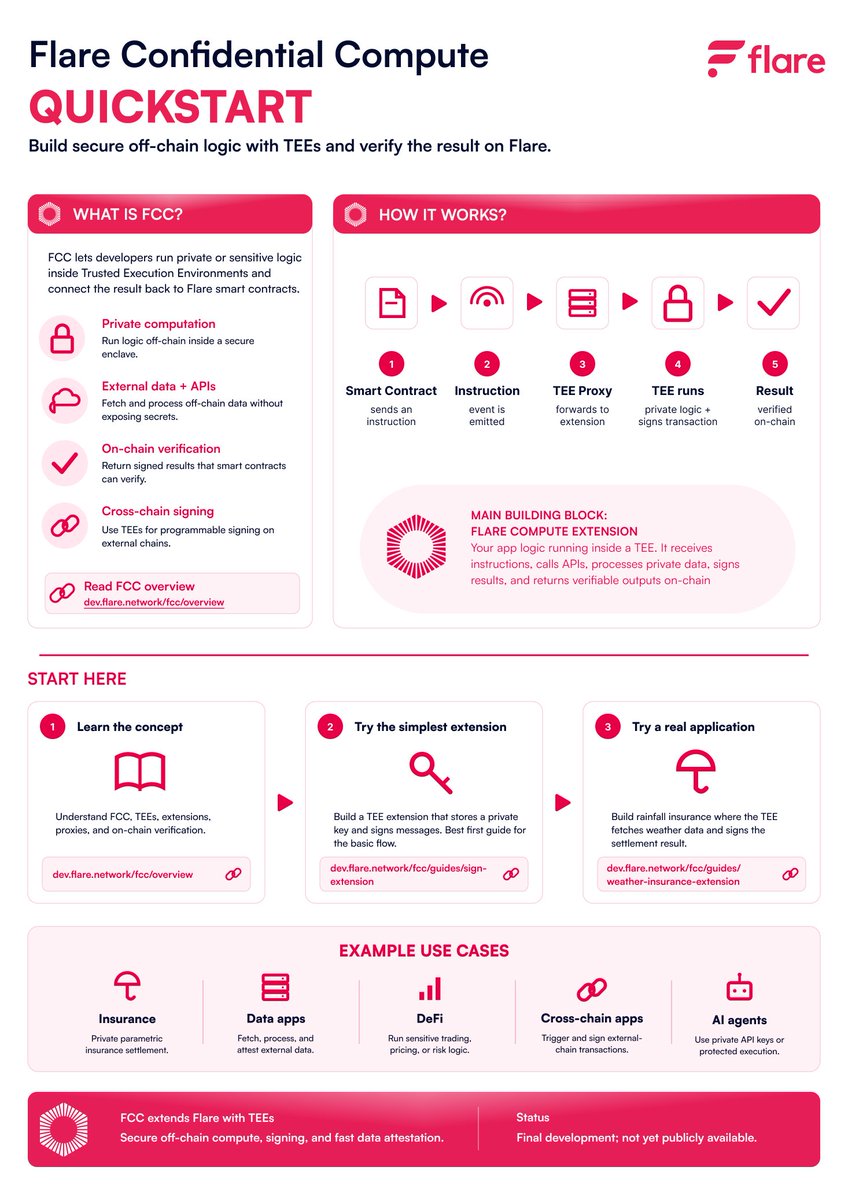
Flare Confidential Compute wasn't an overnight success. It is still in the final development phases and available on the Coston2 test network; here is a quickstart guide for you.
I can guarantee that pretty much any dApp can move its centralized component to a decentralized TEE, which I am already seeing.
Cycles are interesting in that they have zero regard for reality. Vs even 1 year ago Flare is in an inconceivably better utility position. More is coming with Flare 2.0, further expansion of XRPFi, the coming onboarding of meaningful institutional partners (finally), FSA is working to abstract away complexity, FIRE and FIP16 change the token economics for the (vastly) better. And those are just the things that we can discuss publicly. Almost everything we have set out to do is being done (barring adding more FAssets - in the works) and by and large it’s working.
But if you look at the whole crypto market you would think the whole industry is finished - despite more institutional interest and greater clarity than ever before.
Unfortunately cycles are a fact of life, even Amazon had a 94% peak to trough drawdown when the .com cycle burst - but the internet didn’t go away nor did Amazon and neither will crypto and certainly not Flare - which presents more utility than almost anything else in the market.
Every cycle teaches the same lesson, and every time we forget it: near the bottom it always feels like the end, but it never is.
I believe that we're closer to the turn than the mood would have you believe. The roadmap ahead is the thing we're here for. At Flare we trust in the process to ship great product - knowing that is the only true path to winning. Flare will emerge from this brutal winter fighting fit and offering more than ever for the next cycle.
Honest question for the trenches:
How are you guys surviving these days?
InfoFi looks dead, airdrop campaigns are quiet, liquidity is thin, and I’m genuinely wondering where people are finding opportunities right now.
⚠️ Security Alert: Firelight only has one official X account: @Firelightfi, and one official Discord: https://t.co/kIBhoFF64f.
Any other accounts, websites, or groups claiming to represent Firelight are impersonators and scams.
Verify links through our official channels.
Excited to partner with @Kiln_finance on @railnet_org . We have seen this project since the beginning and are excited about being part of the next phase to bring more institutions into DeFi.
Over $1B vanished from DeFi protocols last year.
This isn't the 'cost of business', it's the #1 barrier keeping institutional capital on the sidelines.
Serious funds need guarantees.
We're providing the institutional-grade layer, turning DeFi into an insurable asset class.
Project @Firelightfi takes inspiration from (re)staking platforms like EigenLayer and Symbiotic—but we’ve made some deliberate departures.
(Re)staking has been a clever architectural idea: reuse staked capital to bootstrap new forms of network security. But as the cycle matured, the model has struggled to meet its original promise. Why?
Cost of capital. Restaked ETH competes with ETH’s native staking yield. If you’re taking on incremental risk, the incremental yield must clear a higher bar—and too often (re)staking rewards trade below plain staking. That math simply doesn’t scale.
Viable use cases. “Borrowing” security is interesting, but adoption has been thin. Many potential consumers of that security are early-stage and can’t afford it; technical integrations remain complex and limited, which narrows the surface for real demand.
Layer on top the points fatigue—long, open-ended campaigns that trained expectations but under-delivered at TGE—and you get a model that needs recalibration. That’s an execution problem as much as a design one, but it still matters.
Firelight’s approach: keep what works, change what doesn’t. We target assets with a lower cost of capital (e.g., XRP, XLM) and focus on a single, high-conviction application: DeFi cover/insurance. Instead of being a generic “security marketplace,” we’re laser-focused on underwriting and protecting tier-one DeFi markets—where demand is tangible and risk modeling actually matters. And on incentives: we’ll keep points programs short, transparent, and tied to real participation—no endless gamification loops.
We’ll face our own challenges, no doubt. But we’re choosing different input variables: cheaper capital, a narrower scope, deeper integrations, and concrete deliverables. If (re)staking was a great prototype for reusing trust, Firelight is our attempt to productize that insight where it can create immediate, defensible value—coverage that DeFi actually needs.