$blne
Top news here 👀
RWA play $sol - real estate
Beeline Signs LOI to Acquire TYTL, Expanding into Blockchain-Based Residential Equity
https://t.co/8gzKmz4vpI
Tech stack merger, cash flow positive within a quarter should this non binding LOI complete
$rkt
$XRP
New interview with the CEO of $BLNE, Nick Liuzza.
The conversation is with the Loft 100 Studios team, who produced the "Bizumentary" on the company, released this week.
Nick mentions the TYTL transaction is progressing well, with "news...soon" 👀
https://t.co/smjRbqUfGF
Wake up, folks. Commodities are telling you something, and yesterday the Treasury confirmed it.
Scarcity in the physical world. Repression in the financial one.
Scarcity pushes prices up. Repression holds yields down. The gap between them is the debasement.
Commodities are the only asset class that wins on both sides.
The structural case for commodities has been turbo charged. Underinvestment, deglobalization and electrification all pushing markets like diesel cracks and copper to new highs.
Meanwhile the chokepoints are increasing, from Hormuz to the Red Sea, the Rhine, the Panama Canal, the Black Sea grain corridor and Russian refining capacity. It is becoming increasingly apparent that not a single one of those is reachable by anything in Washington's toolkit whether it be caused by war or weather.
The illusion of abundance is likely behind us. I said as much on CNBC this Monday, and I got long gold, silver and agriculture last week.
Ten points for you to consider. (1/11)
TYTL may have just filed one of the most important breadcrumbs yet for $BLNE.
Yesterday, the company $BLNE is under LOI to acquire filed a $1 BILLION REG D 506(c) offering built around $5M minimum investments and institutional capital commitments.
Even more interesting, TYTL lists Beeline’s headquarters as its address. 👀
The dots are getting easier to connect.
This is bigger than home equity financing. $BLNE and TYTL are building the rails for institutions to invest directly into fractional, tokenized residential home equity at scale.
This has the potential to become an entirely new institutional asset class.
The product and technology is ready. The transaction rails exist. Now the institutional funding vehicle exists.
If the acquisition closes as planned and capital starts flowing, this could be the inflection point where the $BLNE story stops being about potential and starts being about scale.
And if that happens, the entire $BLNE story changes overnight.
I am positioned for it.
https://t.co/ciB9yWxGWx
At the American Mining Roundtable, earlier today @realDonaldTrump and the @DeptofWar confirmed their commitment to invest $400 million into the Syerston Scandium Project in Australia.
Syerston has one of the world’s largest and highest-grade scandium resources. The project will bring a new source of low cost, scalable and reliable supply of scandium to western markets.
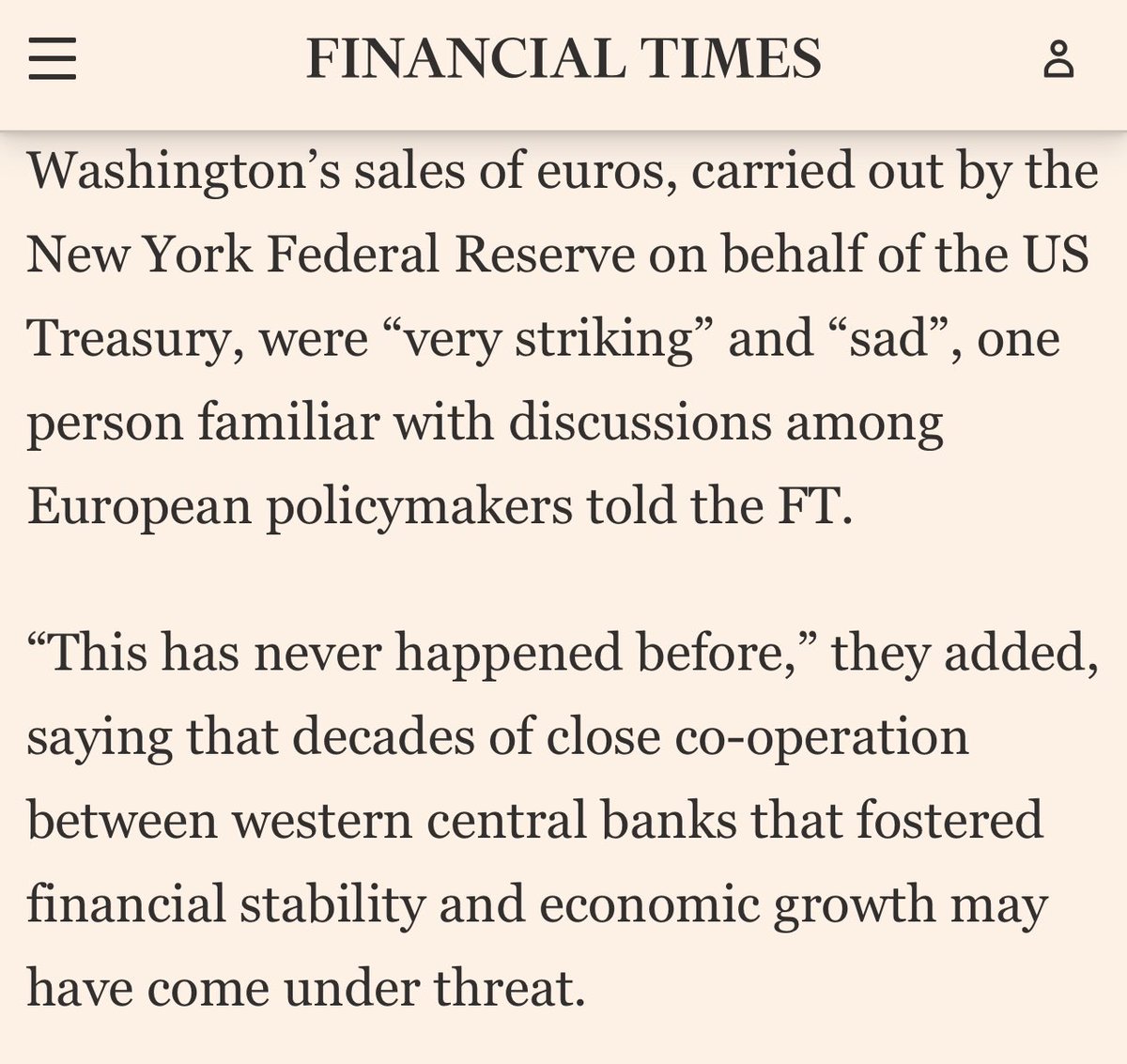
The United States sold euros to buy yen without telling the ECB until after the trade was done. Senior ECB officials called it “an unprecedented breach of longstanding conventions.” One said: “This has never happened before.”
Selling dollars to defend the yen would have contradicted Bessent’s strong-dollar policy. Selling euros avoided that problem. But selling a European asset to defend an Asian currency to protect an American bond market, without consulting the institution whose asset was sold, is not a currency intervention. It is the reserve architecture consuming the alliance architecture.
The reason Washington intervened at all is the part nobody wants to say plainly. Japan is the largest foreign holder of US Treasuries. The yen was at its weakest since 1986. If the yen falls far enough, Japanese institutions sell their most liquid foreign asset to raise cash. That asset is Treasuries. The selling pushes American yields higher at the exact moment the thirty-year just touched 5.28 percent. Washington did not intervene to help Japan. Washington intervened to prevent the Treasury market from absorbing a forced seller at a nineteen-year high in yields.
The convention that was broken to execute this trade is the same kind of convention the reserve confiscation broke in 2022. That one taught central banks their dollar reserves were not safe from seizure. This one taught the ECB that dollar-system cooperation is not safe from unilateral action by its architect. Both lessons point the same direction: build the alternatives faster.
The fix is eating the architecture it was built to preserve.
Aug 4 (Reuters) - @LockheedMartin is in talks to buy supplies of two critical minerals from U.S. mines, two sources familiar with the discussions said, as President Donald Trump pressures defense contractors to cut reliance on China.
The world's largest defense contractor is negotiating with @NioCorp for supply of scandium, and @TeckResources and 5N Plus for supply of germanium, both of which are used in military equipment ranging from aircraft components to infrared sensors, the sources said. $NB $TECK $VNB
In 2018 I attended a strategy meeting involving representatives from several large American banking institutions.
Ripple and the XRP Ledger were already on the radar. Their potential to compress settlement times and reduce the need for prefunded liquidity was understood inside banking circles long before the public began discussing it.
What concerned some institutions was not the technology itself but the pace at which an external infrastructure provider could begin influencing core payment rails.
I remember reading the meeting minutes afterward. One section discussed regulatory pressure and market narrative as tools that could be used if and when Ripple’s influence reached a certain threshold. In plain terms, the view was that if the technology became too disruptive too quickly, institutions would lean on regulatory channels to slow it down.
That is not unusual in banking. Incumbent systems defend themselves. It is part of how large financial networks evolve.
What stayed with me was the emphasis on timing. The document suggested that such pressure would only be applied once adoption, visibility, and institutional exposure reached a point where intervention would be effective.
Looking at the environment today, I cannot help but notice that many of those conditions appear to be aligning again.
You may not like hearing that. But from where I sit, it would not surprise me if Ripple faces another wave of regulatory and institutional assault.
When a technology begins to challenge entrenched financial infrastructure, resistance is not the exception.
It is the rule.
@mrnguyen007
Many people assume wealth if Clarity Acts passes and retire.
What do you believe the upside is?
Personally, I think institutions will fade the news. Am I wrong?
So what are average investor expectations?
$XRP $SOL $ETH $BTC
@mrnguyen007
Many people assume wealth if Clarity Acts passes and retire.
What do you believe the upside is?
Personally, I think institutions will fade the news. Am I wrong?
So what are average investor expectations?
$XRP $SOL $ETH $BTC
When President Trump sign the clarity act into law.. 📃 🖊 🇺🇸
It is the time I say goodbye to all my friends and followers around the world.. 🌎
XRP got true clarity in the USA 🇺🇸
I will retire this account in X..
God bless you & your families..
I ❤️ you..