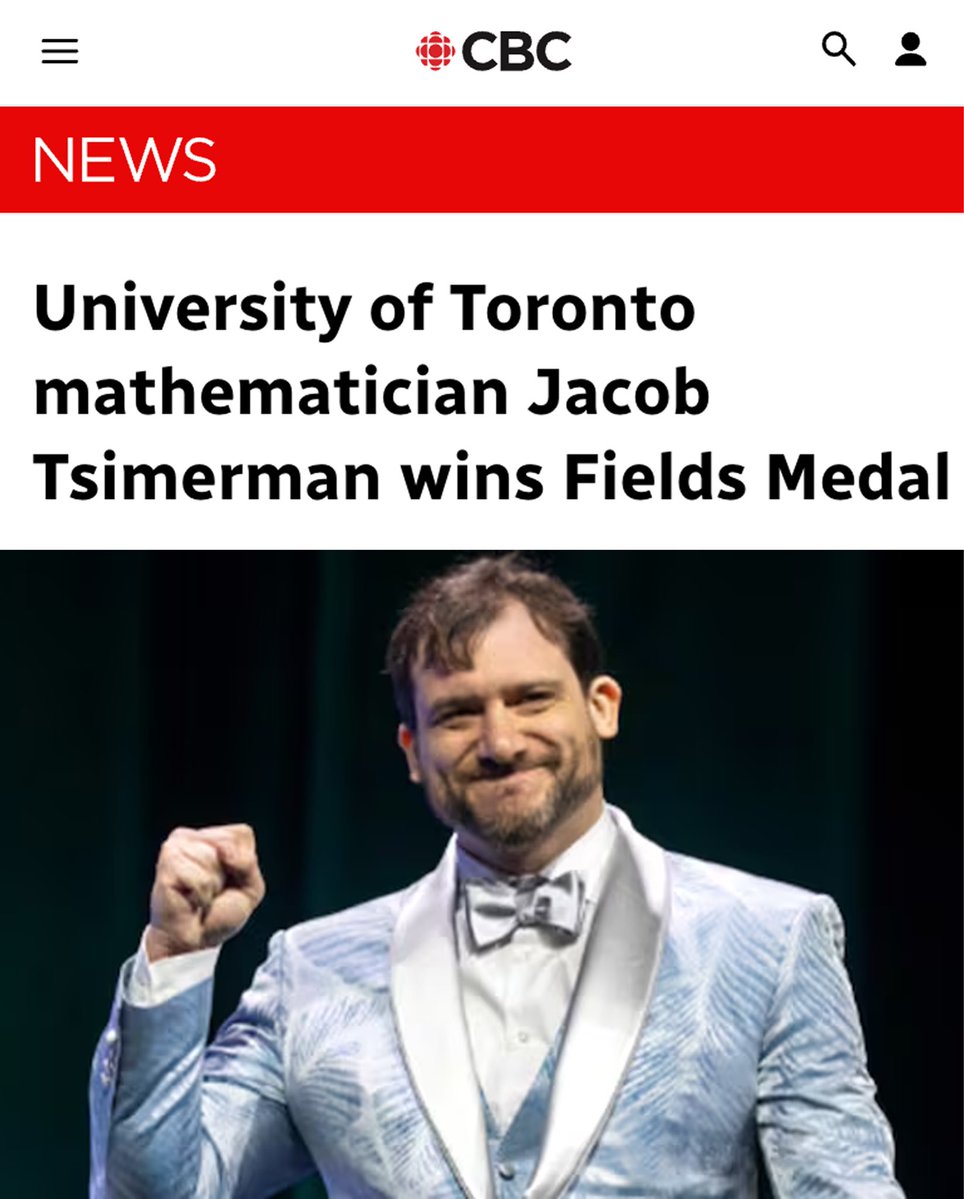
Huge congratulations to Professor Jacob Tsimerman of the University of Toronto on receiving the Fields Medal — one of the highest honours in mathematics.
Nearly a century after Canadian mathematician J.C. Fields established this award in Toronto, it comes home.
Congratulations to the winners of the 2026 Fields Medals. Canada can be especially proud of @UofT professor Jacob Tsimerman who is the very first researcher at a Canadian university who has received this honour, the “Nobel Prize” of mathematics.
Bilim Akademisi Genç Bilim İnsanları Ödül Programı (BAGEP) 2026 sonuçları açıklandı!
2013’ten bu yana verilen 513 ödüle 37 yeni ödül ekleniyor.
#BAGEP2026
Kazananlar, ödül töreni ve destekçiler için: https://t.co/3OoeIWsRok
Every now and then I remember the time my mechanical engineering professor in college, a native Greek, apologized for taking a month to return our midterm grades by saying, "the reason is, you see, my TA, he is a Turk."
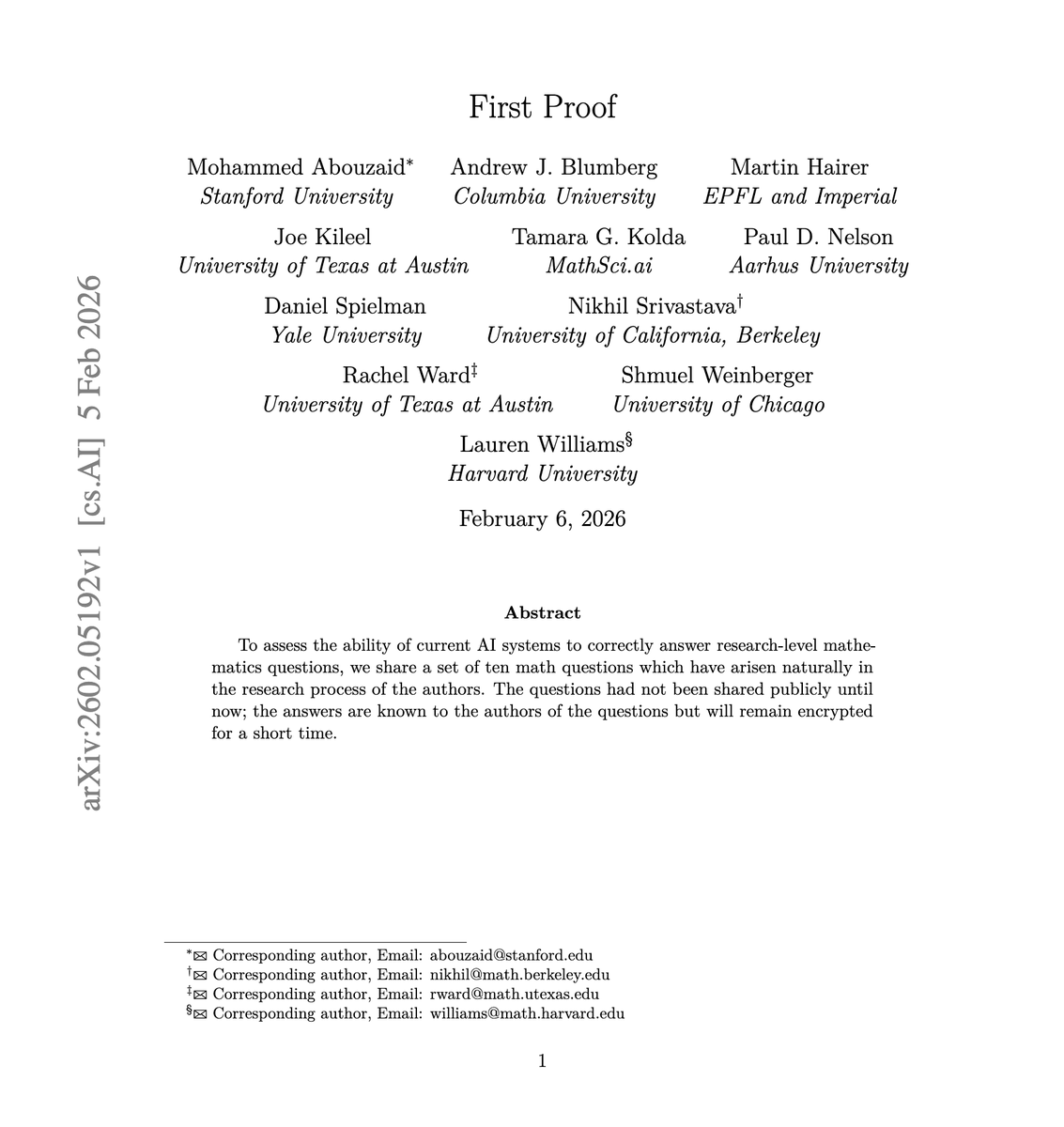
"First Proof"
A team of researchers proposes a way to test if AI can actually do NEW math by releasing 10 freshly-solved and never public research questions, with answers temporarily encrypted.
This let's the community able to measure the genuine performance of LLMs on proof-generation, before their solutions drop.
Questions include:
- stochastic analysis
- p-adic representation theory
- algebraic combinatorics
- spectral graph theory
- equivariant algebraic topology
- lattices in Lie groups/topology
- symplectic geometry
- tensor algebraic relations
- numerical linear algebra
"Hastalık Boğaziçi’nde başlayıp, Boğaziçi’nde bitmiyor elbette. Koyun gibi yaşamayı reddeden her insan, sürüye dönüşmeyi reddeden her kurum bundan nasibini alıyor"
Betül hocanın yazısı:
[Matematik de çökmez, Üniversite de!] https://t.co/qB8avWfKqs @bianet_org
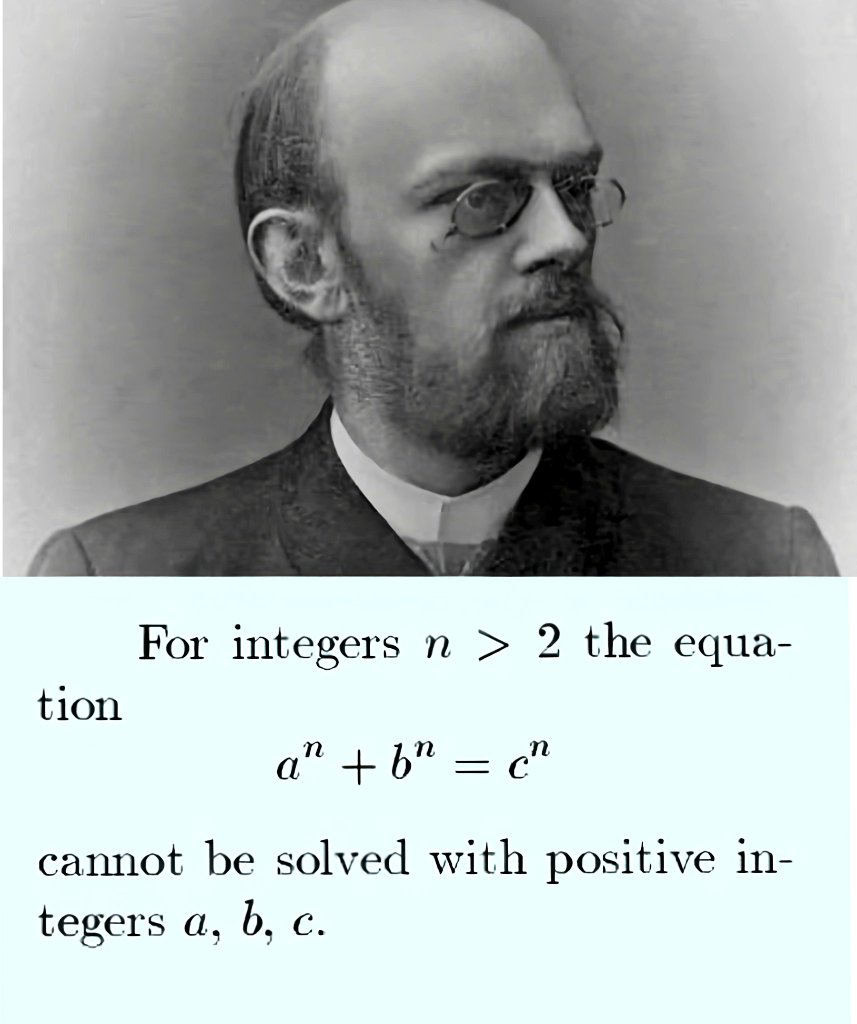
David Hilbert (1862–1943) was invited to a certain university to give a lecture.
He was told to speak on any subject that suited his fancy. He announced that he would speak on “The Proof of Fermat’s Last Theorem.”
Certainly his prospective audience was enchanted and thrilled, because no proof of this famous theorem was known to exist. It is safe to say that the event was much anticipated.
The great day arrived, and the room was packed. Hilbert delivered his lecture, but it had nothing whatever to do with Fermat’s last theorem.
Afterward, someone had the temerity to ask why the great man had chosen a title that had nothing at all to do with the subject matter. “Oh,” said Hilbert. “That was just in case the plane went down.”
Source: Mathematical Apocrypha: Stories and Anecdotes of Mathematicians and the Mathematical by Steven G. Krantz
Bilim Akademisi Genç Bilim İnsanları Ödül Programı (BAGEP) 2026 başvuruları açıldı!
Son gün 23 Ocak 2026.
Detaylar ve başvuru formu bağlantıda.
https://t.co/Y7N5aM1NzQ
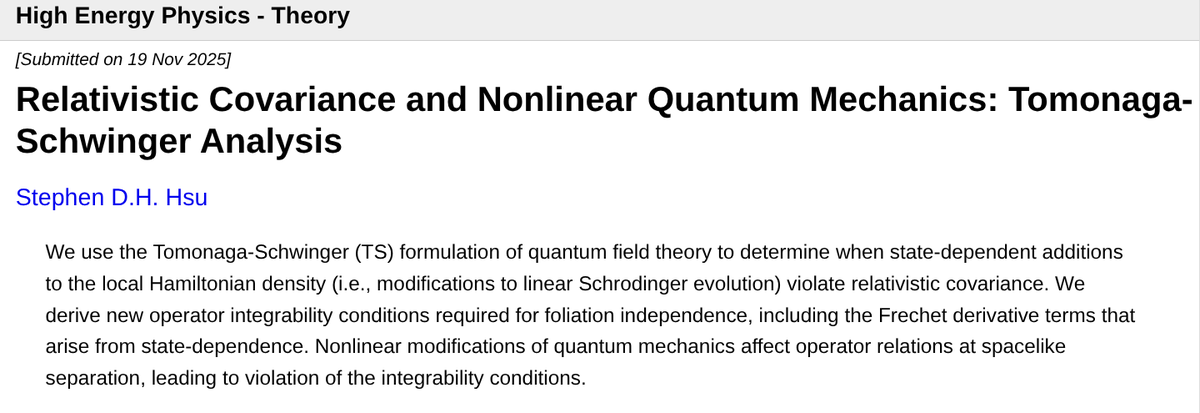
I think I’ve published the first research article in theoretical physics in which the main idea came from an AI - GPT5 in this case. The physics research paper itself (on QFT and state-dependent quantum mechanics) has been published in Physics Letters B.
I've written an accompanying AI paper describing the Generator - Verifier method I used to obtain useful research results from frontier LLMs. It may be of interest to other physicists and to AI researchers.
From the AI paper:
... models sometimes make very simple mistakes (e.g. in calculation) and also even make incorrect conceptual leaps that are superficially plausible. The second type of error can lead even expert researchers astray, consuming large amounts of effort to detect and correct. Research with an LLM might be compared to collaboration with a brilliant but unreliable human genius who is capable of deep insights but also of errors both simple and profound.
Fortunately, both types of errors can be strongly suppressed by using structured orchestration of multiple model instances, greatly improving reliability. A Generate - Verify protocol, in which one model produces a step forward and another model instance independently checks it, reduces hallucination errors significantly compared to single-pass generation. ...
The physics paper (abstract below) derives new operator integrability conditions required for foliation independence (necessary for integrability of quantum field theory; cf Tomonaga-Schwinger) that are very difficult to satisfy in any modifcation of quantum mechanics that is "state dependent" - i.e., deviates from linear Schrodinger evolution.
Whether quantum evolution is EXACTLY linear is one of the most fundamental questions in all of science. It has implications for quantum computing and quantum foundations - i.e., whether we live in an Everettian multiverse!
I've spent my career thinking about hard math problems.
I am excited to share that I've joined Axiom @axiommathai as Founding Mathematician working with my former student @CarinaLHong.
AI for mathematical discovery in WSJ today.
The Lewis Chessmen! 🤩
Characterful medieval chess pieces with wonderfully expressive eyes! 👀
From a large gaming hoard found on the Isle of Lewis, Scotland, in 1831. National Museum of Scotland, Edinburgh
📷 by me
#Archaeology
Yapay zeka fiziği nasıl değiştirecek? Microsoft Research'ten Dr. Deniz Günceler'i bu akşam 19:00 da dinleyip öğreneceğiz. Ayrıntılar ve bağlantı linki için: https://t.co/lNP9Wiu6iK