When I started @Triple-A, most people in the crypto industry were acting like cowboys, saying "crypto isn't regulated, it's different." I immediately took the opposite view.
I thought we needed to be cleaner than clean and operate within strict regulations. My vision has always been to be a payment institution first and foremost, and to use crypto rails to execute payments because they're more efficient.
Triple-A is licensed in Singapore under MAS and in the EU under MiCA. We hold Money Transmitter Licenses across 20+ US jurisdictions and are registered as a Money Services Business in the US and Canada.
Today, this In-Principle Approval for Broker-Dealer services from the Virtual Assets Regulatory Authority is new proof of our commitment to compliance.
We've already had advanced discussions with major companies in Dubai to enable them to accept stablecoin payments, and I'm looking forward to taking this further.
It was a pleasure chatting with @ericbarbier on our most recent recording.
He’s built one of the top stablecoin payment companies in the world based on his experience building in traditional cross boarder payments.
If you don’t know @TripleAHQ yet - you will soon
@ericbarbier and I spoke about how stablecoins are, fundamentally, an international currency.
Anyone needing to work with money has gone through the pain points of needing to deal with multiple currencies, rails, regulations, etc.
Treasury management (which sounds really boring) is one of the strongest use cases that exemplifies this idea.
Companies that need to move money around the world today must hold a complex series of accounts in various geographies, and managing this structure is a massive operational expense.
Using stablecoins, companies are streamlining this process and enabling their businesses to operate globally with ease.
It's not just @TripleAHQ that realizes this - treasury management comes up as a top use case with almost every single stablecoin payment company that I talk to.
If you run a traditional company today that needs to manage a global treasury, fire your CFO if they are not pestering you to use stablecoins.
. @ericbarbier, Founder and CEO of @TripleAHQ, joins @DanteReminick to discuss why some of the biggest stablecoin payment opportunities are emerging where traditional payment rails fall short.
"50% of the sales that they're making into Africa are done through stablecoin."
For many consumers across emerging markets, international payments can still be limited by card restrictions, spending limits, and higher decline rates. For merchants, that means demand can exist without a reliable way to convert it into revenue.
Triple-A abstracts the stablecoin complexity so enterprises can accept stablecoin users while managing compliance, liquidity, and settlement behind the scenes.
The biggest barrier to global commerce isn't always demand. Sometimes it's payment acceptance.
Stable Pulse - What's Next Beat episode below 👇
Napoleon said, "Take time to deliberate, but when the time for action has arrived, stop thinking and go in."
That moment has arrived for stablecoins. Truthfully, it arrived a while ago. The time for "strategizing" is through. The technology matured. The law arrived.
@ericbarbier, Founder @TripleAHQ, and I sit down to chat about why building stablecoin products has become dramatically easier over the last few years. There are no excuses for having only a strategy.
Two exits. Three companies. Twenty years building global payments infrastructure.
That's how @MichelBreeuwer describes our CEO, @ericbarbier, in his new podcast, Purpose Driven.
They talk compliance, the balance sheet problem, why Asia and Europe bet on risk differently, and what it means to find purpose after the exits and to build again.
Full episode 👇
One of my very first conversations with a prospect at @TripleAHQ was with the CEO of a publicly listed company who wanted to accept crypto payments and hold them on the balance sheet. Elon Musk's announcement that he held bitcoin had left its mark, and for certain executives, exposure to crypto had become a strategic signal. But the conversation quickly took a turn.
Faced with the CEO's enthusiasm, the CFO raised a more grounded concern: what does it actually mean, for a listed company, to carry crypto-asset lines on its balance sheet? How do you explain them to auditors, to regulators, to the risk committee? What he mainly saw was complexity for an uncertain upside.
From that meeting, my conviction took shape.
Most large companies want the efficiency of crypto rails without importing the risk and regulatory complexity onto their balance sheet. That's why, rather than chasing crypto-natives, we turned to e-commerce players and large enterprises that want to offer crypto payments without ever having to touch crypto themselves.
Bank transfers cost 3-7% to cross a border.
The stablecoin sandwich does it for under 1%.
How it works: local currency converts to USDC, moves across a blockchain in minutes, and converts back to the recipient's local currency at the destination.
The sender pays in their currency. The recipient gets paid in theirs. Neither side holds nor manages stablecoins.
The results: settlement in minutes instead of 2-5 days, full on-chain transaction visibility, and no capital locked in prefunded accounts.
There's now a "stablecoin toast" variant! Recipients keep stablecoins in their digital wallets rather than converting them to local currency. Gaining traction for contractor and creator payouts where holding USD beats the local alternative.
Full breakdown at the link: https://t.co/n0g3XWTSRQ
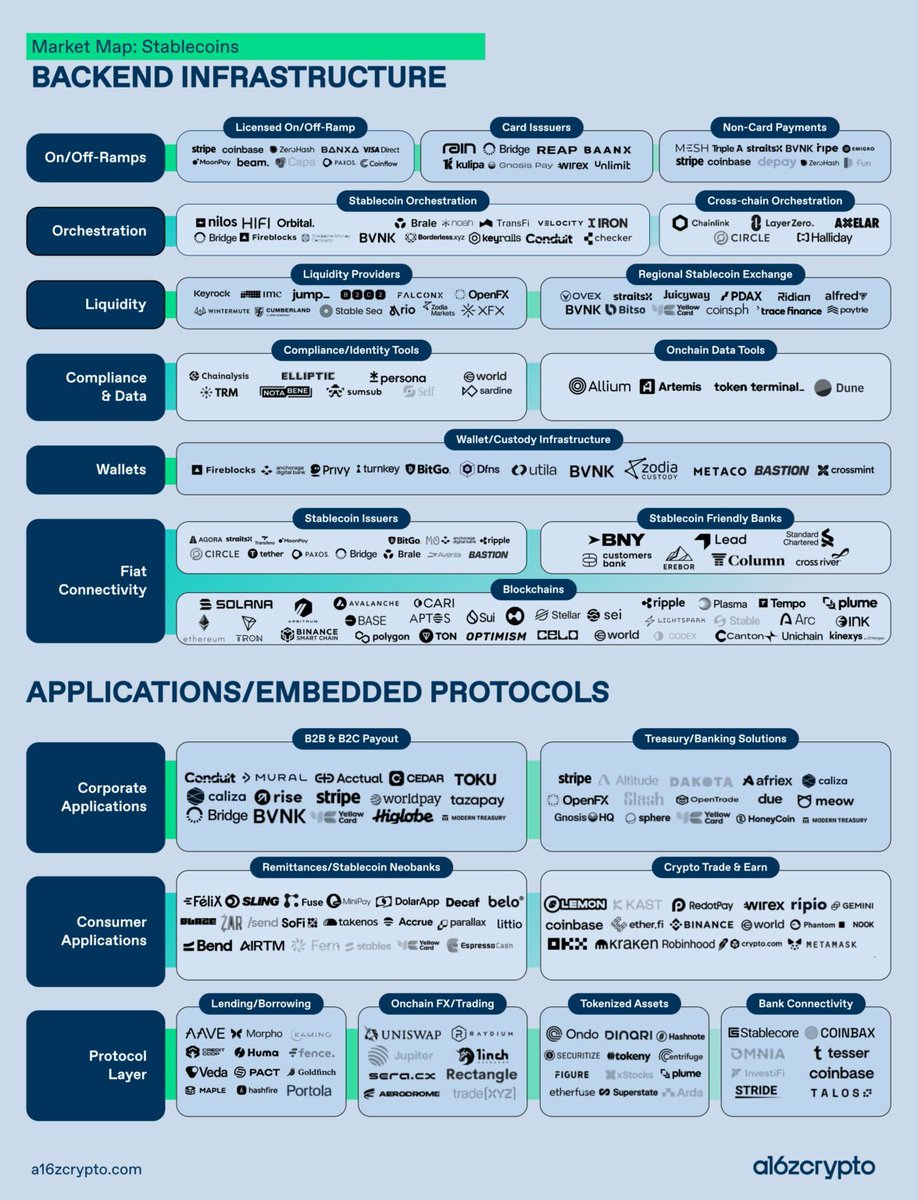
@a16zcrypto just mapped the stablecoin infrastructure stack.
Triple-A is on it. One of the names building the new rails for global finance.
700M+ people already hold digital currencies. The infrastructure to serve them is being built right now.
Proud to be part of that map, helping businesses pay and get paid in stablecoins, without ever holding digital assets.
🧵500 million people already hold stablecoins, and cross-border commerce will never be the same.
.@ericbarbier, CEO of @TripleAHQ, breaks down what's driving stablecoin adoption in C2B payments and where it's headed 👉 https://t.co/Ptx1mYpf6q
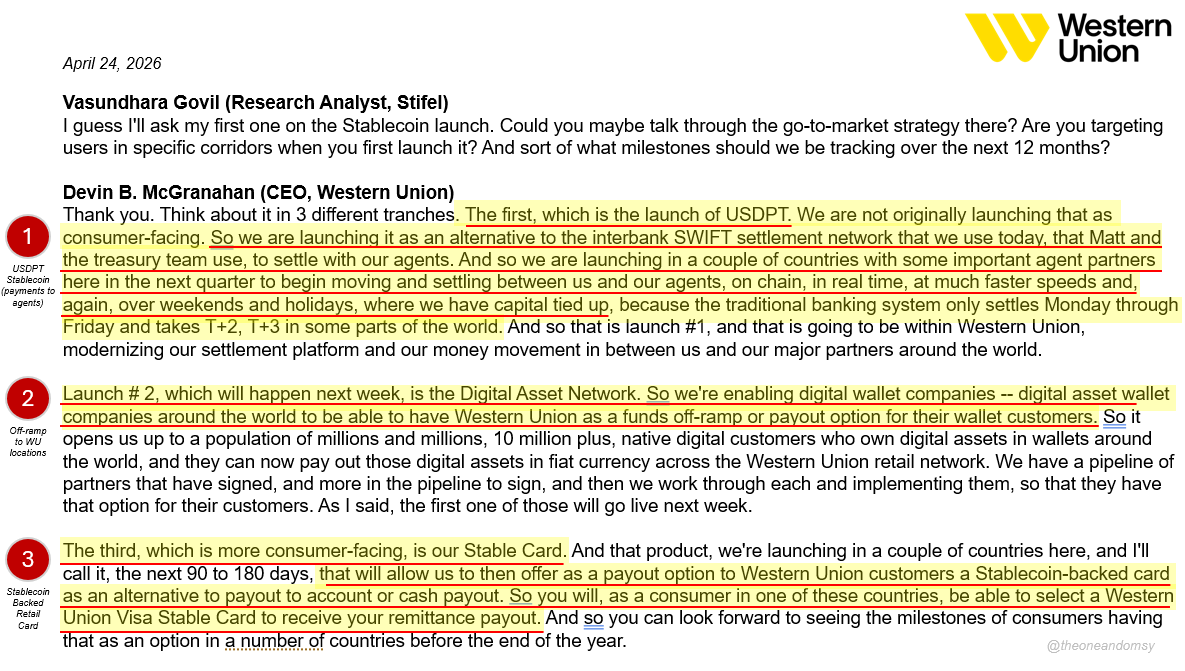
Western Union $WU (~5.5x '26E) dropping the latest on their stablecoin plans yday after earnings:
> Offramp network launching next week: will let users offramp stables -> fiat via WU locations
> Stablecoin (USDPT on @solana ) launching this q, will initially be used by their treasury team to pay their agent locations (~$500m stuck in pre-funding daily)
> Stablecoin card (h/t @raincards) for consumers to spend remittances w/out off-ramping to local cash
Markets continue pricing WU as if it's going to die. And fwiw it likely will. BUT the stablecoin business represents their best shot at salvation, letting them leverage their licenses, brand, physical locations, and flows across segments to audible the business into a modern digital pmts co
Think if we see any uptake here, it reprices or you start seeing serious acquisition discussions (i.e. @circle makes a bid, rolls it in w/ Arc and routes all the flows from merchants and consumers across their new pmts chain)
(Disclaimer: own long-dated calls in case they pull-it off, views are my own and not those of Dragonfly)
Sing Jie Lim, our Head of Business Development for SEA, was named to the Money 20/20 RiseUp Asia 2026 cohort at Money 20/20 Bangkok this past week.
One of 17 selected from across the industry. A program that has put 450+ women through leadership development since 2018, with 78% going on to a promotion or more senior role after completing it.
People talk about Triple-A's licensing footprint and infrastructure. We're proud of both. But none of it moves without the people behind it.
Congratulations, Sing Jie.
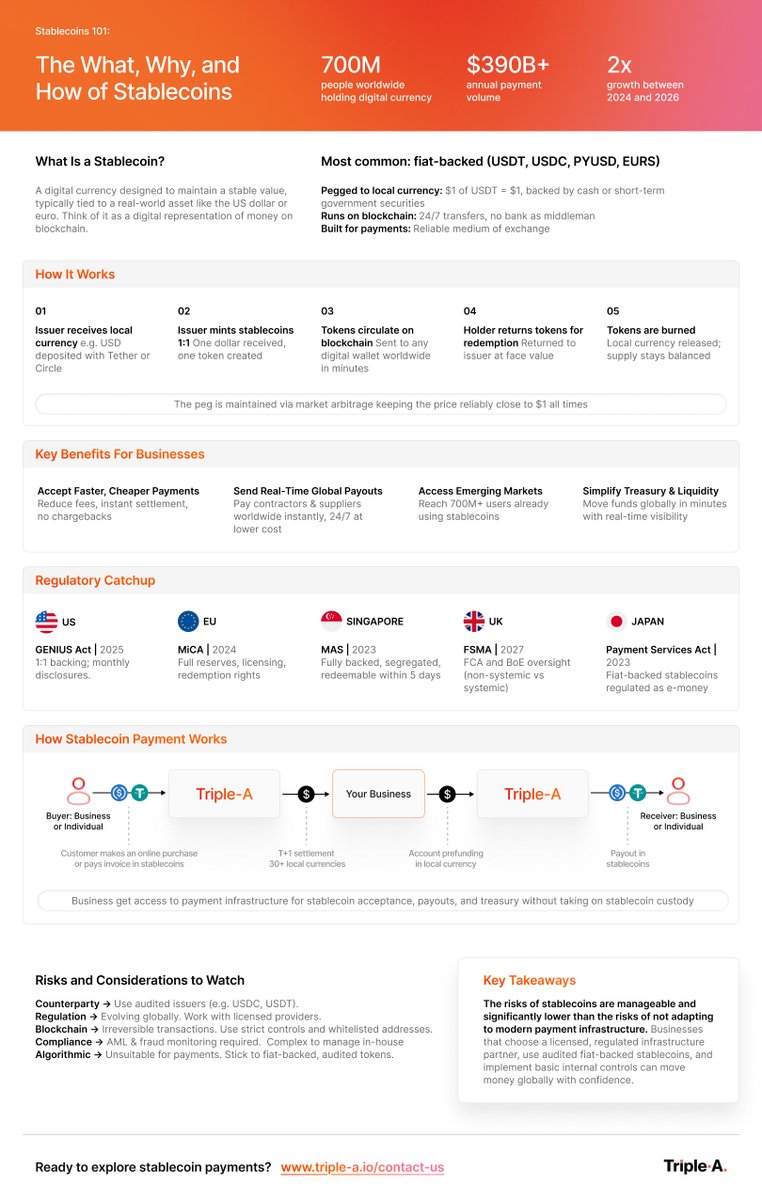
Stablecoin payment volumes have reached over $390B in 2025. At Triple-A, 85% of our payment acceptance volumes are driven by stablecoins.
If you’re a business owner considering stablecoin payments and want to know more about them, read our Stablecoin 101 guide here: https://t.co/pVYepcMgsb
#Stablecoins #Payments #Fintech #CrossBorderPayments
Triple-A is attending Money 2020 Bangkok (21-23 April), the leading global event for the Fintech industry 🇹🇭
@ericbarbier (CEO), Kailash Madan (CCO), Sing Jie Lim (Head of Business Development) and other members of the team will attend to engage with the Fintech community and exchange views on how stablecoins can improve efficiency and speed within the financial ecosystem.
If you’re attending Money 2020 Bangkok, let’s connect!
#Money2020 #Fintech #Payments #Stablecoins
⚖️ The shift is in: Singapore fintech is moving from payments to institutional infrastructure.
These 10 voices aren't chasing visibility—they are setting the direction for how finance will be built and governed across Asia.
📖 Read the full list: https://t.co/vfmtoRaPrT
🚨 Ep. 3 of Stablecoin Stories: Serial Founder Eric Barbier - Why Stablecoins Are the Best Cross Border Rail
With hosts:
💳 @sytaylor, GTM, @tempo
🔥 @rangoldi, VP Payments, @FireblocksHQ
With guest:
🌐 @ericbarbier, CEO, Triple-A
In this episode, Sy, Ran and Eric discuss:
💥 The inefficiencies in traditional remittance that inspired Triple-A
💸 How stablecoins reduce working capital needs in payments
🌍 Real world example of using stablecoins for cross border B2B
📊 Why Fortune 500 companies avoid holding stablecoins on their balance sheet
🪙 Stablecoins as a lifeline for consumers in emerging markets with dollar restrictions
🎮 Adoption of stablecoins in the global gaming sector
🏦 The regulatory landscape and challenges with banks for stablecoin firms
***
Timestamps:
00:00 Introduction
2:21 The inefficiencies in traditional remittance that inspired Triple-A
7:44 How stablecoins reduce working capital needs in payments
10:55 Real world example of using stablecoins for cross border B2B
13:06 Why Fortune 500 companies avoid holding stablecoins on their balance sheet
18:33 Stablecoins as a lifeline for consumers in emerging markets with dollar restrictions
24:24 Adoption of stablecoins in the global gaming sector
29:08 The regulatory landscape and challenges with banks for stablecoin firms
***
👉𝘚𝘦𝘢𝘳𝘤𝘩 '𝘛𝘰𝘬𝘦𝘯𝘪𝘻𝘦𝘥 𝘗𝘰𝘥𝘤𝘢𝘴𝘵' 𝘖𝘯 𝘠𝘰𝘶𝘛𝘶𝘣𝘦. 𝘈𝘱𝘱𝘭𝘦, 𝘚𝘱𝘰𝘵𝘪𝘧𝘺 𝘰𝘳 𝘢𝘯𝘺 𝘗𝘰𝘥𝘤𝘢𝘴𝘵 𝘗𝘭𝘢𝘺𝘦𝘳! 👈
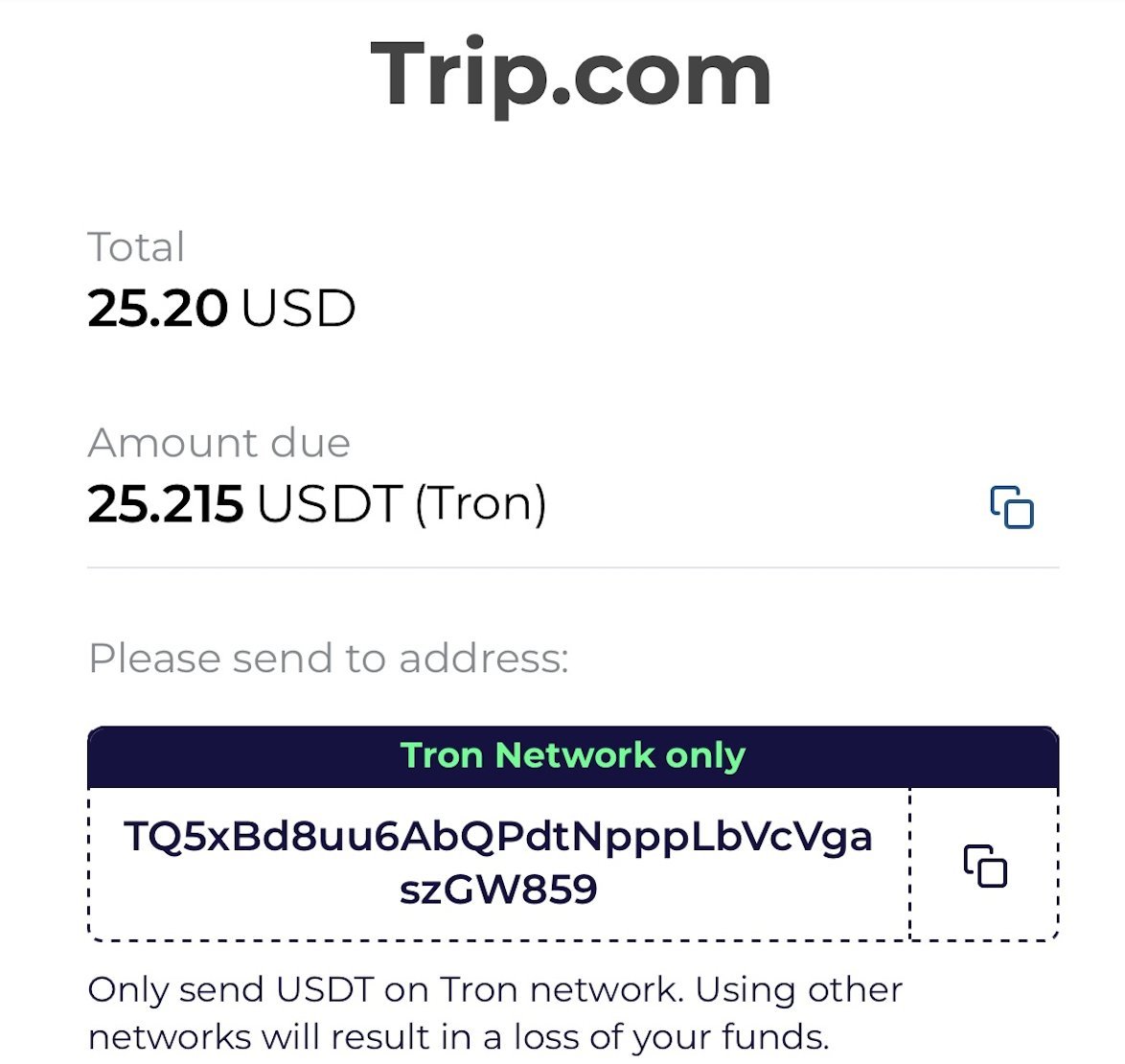
Trip. com rolls out stablecoin payments for travel bookings
@Trip, the overseas brand of Ctrip, has launched stablecoin payments for hotel and flight bookings, supporting $USDT and $USDC.
The feature is powered by Singapore-licensed crypto payment provider Triple-A and supports multiple blockchains, including #Ethereum, #TRON, #Polygon, #Solana, #ArbitrumOne, and #TON.
For hotel bookings paid in $USDT, users only need to provide a name and email, while flight bookings still require passport details to meet aviation compliance requirements.
#Stablecoins #CryptoPayments #TravelTech #Web3
I think we should replace the stablecoin sandwich with the stablecoin toast.
For many of our clients, the real pattern isn’t fiat/stablecoin/fiat. It’s stablecoin/fiat or fiat/stablecoin.
Take one of our clients in Asia who exports to Africa.
His customer in Nigeria accepts payments in stablecoins and keeps them. The local currency never enters the picture. No conversion, no top slice of bread.
But our client wants to be paid in its local currency. He’s a traditional business in Asia and doesn’t want to hold stablecoins. So we convert them for him.
That’s the classic toast scenario: one side in stablecoin, the other in fiat.
In a country with an unstable currency, holding stablecoins is safer, more liquid, and even offers yield. And since the local ecosystem widely accepts stablecoin payments—freelancers, merchants, suppliers—it has become the natural choice (and will increasingly be so).
The stablecoin sandwich exists, yes. But in reality, what we see most often is the stablecoin toast.