You need to stop and read this again…
Warren Buffet’s final words of advice from his very last annual letter 🥹
"One perhaps self-serving observation. I’m happy to say I feel better about the second half of my life than the first. My advice: Don’t beat yourself up over past mistakes – learn at least a little from them and move on. It is never too late to improve. Get the right heroes and copy them. You can start with Tom Murphy; he was the best.
Remember Alfred Nobel, later of Nobel Prize fame, who – reportedly – read his own obituary that was mistakenly printed when his brother died and a newspaper got mixed up. He was horrified at what he read and realized he should change his behavior.
Don’t count on a newsroom mix-up: Decide what you would like your obituary to say and live the life to deserve it.
Greatness does not come about through accumulating great amounts of money, great amounts of publicity or great power in government. When you help someone in any of thousands of ways, you help the world. Kindness is costless but also priceless. Whether you are religious or not, it’s hard to beat The Golden Rule as a guide to behavior.
I write this as one who has been thoughtless countless times and made many mistakes but also became very lucky in learning from some wonderful friends how to behave better (still a long way from perfect, however). Keep in mind that the cleaning lady is as much a human being as the Chairman."
And then today, his last letter to shareholders as chairman…
Today is another reminder of just how fast things can change.
Just 9 months ago, markets were pricing in 3 rate cuts in 2026 and we had $60 oil prices.
Today, a new Fed rate hike cycle has begun, oil prices are above $100, and diesel prices are at record highs.
The market and the Fed are in agreement, lower rates are not coming as long as the current energy crisis continues.
There simply is no scenario where rate cuts are warranted with $100+ oil prices and 3.5%+ inflation, aside from an economic depression.
Luckily, we are also in the midst of the biggest technological revolution in history, and the AI boom continues to provide substantial support for the S&P 500.
Without the AI Revolution, markets would be in a much darker position right now.
On the flip side, a resolution to the current energy crisis opens for the S&P 500 to rise well above 8,000.
For now, a long and bumpy road appears to be ahead as the Fed continues its 60-straight-month battle against inflation.
"Higher for longer" has returned.
It seems most people don't understand how severe the energy situation is right now in the Middle East.
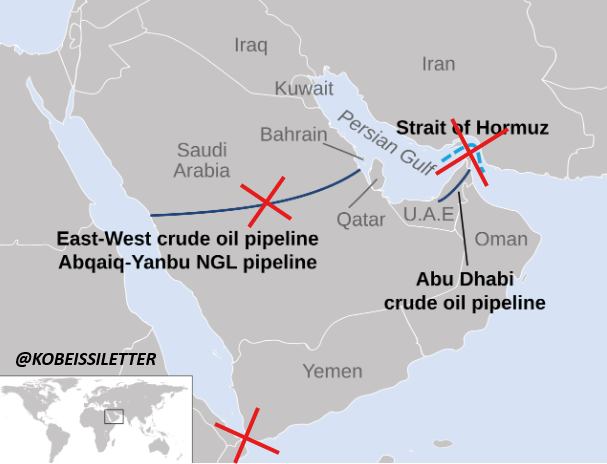
As of Friday, Saudi Arabia's East-West pipeline has officially been shut down after recent attacks, putting -4 million barrels of daily oil exports at risk.
Meanwhile, the Bab el-Mandeb Strait is now at risk of being shut down, threatening up to -9 million barrels of daily oil supply.
All while the Strait of Hormuz is operating at ~20% of its pre-Iran War capacity, removing -15 million barrels of daily oil flows.
Combined, this represents nearly ~30 MILLION barrels per day of oil flows that are either offline or at risk.
Even after accounting for some overlap between these routes, the scale of the potential disruption is enormous relative to the ~100 million barrel per day global oil market.
This is one of the most severe energy supply situations in modern history.
Welles Crowther.
24 years old. Equities trader on the 104th floor of the South Tower. Former volunteer firefighter. He carried a red bandana in his back pocket every day because his father had given it to him as a boy. “One to show and one to blow.”
When the second plane hit, he called his mother.
“Mom, this is Welles. I wanted you to know that I’m okay.”
Those were the last words she ever heard from him.
He didn’t stay on 104.
He went down to the 78th-floor sky lobby, where people were burned, bleeding, and lost. Survivors later described a calm young man with a red bandana over his face who found the one working stairwell and started moving them.
He carried a woman on his back for 17 floors.
Then he told the group to keep going and turned around.
He went back up.
He did it more than once.
At least a dozen people who made it out later identified him from photographs as the stranger who saved them. They never knew his name that morning. They just knew the red bandana.
He could have walked out with them.
He didn’t.
They found his body months later in the wreckage, near the firefighters.
Think about the ordinary lives that continued because a 24-year-old kid in a suit decided the people on the 78th floor were his responsibility.
Birthdays. Weddings. Kids who grew up with their parents.
And a mother who only got that one short voicemail.
Welles Crowther. Hero.
Welles Crowther was a former Boston College lacrosse player whose trademark was a red bandana.
On September 11, 2001, he led people to safety after terrorists struck the World Trade Center.
This is his story.
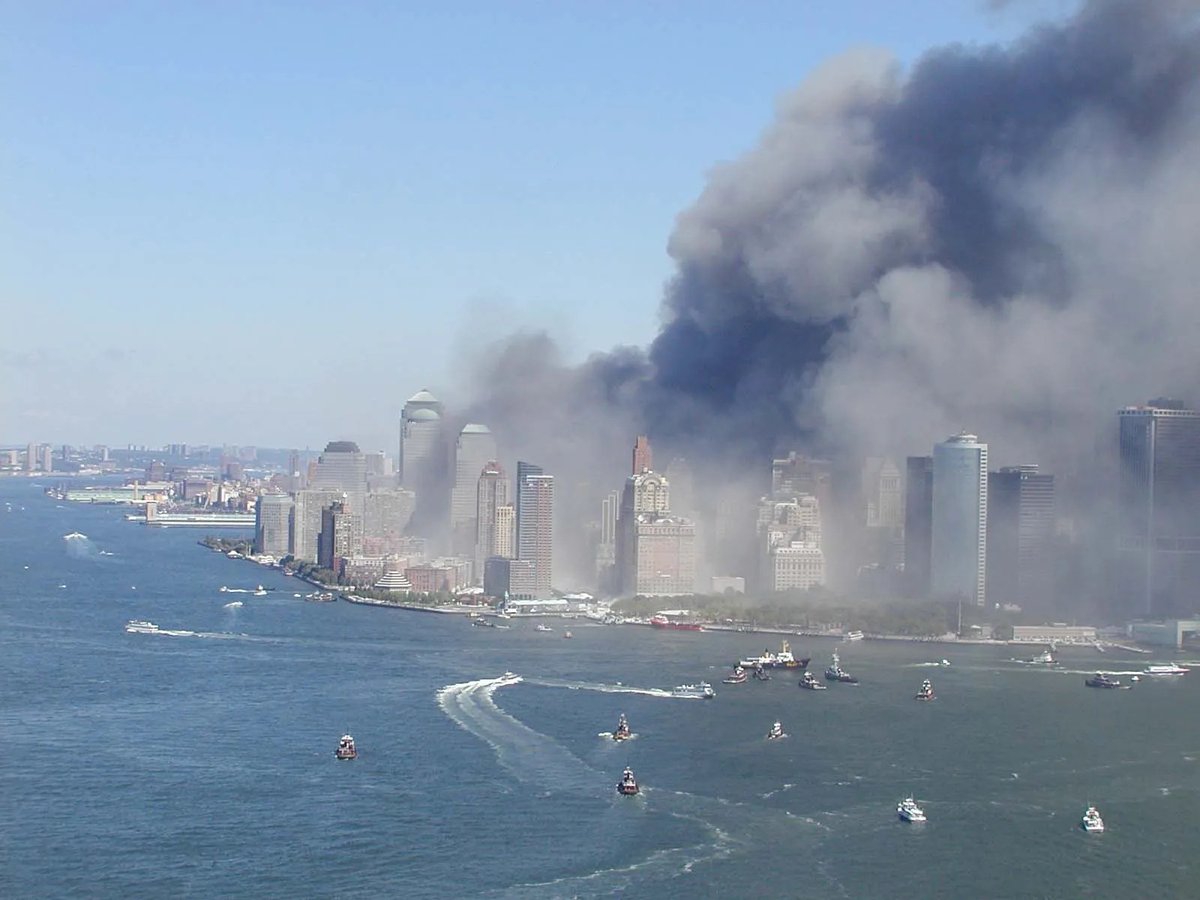
If you were young in 2001, or weren’t even born yet, it can be hard to imagine what 9/11 felt like. The shock of that beautiful, cloudless morning. The heartbreak of the families whose loved ones were taken with such swiftness and cruelty. The realization that the forces of malevolence and violence were closer, and the future less certain, than we knew.
But in the days that followed, we felt something else, too. Pride in the rescue workers who had rushed to the scene, and the passengers who had stormed the cockpit. Admiration for the men and women who left behind lives of comfort to serve their country. A deep resolve that nothing would break the will of a truly United States of America.
Today Michelle and I are remembering those we lost that day, and those who made the ultimate sacrifice in the wars that followed. We pray for their families. And we hope Americans everywhere remember the true lesson of 9/11: that we can survive even our darkest days as long as we move forward as one nation and one people.
🇺🇸 The Boatlift That Was Bigger Than Dunkirk
At 10:45 a.m. on September 11, 2001, a Coast Guard lieutenant named Mike Day keyed a radio in New York Harbor and said the only sentence that mattered.
“All available boats. This is the United States Coast Guard. Anyone wanting to help with the evacuation of Lower Manhattan, report to Governors Island.”
The boats were already coming.
The bridges were closed. The tunnels were closed. The subways were dead. South of the towers, hundreds of thousands of people had nowhere left to walk. Some jumped into the Hudson. Some stood on seawalls that were never meant to be docks and waited for anything that floated.
Dunkirk took nine days to pull 338,226 Allied soldiers off a beach in 1940.
On 9/11, roughly 800 mariners on about 150 vessels moved as many as 500,000 civilians off Manhattan in about nine hours. Ferries. Tugs. Dinner boats. Pilot boats. Yachts. A retired fireboat. Rubber dinghies that held two people. The largest water evacuation in history.
NY Waterway did not wait for the official call. After the second plane hit, the whole fleet moved. Captain Rick Thornton nosed his ferry against a seawall that was not a slip and started taking people off. Some of them he pulled out of the river. His company alone carried about 158,000 people to Jersey City, Hoboken, Weehawken, Brooklyn, and Queens.
On a normal Tuesday they carried 34,000.
The Staten Island Ferry moved more than 50,000 people and came back the other way with water, bandages, and men who still had work to do in the dust.
The old fireboat John J. Harvey, already retired, tied up near the Museum of Jewish Heritage, took civilians off the seawall, then pumped water when the hydrants downtown died.
Lt. Day later admitted what the day required. “I broke more rules that day than probably I’ve enforced in my whole Coast Guard career.”
In raw numbers it was bigger than Dunkirk. No boat went down. By nightfall the southern tip of Manhattan had been emptied by people who were not on anyone’s list of heroes when the morning started.
They were tug captains. Ferry deckhands. Pilots. A lieutenant with a microphone. Ordinary boats answering one sentence.
All available boats.
The entire legal profession is having a "what comes next?" moment...
Goldman, Morgan Stanley, and Citi are telling Big Law firms to cut fees.
Their argument is simple: AI has made research, contract review, document review, and discovery faster, so the bills should come down.
Citi is already asking firms to show the AI savings when they bid for work.
Morgan Stanley’s general counsel said the old model, where partners get paid off associates billing long hours, is now unstable.
That model exists because the same clients asked for it.
Firms then built their economics around leverage: junior lawyers doing the volume work at high rates.
Now, the whole thing is unstable!
Whatever happens next, @smblawgroup will be on the cutting edge...
JUST IN: Wall Street investment banks are pressuring large law firms to reduce their fees, saying that the traditional model of associates billing excessive hours is no longer viable in an era of rapidly advancing AI, per Bloomberg
I’m a retired brain surgeon and I wanna tell you why you feel like life is passing by. I just need one minute to explain this to you so hang in there.
Repetitive daily routines stop the brain from recording clear detailed memories. When every day looks the same, your brain does not track time the same as a clock does. It tracks change. If nothing new happens then days, months, and years start to blur together.
This is know as Time compression. When life lacks variety, your brain compresses past days together, making it feel like time is sped up.
To stop feeling like life is passing you by, add new experiences to your life. Break routine habits, like changing your daily home routine, taking a different route to work, or trying a new hobby.
Schedule small trips or plan new adventures so your days do not blend together.
Practice mindfulness by staying fully focused on what you are doing right now and not trying to race off to the next task.
Keep a journal and write down happy memories or memorable parts of the day before you go to sleep.
Take deep, calm breaths when you feel anxious or rushed to return your focus to the moment.
You can and you will retrain your brain to not feel like life is passing you by by following these few simple measures.