Co-built a $100m+ supply chain assurance business, now with Private Equity on next leg. Hawaiian 🤙 trying to make my ancestors proud. Views are my own!
Somehow Gavin touched indirectly on the Texas-California debate — one I’ve debated myself.
For anyone wondering why it has been harder than expected for pro-Florida and pro-Texas companies to pull top technical talent out of California, the answer is not just taxes. It is community.
California’s advantage is not only its companies. It is the whole ecosystem around the talent: deep labor markets, universities, immigrant networks, cultural infrastructure, food, family, dating pools, professional networks, and a sense of belonging.
That matters. A lot.
Engineering talent — including many Asian and Asian-American engineers who have long been central to Silicon Valley and Southern California tech — often chooses California because it already has the communities that make life feel whole outside of work.
A Korean-American engineer in Hawthorne can get to K-Town or the San Gabriel Valley. A Taiwanese-American engineer in Palo Alto has access to San Francisco, Milpitas, Cupertino, Fremont, and a broader Bay Area ecosystem that feels familiar. That is not trivial. That is quality of life.
People do not make relocation decisions on tax rates alone. They make them based on career opportunity, community, family, food, schools, culture, weather, dating, mental health, and whether the place feels like somewhere they can actually build a life.
Texas and Florida have real advantages. Lower taxes matter. Lower costs matter. Business friendliness matters. But if they want to compete for the deepest pools of technical talent, they have to build more than office parks and incentives. They have to build communities people genuinely want to join.
This is also why California remains so hard to displace. It has the talent, the companies, the culture, the ocean, the universities, the immigrant networks, the arts, the food, and the climate.
California is expensive for a reason. People are not just paying for geography. They are paying for belonging.
Still the best state.
Gavin on why Elon's new chip fab, Terafab, will be successful:
"One, they have a partnership with Intel, which is very important. They're getting access to 50 years of institutional knowledge.
The A teams at the semi cap equipment companies will be working with them. ASML, KLA, Lam Research, Applied Materials.
One big reason Taiwan Semi caught up is those companies wanted them to catch up. They don't like having a monopsony.
And Elon is a living deity in China, Taiwan, South Korea, and Japan.
He's going to recruit the best people because the best engineers want to work for him, especially in hardware engineering.
Then next to Terafab, there'll be a Taiwan Town. 'These are your favorite restaurants? I'm going to move them and their whole staff from Taiwan to Texas.' Then we'll have Japan Town. Then Korea Town.
That's just not the way the people who run Intel and Samsung think.
So he's going to have the best talent, the A teams at the wafer fab equipment companies and he has Intel.
And it's different enough that it will not alienate Taiwan Semi."
While I think Google’s Gemini Omni is technically awesome, I can’t imagine anyone other than brainrot aficionados actually cares.
Sincerely — who wants art to be prompted, other than those profiting from children or young people glued to stupid short videos on their phone?
The real world is where beauty and human interest will ultimately progress.
This feels cheap. It feels uninteresting.
We don’t want AI to do our art, we want AI to do our dishes.
Gemini Omni doesn't just build scenes that look real, it reasons about what should happen next. It combines an intuitive understanding of physics with Gemini's knowledge of history, science, and cultural context.
Rolling out today starting with video outputs to Google AI Plus, Pro and Ultra subscribers globally through the @Geminiapp + Google Flow, and @YouTube Shorts this week.
My fiancée and I discussed this at length this morning.
We are planning our wedding for next summer in Malibu, with a year-plus gap for planning and coordination since our friends are global.
We want to have kids in the next few years. She is 33, and I am 40.
We reflected on a world without smartphones and rapid access to information:
- Would we have met?
- Without the social pressures of “putting on a show,” would we take over a year to plan our wedding?
- Would we even know about our venues (given social media)?
- In a world less enabled by 24/7 comparative market information, would wedding costs be so high? Or perhaps lower due to competition?
- Would she or I have the “success” we’ve had (we both believe our financial success stems from curiosity and internet access) and the security to afford such a wedding?
- Would our hesitance to have kids too soon or until meeting certain milestones be less?
There are many alternate worlds where she and I already have kids.
There are equally possible worlds where I would never have met the love of my life.
Very nice piece by @jburnmurdoch makes a case for smartphones being responsible for the fertility decline, through channels like
• pure time displacement
• changing (gendered) norms
• decreased socialization
Notice the flip flop here.
In 2015, Xi said that "there's no such thing as the so-called Thucydides Trap in the World" and now?
Xi just sat across from Donald Trump in the Great Hall of the People and asks whether the two powers can “overcome the Thucydides Trap” and “forge a new paradigm” for great-power relations.
Funny! Because a decade ago, he used the phrase "so-called" to describe it and outright denied that it was an applicable concept.
So why the change of tone you ask?
This is what you'd call a tell, an involuntary admission that Beijing’s position has deteriorated sharply since 2015.
Back then, China was at the height of the post-financial crisis boom. Beijing was surging with double digit growth (on paper), the Belt and Road Initiative was rolling out to great fanfare, island building in the South China Sea was barely met with any Western response (thanks Obama), and the American president was still preaching “strategic patience.”
Today, in 2026, the material reality has flipped. China’s much-hyped “century of rejuvenation” has slammed into structural headwinds that no amount of state media spin can hide - a demographic death spiral, a property sector collapse that wiped out trillions in household wealth, local government debt bombs lurking on the books, and a tech ecosystem increasingly isolated by US export controls and friend-shoring.
The GDP overtake narrative that once enthralled the elites at Davos has quietly died; projections now show America pulling further ahead in nominal terms. Xi’s “China Dream” is at best delayed and at worst, never materializing.
Trump 2.0 brought tariffs back on the table, hardened alliances with Japan and the Philippines, accelerated arms sales to Taiwan, and an American public finally awake to the CCP’s game. Knowing that China requires continued access to Western markets, capital, and technology to avoid stagnation at home, Xi now does a U-Turn and reaches for the historical analogy he once dismissed.
Basically when you’re strong, you deny any threat exists hoping to lull the bigger power into complacency.
When your power and strength wanes, warn that resistance will produce the very conflict you claim to fear.
Xi is essentially saying to America, "don't contain us, don’t push back too hard, or you’ll be the paranoid Sparta that started the war against Athens.”
It's actually a veiled threat to keep the one-way transfer of power and wealth open, OR ELSE. This 180 deg shift proves that the balance is tilting back toward American strength.
The correct US response is to reject the premise entirely, and continue to maintain unrelenting pressure on every front and force Xi to choose between genuine reform at home or managed decline on Beijing’s terms. Xi’s sudden invocation of the Thucydides Trap - something he used to dismiss - simply confirms that the pressure worked.
Americans should take this as a sign that their country is not in decline, despite the insane amount of propaganda now also being touted by American influencers and podcasters.
I feel for him.
The man lost his home, is angry and has found political will. Being down on his luck and with some name recognition, he is milking his options.
Spencer Pratt has no executive experience and is using words + celebrity to take his shot.
The second largest city in America needs a serious executive. Not a reality star.
Truthfully anyone considering him (especially picnics) is not a serious person.
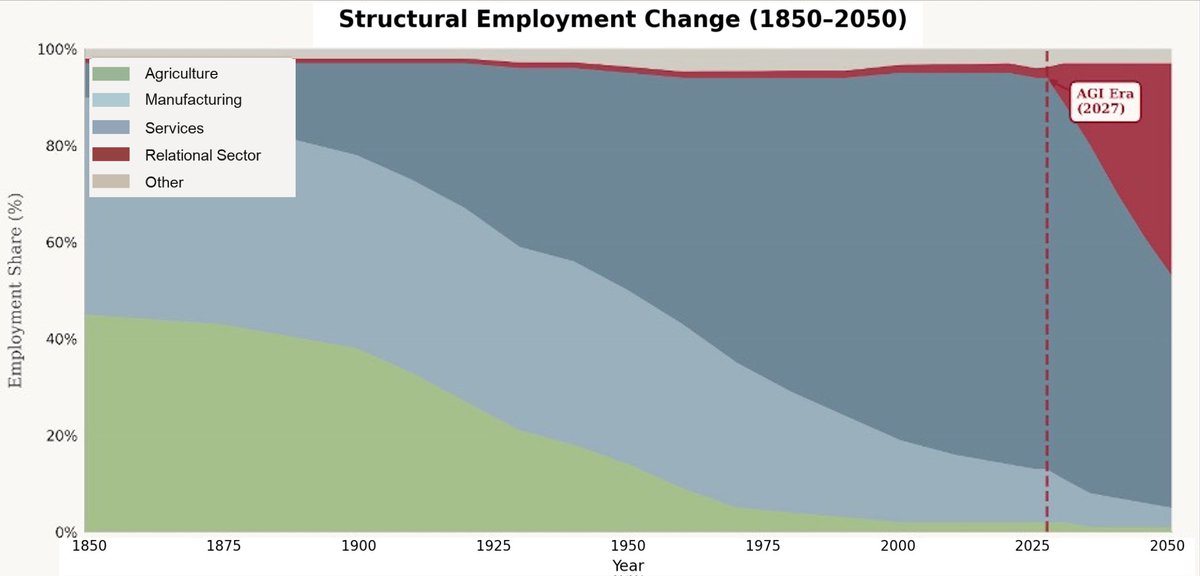
New essay on the economics of structural change and the post-commodity future of work.
1. Almost any question about the impact of advanced AI on the economy needs to start at the same place: what is still scarce? Answer that, and the analysis becomes pretty straightforward. This essay explores what becomes scarce if AI really can replicate most of what humans do in production, and what this mean for the future of jobs.
2. My conjecture, working through the economics: labor reallocates across sectors, and the sector it reallocates to has properties that keep labor a meaningful share of the economy. Ultimately this is about the structure of demand itself. For this, we have to go back to Girard, Augustine and Rousseau: once people's base needs are met, their preferences shift to comparative motives (e.g., status, exclusivity, social desirability). This motive is inherently non-satiated.
4. The key paper is Comin, Lashkari, and Mestieri (Econometrica 2021). As people get richer, they don't buy proportionally more of everything. They shift spending toward sectors with higher income elasticity. They estimate income effects account for 75%+ of observed structural change.
5. The ironic consequence: the sector that gets automated becomes a smaller share of the economy, not a larger one. Agriculture got massively more productive and its share of employment collapsed. Manufacturing too. The "stagnant" sectors absorb the spending and the jobs.
6. So the question is: which sectors have high income elasticity in a post-AGI world? I argue it's what I call the relational sector. Categories where the human isn't just an input into production, it is part of the value.
7. Why does the relational sector have high income elasticity? Because human desire has a mimetic, relational dimension. We don't just want things for their intrinsic properties. We want what others want, and we want it more when others can't have it. Girard, Rousseau, Augustine, and Hobbes all saw this.
8. In work with Kristóf Madarász, we showed this experimentally: WTP roughly doubles when a random subset of others is excluded from the good. And in new work with Graelin Mandel, AI involvement kills the premium. Human-made art gains 44% from exclusivity; AI-made art only 21%.
9. This all comes together for the core argument. The sector that absorbs spending as AI makes commodity production cheap is one where human provenance is part of the value, and demand for it grows faster than income. Exactly the profile that keeps labor meaningful.
10. To be clear about the claim: I'm NOT saying aggregate labor share must rise. It may fall. The claim is about sectoral composition, i.e., where expenditure and employment go once commodities get cheap, and the fact that the sector that will absorb reallocated labor maps to a substantial component of human preferences and desire.
11. If you're interested in the formal model, a linked companion technical note works out all the economics.
Read the essay here: https://t.co/NcjVgn2o8g
YC announced Autonomous, an AI-native wealth strategist that brings elite strategies used by the ultra-wealthy, now available to everyone at 0% advisory fees.
Get early access: https://t.co/AX1K2Wwgcs
https://t.co/CiaXzGRCsF