Doctors didn’t save my life.
They denied my death.
A traumatic brain injury has stolen 24 years of my life.
I’ve tried to work since 2010, but even limited hours risk the insurance I need to survive. Losing it means years of waiting to get treatment again.
I’m so desperate I’m selling the belt I was wearing the day of the accident in 2001. I don’t want to part with it, but I have no choice right now.
The procedure I need costs only 7–10% of what it costs in America.
I want to be able to say my life was saved — not that my death was denied.
GoFundMe link in bio.
Even sharing is just as powerful as donating.
#TBI #BrainInjury #HelpNeeded #GoFundMe #MedicalHelp
Thanks to all who watched & shared. Sleep science fascinates me, & your curiosity encourages me. Please tell me what helps YOU wind down at night 😴
Sleep isn't just on or off, is it? Geneva researchers found gentle rocking, ~1 sway per 4 sec, sped up falling asleep, a possible reason I rock my feet at night. 25 years after a brain injury:
GoFundMe: https://t.co/k3lSX0jM0K
Belt & watch: https://t.co/NhEgEIc3b5
The brain can wake up in sections, like circuits on a fuse box. 💡 Across 84 parasomnia episodes, 256-electrode caps showed sensory and movement areas at the back of the brain partly waking. Frontal areas for judgement and emotional control stayed asleep. 🧠 #Neuroscience
https://t.co/Xi2Kl6Bt6O
Thank you for the views & kindness today. I'm just a guy with a phone & a brain injury story, so every watch, share & prayer truly lands. Bless you all 🌙
If 2-5am thoughts aren't good data, a calm exit plan helps. Mine: slowly rocking my feet, as Geneva's rocking studies suggest may ease sleep onset (a possible explanation). 25 years after my brain injury:
GoFundMe: https://t.co/k3lSX0jebc
Belt & watch: https://t.co/NhEgEIbvlx
Ross Edgley and I discuss how to endure and thrive while doing hard work over long periods of time. Tool 1: Don’t believe your thoughts at certain times of the circadian cycle. They are not good data. For most (not all), 2-5am is the danger zone.
Grateful to everyone who watched my Life Upgrade video. Four more are coming this week, so stay tuned. Your support & prayers mean more than I can say 🙏
Dim evenings & dark bedrooms, great advice, Rhonda. My free add-on: rocking my feet slowly at bedtime, inspired by Geneva rocking research (a possible explanation, not proof). My 25-year chapter:
GoFundMe: https://t.co/k3lSX0jebc
Belt & watch: https://t.co/NhEgEIbvlx
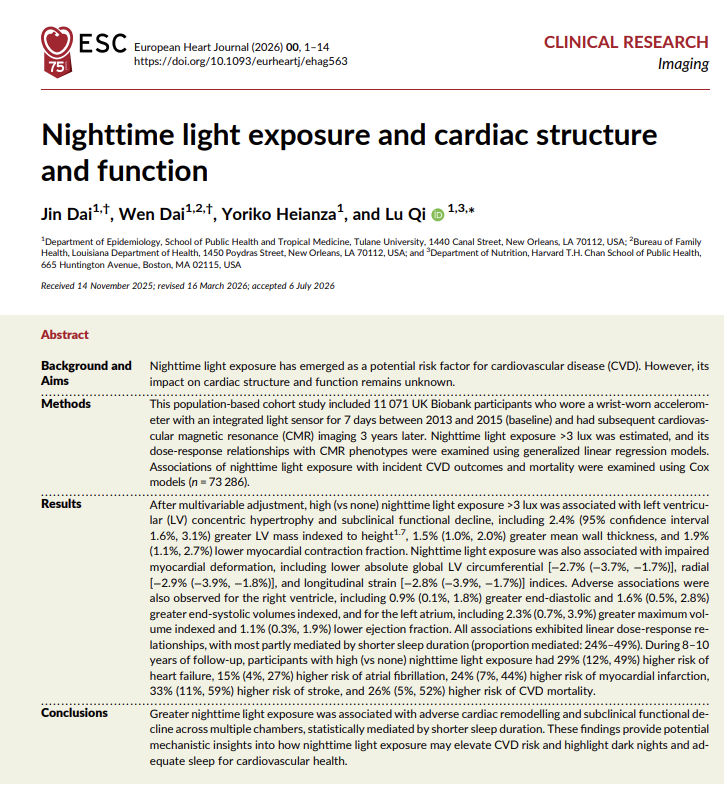
More light at night was associated with subtle differences in the heart’s structure and ability to contract, even in adults without diagnosed cardiovascular disease.
Compared with no nighttime exposure, high exposure (about 34 minutes per night) was associated with thicker walls and greater muscle mass in the heart’s main pumping chamber, along with poorer measures of contraction.
High exposure was also associated with a 15-33% higher risk of heart failure, heart attack, stroke, Afib, and cardiovascular death in a larger follow-up analysis.
Light is a biological signal, and evening light can suppress melatonin and shift our circadian clocks later, affecting systems that regulate sleep and cardiovascular function.
I’ve previously shared how I programmed my home lighting to turn red in the evening and used blackout curtains in our bedrooms to support sleep.
So to me, this study is yet another reason to take nighttime light seriously. Bright days, dim evenings, and dark bedrooms are practical ways to support our circadian rhythms (and our heart health!)
Thank you, everyone who tuned in. Tell me what knocked you out quicker, bare feet or under a blanket. Your comments, shares & prayers carry me through this 🕷️💤
Even jumping spiders get their sleep! Humans struggle more, so I filmed a short on rocking your feet to drift off, inspired by Geneva's rocking studies (a possible explanation). 25 years post brain injury:
GoFundMe: https://t.co/k3lSX0jM0K
Belt & watch: https://t.co/NhEgEIc3b5
Jumping spiders actually fall asleep, even entering a REM-like state in which they may be dreaming.
Learn more: https://t.co/VV5qjRkMIk @NewsfromScience
Thank you for stopping by, everyone. If you try the slow rocking tonight, tell me how long it took to drift off. I'm grateful for each view, share & kind word 💛
3 a.m. wake-ups are rough, & I've had 25 years of rough nights since my brain injury. My short shows one gentle idea: slow foot rocking, echoing Geneva's rocking studies. A possible aid, not a cure 🙏
GoFundMe: https://t.co/k3lSX0jebc
Belt & watch: https://t.co/NhEgEIbvlx
Waking up at 3 or 4 a.m. and can’t fall back asleep? @hubermanlab explains why.
Around that time, your melatonin levels drop naturally. If you’re consistently waking up in those early hours, it’s likely that you’re running out of melatonin because you stayed up too late for your body’s natural rhythm.
Some people are simply built to fall asleep earlier, their circadian clock runs ahead. Trying to push your bedtime later can create that 3 a.m. wake-up pattern.
Your brain’s “seesaw” between alertness and calm works best when you align with your body’s natural timing. When you stay up late under bright light, you delay melatonin release — then it drops too soon in the night, waking you up mid-cycle.
So if you’re tired of those 3 a.m. wake-ups, don’t fight your biology.. work with it! Get morning sunlight to anchor your rhythm, dim lights at night, and honor your body’s clock.
Can't sleep? The fix might be at the end of your legs 🦶😴
Life Upgrade #1 of 5: rock your feet, bare first, then under a blanket. Geneva researchers found gentle rocking about every 4 seconds sped up sleep & deepened it.
Every share helps me close this chapter 🙏
GoFundMe: https://t.co/1etjIdQ0ku
Belt & Waltham watch: https://t.co/UxJYyxZzPF
Coming this week: 5 life upgrades in 5 videos, from 25 years of surviving since a semi clipped me at 60 mph on my motorcycle. Sleep, migraines, supplements, your heart… & #5, a theory you've never heard 🔒
This is the menu. Follow so you catch every drop.
GoFundMe: https://t.co/1etjIdQ0ku
Belt & gold Waltham, $5,500: https://t.co/UxJYyxZzPF
#TBIsurvivor #lifeupgrades #comingsoon
Greetings, vintage lovers. This 14K Waltham pocket watch keeps the quiet beauty of its era: 17 jewels, a serial-numbered movement, & a Keystone case stamped .585. It's listed with the belt I wore through a 2001 semi crash, a long story in two objects: https://t.co/NhEgEIc3b5 🙏
Watch Enthusiasts: not a Rolex or a Patek, but it earns a seat. Solid 14K gold Waltham, 17 jewels, serial-numbered movement, Keystone case, 188.8 g with chain & fob. Comes with the belt from my 2001 semi crash & coma. Eyes welcome: https://t.co/NhEgEIbvlx 🙏
@StanCzubernat Lovely 1914 trench watch, Stan. Dennison cases do have presence. If you'd glance at a Waltham I'm passing on, I'd be honored: 17 jewels, movement 13663971, 14K Keystone case stamped .585. It rides with my accident belt: https://t.co/NhEgEIbvlx 🙏
@CreakyJoints 'But you don't look sick' has followed me for 25 years, ever since a semi sent me flying 150 feet. Scars hide well. Thank you for naming it. The full story, if you wish: https://t.co/k3lSX0jM0K The belt from that day, now with a gold Waltham: https://t.co/NhEgEIc3b5 💙
Hello Stroke Twitter. At 19 my brain bled. The staples are long gone, but the damage isn't. After 25 years, I'm still learning what that day took. Survivors know the road after the ICU is the longest. My story: https://t.co/k3lSX0jM0K Prayers & shares help 🙏