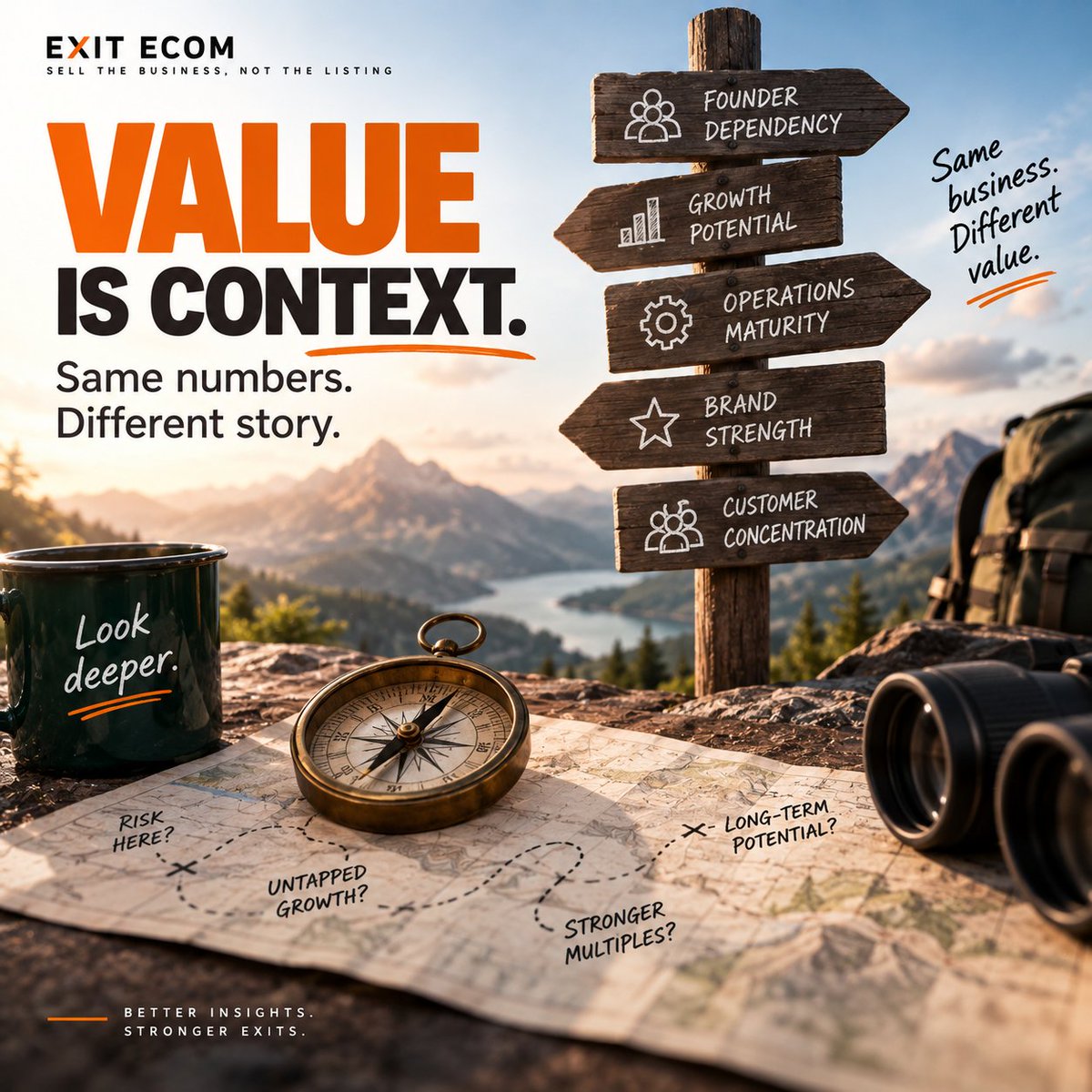
Your $1.5M e-commerce business could sell for $400K.
Same business. Different valuation.
Small mistakes can destroy hundreds of thousands in exit value.
This video↓ explains why and what to do before you sell.
The real moat isn't finding cheaper customers.
It's building a business that can afford expensive ones.
Anyone can scale when Meta is handing you $30 customers.
The interesting brand is the one that stays profitable when the easy audience runs out.
That's when unit economics become a competitive weapon.
@Chris_Wichert@Skarangoh that last part is the tell. if customers only come back when you discount them, the “brand” may be buying loyalty rather than earning it.
If I were building an ecommerce business today with an eventual exit in mind, I'd focus on 5 things:
1.
Strong cash flow
2.
Low founder dependency
3.
Multiple acquisition channels
4.
Clean, defensible data
5.
Simple operations
@Skarangoh exactly. branding is the input; customer behavior is the proof. repeat purchases and pricing power are much harder to fake than a polished identity.
@markbuildsbrand Because info teaches you to sell leverage.
Ecom makes you earn it.
Inventory, fulfillment, cash flow, returns, suppliers... suddenly the “business” has a physical reality you can't funnel your way around.
That's probably why the traffic is mostly one-way.
@topphamilia@alexpagepilot that’s the key distinction: acquisition that compounds vs acquisition you have to keep renting. that difference gets very interesting when a buyer is evaluating the business.
@joelrybinn@CEO_Vlad the trend matters more than the snapshot. a clean quarter is nice; a sustained decline in tickets and refunds shows the underlying problem was actually fixed.
"I'll fix it after I sell"
That's not an exit strategy.
That's buyer leverage.
Weak retention?
Fix it.
Founder dependency?
Fix it.
Single-channel acquisition?
Fix it.
Messy supplier records?
Fix it.
The best time to remove buyer objections is before the buyer sees them
@arnavsawantt that’s the trap. founders optimize for running the business, when buyers are really underwriting whether they can own it without becoming the new founder.
Profitable is not the same as sellable.
A buyer is underwriting what survives after the founder leaves.
If you still:
•Approve every important decision
•Control the key supplier relationship
•Run the main acquisition channel
•Know where all the operational bodies are buried
Then the business may be profitable.
But it isn't fully transferable.
Revenue proves the business works.
Transferability proves someone else can own it.
@Skarangoh Absolutely.
But i’d separate “strong brand” from just having good branding.
Buyers care more about whether that brand creates repeat purchase, pricing power, and durable demand.
those are what actually show up in the valuation.
POV:
You listed your ecommerce business for sale.
Then the buyer opens diligence.
You:
"Revenue is up."
Buyer:
"Show me why it's durable."
And suddenly they're asking:
Where did the last 12 months of sales come from?
What happens when ad costs rise?
What breaks if you disappear for 30 days?
That's why you should build the answers before the buyer asks the questions.
The trap isn't ambition.
It's making every goal a referendum on your self-worth.
$5K/day happens? “What's next?”
Doesn't happen? “I'm behind.”
You'll never outrun that mindset because the finish line keeps moving.
Be obsessed with improving the business, not with proving you're ahead of everyone else.
Delusional optimism is great.
Just don't let it become delusional dissatisfaction.
Paid and organic are two sides of the equation, but I'd change one thing:
Don't build organic just to “reduce paid dependence.”
Build organic because it makes your paid traffic more valuable.
Someone sees you organically, researches you, sees you again through an ad, then buys.
Paid captures demand. Organic compounds attention. The strongest brands make each one make the other cheaper.
The underrated part isn't seeing bigger numbers.
It's seeing how those numbers are actually produced.
$100K/month sounds insane from the outside.
Then you meet someone doing it and realize they're dealing with suppliers, cash flow, hiring, CAC, retention, and 47 problems you never knew existed.
The right environment doesn't just raise your ceiling. It makes the path to the ceiling visible.
This is the part people underestimate:
Your reputation is an asset on the balance sheet, even if QuickBooks can't record it.
$100K/month can disappear.
A customer who trusts you, a partner who vouches for you, and a network that wants to work with you can compound for decades.
Don't build a business you'll eventually have to explain away. Build one you'll be proud to put your name on.
The first few sales prove you can sell.
The next 1,000 prove you can operate.
A lot of stores die in the gap between those two milestones.
Late shipments, stockouts, inconsistent quality, shrinking margins, angry customers...
A winning product gets you orders. A reliable supply chain determines whether those orders become a business.
The Ferrari is real.
The “reliably” part is the dangerous bit.
Ecom has one of the lowest barriers to entry and some insane upside, but that also means thousands of people enter every year chasing the exact same outcome.
You can go broke faster too.
Ecom is a leverage game, not a guarantee. The opportunity is massive. The survivorship bias is too.
$500K IN CASH TODAY
IS NOT THE SAME DEAL
AS
$500K PAID OVER TWO YEARS.
The purchase price is one number.
THE DEAL STRUCTURE IS THE DEAL.
Don't celebrate the headline.
READ THE TERMS.
LISTEN TO ME
SELLER FINANCING IS NOT FREE MONEY.
A buyer says:
“I'll pay you $500K.”
Sounds good.
Then you read the terms.
$200K upfront.
$300K over 24 months.
And suddenly that $500K headline means something VERY different.
BECAUSE TERMS MATTER.