Congrats to the @0xPredicate team on launching Predicate Asset Compliance.
Stablecoin and RWA issuers have historically managed compliance manually, coordinating across compliance, legal, and engineering just to maintain basic controls like freeze lists and transfer restrictions. At institutional scale, that process breaks down.
Predicate enforces compliance at the token contract level: issuers set their policies and the controls execute onchain in real time, covering address freezes, transfer restrictions, and regulatory reporting without engineering involvement each time.
Day one customers include M0, Consensys, Centrifuge, Stellar Development Foundation, and Startale Group. We co-led Predicate's seed round in 2024 because institutional adoption of stablecoins and RWAs has always required this compliance infrastructure to exist. Now it does.
Crypto has a privacy problem. And the industry is still thinking about it wrong.
Blockchains are completely public: every transaction, every balance, visible to anyone forever. No institution runs its finances like that. But when $1.4B was stolen from Bybit, the only reason any of it got traced was blockchain transparency. Full privacy and that money is gone permanently.
Institutions won't move their finances onchain without it. For institutions evaluating onchain infrastructure, this is still an unsolved problem. It's also the thesis behind 1kx's investments in privacy infrastructure, where we're backing teams building the version institutions can actually adopt.
1kx Partner and cryptographer @_weidai writes in @Forbes on why threat-resistant privacy is the only version worth building:
https://t.co/M8JY2rENgR
Tomorrow, @zachxbt is announcing the results of a major investigation into insider trading at one of crypto's most profitable businesses. And of course, there's already a Polymarket on which company it'll be...
People are joking that the ultimate insider trade would be for those employees to bet on it.
Turns out… they actually could. Well, the company could!
US prediction markets like Polymarket and Kalshi are regulated by the CFTC as futures exchanges.
And yes — the CFTC does have insider trading rules.
But here's where it gets interesting:
1. In commodities law, insider trading isn't about fairness. It's about theft. An oil trader can't front-run her own company's positions for personal gain. But the company itself can trade on its own proprietary knowledge — production plans, internal data, all of it.
That's not illegal. That's literally what hedging is.
2. Former CFTC Commissioner Caroline Pham put it plainly:
Commodities insider trading is only illegal when it involves misappropriated confidential information — a breach of trust to the source.
3. So, back to the hypothetical:
If a rogue employee bets on the Polymarket before the investigation drops — that's probably insider trading. They're using information that isn't theirs.
But if the company itself bets? It's their information.
Under commodities law… that's likely legal.
Will be at ETHDenver next week, hmu if you're building in DeFi, RWAs, stablecoins or payments and would like to meet.
We're actively leading rounds and looking forward to catching up with our network / meeting new community members.
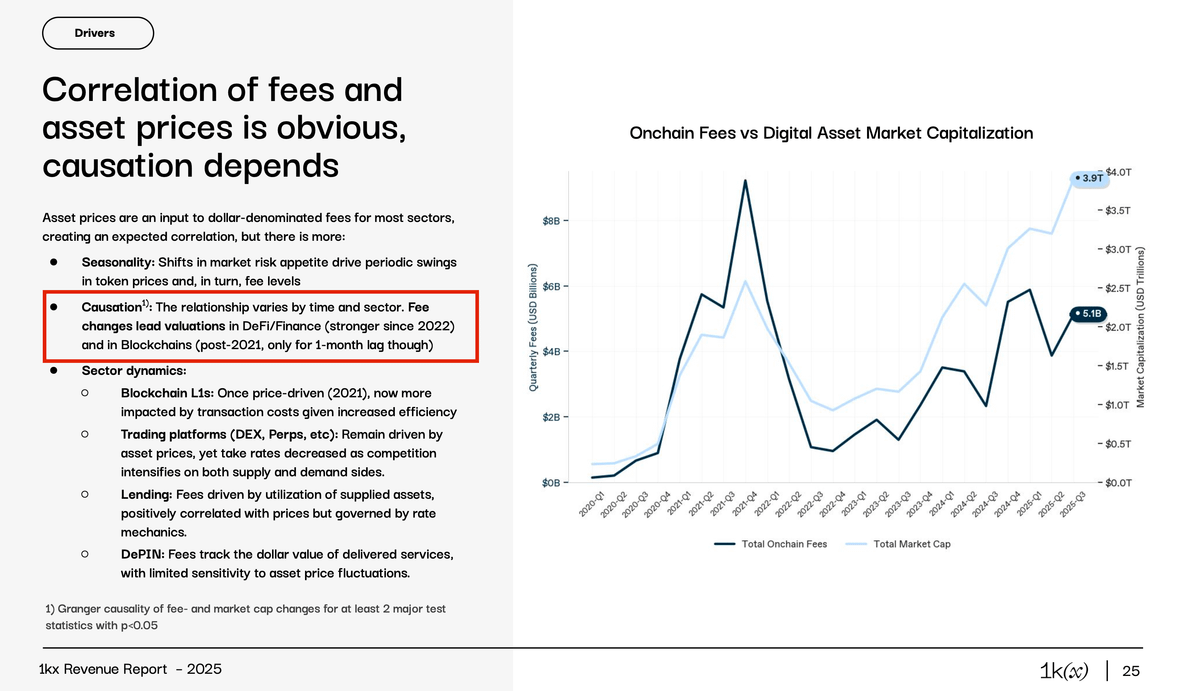
No shortage of debates surrounding protocol fees and valuations, but what does the data say? We covered this in our Onchain Revenue Report - now let’s do a deeper dive on causation. While many factors dictate token prices, the data suggests fundamentals are chief among them 👇
We're hosting this event next week for @EFDevcon in Buenos Aires.
+ Actively leading rounds! (we're the most active we've been this year)
Amidst the market chaos, we continue to show up ready to catchup with our network and meet new community members.
Me and our team included: @_weidai@nichanank@jakub_rusiecki@Mikey0x_@Explorerdfa will all be here and would to meet.
I’ve been in crypto for over a decade, and one question from outsiders and skeptics kept being asked: “What is the value that crypto provides?”
We at 1kx are trying to answer this question once and for all: by surfacing onchain fees as the best indicator of repeatable utility that users and firms are willing to pay for. As protocols mature and regulation improves, the ability to generate and distribute consistent fee revenue will separate durable networks from early-stage experiments.
We think that digital tokens are primarily misunderstood as speculative assets for retail investors. We say they can evolve into an investable asset class for a broader, more sophisticated set of market participants, where token networks achieve product–market fit and sustainable business models.
We @1kxnetwork just released the most extensive report on monetization of the crypto industry to date:
The 1kx Onchain Revenue Report (H1 '25) aggregates verified onchain fee data across 1,200+ protocols - mapping where users pay, how value flows, and which sectors are driving growth👇
@0xCosmico @gem_insider@Karak_Network@BillyBobBaghold strange that no one has said anything about it at all... also I think vested tokens were unlocked yesterday idk what's going on
@0xCosmico @gem_insider@Karak_Network I’ve been wondering the same thing… based on the number of bots that have been tweeting about buying $vec the past week I think it’s a rug. Shocked no one has said anything about it/announcement hasn’t been made..