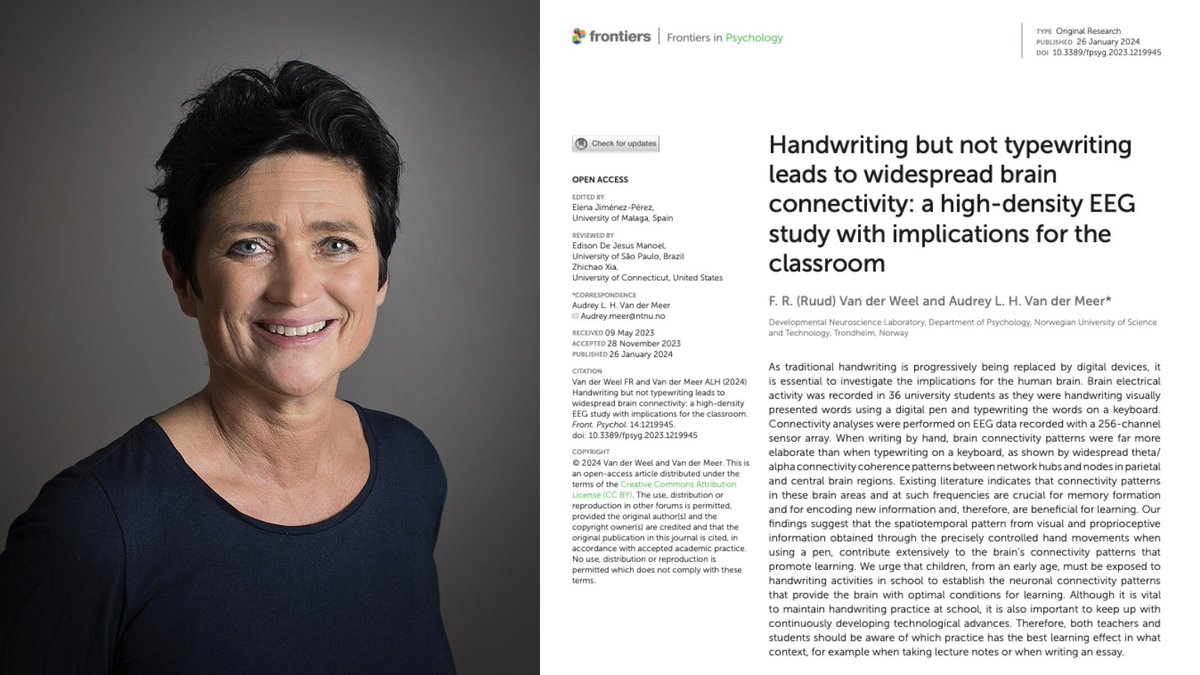
A Norwegian neuroscientist spent 20 years proving that the act of writing by hand changes the human brain in ways typing physically cannot, and almost nobody outside her field has read the paper.
Her name is Audrey van der Meer.
She runs a brain research lab in Trondheim, and the paper that closed the argument was published in 2024 in a journal called Frontiers in Psychology. The finding is brutal enough that it should have changed every classroom on Earth.
The experiment was simple. She recruited 36 university students and put each one in a cap with 256 sensors pressed against their scalp to record brain activity. Words flashed on a screen one at a time.
Sometimes the students wrote the word by hand on a touchscreen using a digital pen, and sometimes they typed the same word on a keyboard. Every neural response was recorded for the full five seconds the word stayed on screen.
Then her team looked at the part of the data most researchers had ignored for years, which is how different parts of the brain were communicating with each other during the task.
When the students wrote by hand, the brain lit up everywhere at once.
The regions responsible for memory, sensory integration, and the encoding of new information were all firing together in a coordinated pattern that spread across the entire cortex. The whole network was awake and connected.
When the same students typed the same word, that pattern collapsed almost completely.
Most of the brain went quiet, and the connections between regions that had been alive seconds earlier were nowhere to be found on the EEG.
Same word, same brain, same person, and two completely different neurological events.
The reason turned out to be something nobody had really paid attention to before her work. Writing by hand is not one motion but a sequence of thousands of tiny micro-movements coordinated with your eyes in real time, where each letter is a different shape that requires the brain to solve a slightly different spatial problem.
Your fingers, wrist, vision, and the parts of your brain that track position in space are all working together to produce one letter, then the next, then the next.
Typing throws all of that away. Every key on a keyboard requires the exact same finger motion regardless of which letter you are pressing, which means the brain has almost nothing to integrate and almost no problem to solve.
Van der Meer said it plainly in her interviews.
Pressing the same key with the same finger over and over does not stimulate the brain in any meaningful way, and she pointed out something that should scare every parent who handed their kid an iPad.
Children who learn to read and write on tablets often cannot tell letters like b and d apart, because they have never physically felt with their bodies what it takes to actually produce those letters on a page.
A decade before her, two researchers at Princeton ran the same fight using a completely different method and ended up at the same answer. Pam Mueller and Daniel Oppenheimer tested 327 students across three experiments, where half took notes on laptops with the internet disabled and half took notes by hand, before testing everyone on what they actually understood from the lectures they had watched.
The handwriting group won by a wide margin on every question that required real understanding rather than surface recall.
The reason was hiding in the transcripts of what the two groups had actually written down.
The laptop students typed almost word for word, capturing more total content but processing almost none of it as they went, while the handwriting students physically could not write fast enough to transcribe a lecture in real time, which forced them to listen carefully, decide what actually mattered, and put it in their own words on the page.
That single act of choosing what to keep was the learning itself, and the keyboard had quietly skipped the choosing and skipped the learning along with it.
Two studies. Two countries. Same answer.
Handwriting makes the brain work. Typing lets it coast.
Every note you have ever typed instead of written went into your brain through a thinner pipe. Every meeting, every book highlight, every idea you captured on your phone instead of on paper was processed at half depth.
You did not forget those things because your memory is bad. You forgot them because typing never woke the part of the brain that would have made them stick.
The fix is the thing your grandmother already knew.
Pick up a pen. Write the thing down. The slower road is the faster one.
Palmerston, Diplocat extraordinaire, passed away peacefully on 12 February. “Palmy” was a special member of the Government House team in Bermuda, and a much loved family member. He was a wonderful companion, with a gentle nature, and will be sorely missed.
Ivermectin and Polysorbate 80: rabbit hole🤔🤔
Rockefellers planned all this with operation lockstep in 2010.
⚡️For pulling out metals organic papaya seeds, dragons blood, baking soda, or Turpentine.
Papaya + Heavy metals detoxing: https://t.co/XO6mD4LLqQ
People love to assume I’m sad because I am childless, but they couldn’t be more wrong. In fact, I’m deeply grateful to be in the position I am right now. Here’s why:
Until a year and a half ago, I was literally dying. If I had brought children into the world at that time, they would have inherited terrible health—impaired thyroid function, mineral deficiencies, a compromised gut microbiome, and hormonal imbalances. They would not have been healthy children.
Instead, I made the conscious decision to fix my health first and ensure I’m in a stable, low-stress position in life before even considering having children.
And I highly encourage others to do the same. Too many children are being born to sickly, metabolically-impaired women, and are themselves weak, sickly and challenged: you can literally see it.
I firmly believe women should prioritise getting healthy before considering pregnancy.
Beyond health, I’m actively working on my financial stability so I can provide my future children with the best food, the best housing, the best education, and the best care possible, because that’s what sets them up for real success in life.
Glorifying poverty is not noble-it’s reckless. Just having kids for the sake of it, while being in poor health, financially unstable, or unable to breastfeed due to hormonal imbalances, means your child will carry those burdens, maybe for the rest of their lives.
To be crystal clear: the idea that women have some tiny window for pregnancy is a complete myth. Pregnancy is possible well into the 40s and even 50s, and research consistently links later pregnancies with greater longevity and improved maternal health outcomes. Dr Abud Bakri has discussed this recently, and Dr Ray Peat himself pointed out that women who conceive later often have better hormonal environments and healthier pregnancies. It’s not about when you have children, it’s about having them in the best possible conditions.
And let’s talk about isolation. Too many women today are raising children completely alone, without the support of extended family, like it has been historically, in an era where relationships are disposable and divorce is common.
This isn’t the 1950s, where social pressure forced people to stay together. The reality today is different: choosing the wrong father has real consequences. I can confidently say I wouldn’t have made the best choice 5 or 10 years ago because of my poor metabolic health.
Many women already come from dysfunctional families; and aren’t even in a position yet to choose wisely, and that’s something that has to be factored in. Dysfunction breeds dysfunction.
So instead of indulging in utopian thinking and naive nostalgia, let’s actually face reality. Tradition is not about going backwards; it’s about moving forward, adapting, and carrying the best of the past into the future.
Bioenergetics teaches us to adapt to our environment, not force outdated models onto a world that no longer functions that way. We should be evolving with the times, not clinging to a version of the past that no longer exists.
The real question should be about how we can thrive within the reality we live in. Given the current environment and the challenges we face, health-wise, socially, politically, and economically, how do we build strong, resilient families? How do we create better systems of support for women, children, and communities, rather than shaming and dividing each other over impossible standards?
We should be finding solutions that actually work. How can we adapt to modern challenges while preserving the core values that matter; reclaim community, intergenerational support, and financial stability in a way that makes sense TODAY, rather than just pretending we can return to a past that no longer exists?
Tradition should not be a rigid, nostalgic fantasy. It should be something we refine, strengthen, and carry forward. That’s the conversation I’m into.
I wish you all health and happiness 💙.
🚨🇺🇸 South Carolina to launch investigation into Dr. Anthony Fauci ‼️
Biden’s pardon doesn’t extend to State prosecutions - the Hammer of Justice is coming.