@Pontifex Person behind this attack is visiting USA and talking about religious harmony. If you don't raise strong objection and get his visa cancelled many more such attack will happen.
Members of Hindu Sanghati attacked a Christian prayer meeting, vandalised property, and harassed attendees, alleging that they were involved in religious conversion to Christianity through healing and inducements.
Location: Uluberia, Howrah, West bengal. Date: August 23
@SCSTOBC_voice Even better way is make issuance of caste certificate so difficult that no one gets benifit of reservation. I was shocked when I went for caste certificate for my self. Check once
“Foreign Algorithms Are Quietly Conditioning the Minds of India’s Youth” - Mallika Bajaj
Digital transformation architect Mallika Bajaj, who studies how technology shapes the way people learn, behave and think, raises a provocative question: Are foreign social media algorithms conditioning the minds of India’s youth?
She describes this as a form of “cognitive warfare” driven by an Algorithmic Cognitive Reinforcement Loop (ACRL), where engagement-driven platforms can end up rewarding the “Four Vs” - Viciousness, Virality, Vulgarity and Violence, over truth and nuance.
Her argument is that India needs to think seriously about cognitive neural sovereignty, responsible technology, and the development of indigenous digital capabilities.
An important conversation about technology, algorithms and the battle for attention and ultimately, for minds.
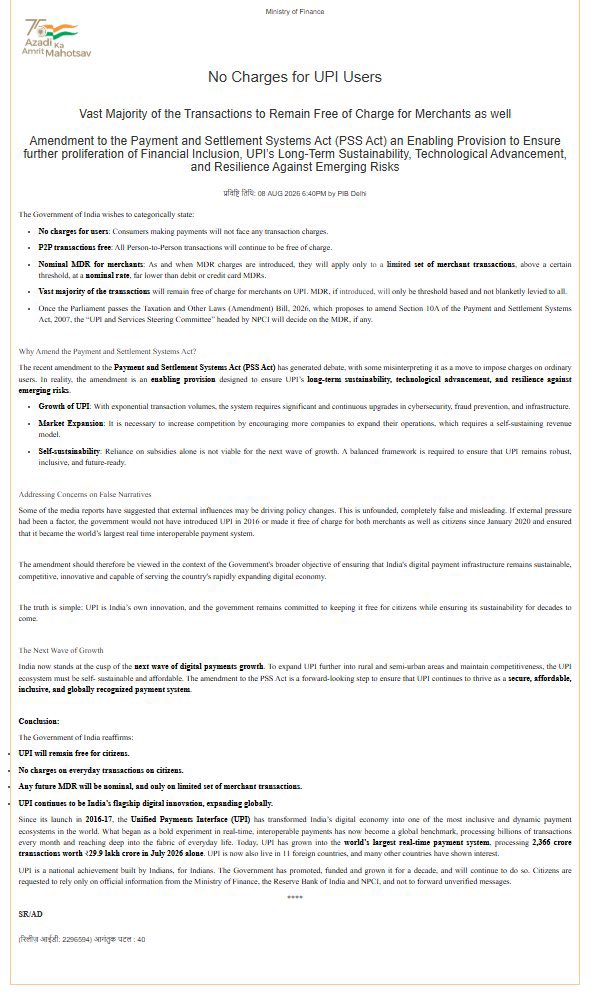
Remember the noise over UPI? “UPI will no longer be free.” “Modi government is going to charge citizens.” “Foreign pressure is behind this.”
The Ministry of Finance has now put the facts on record. The entire narrative was misleading.
Here is what the government has categorically clarified:
1. No charges for UPI users.
Consumers making payments through UPI will not face transaction charges.
2. Person-to-person UPI remains free.
P2P transactions will continue to be free of charge.
3. No charges on everyday citizen transactions.
There is no proposal to impose a charge every time an ordinary citizen scans a QR code or pays through UPI.
4. MDR, where introduced, will be limited.
Any Merchant Discount Rate will apply only to a limited set of merchant transactions above a specified threshold, with rates lower than debit or credit cards.
5. The vast majority of merchant transactions will remain free.
The government has made it clear that the bulk of UPI merchant transactions will continue without charges.
So what is the amendment actually about?
UPI has grown from a pioneering digital-payment system into the backbone of India’s digital economy. With transaction volumes exploding, the ecosystem needs sustained investment in cybersecurity, fraud prevention, infrastructure and technological upgrades.
The government’s stated objective is therefore to create a self-sustaining, competitive and resilient payment ecosystem, rather than relying indefinitely on subsidies.
And this also demolishes another manufactured narrative: that some external power is dictating India’s UPI policy.
The government points out a simple fact: UPI was introduced in 2016, and it has remained free for citizens since January 2020. It has become one of the world’s largest real-time payment systems precisely because India built and scaled it on its own terms.
The bottom line is crystal clear:
✅ UPI remains free for citizens.
✅ No charge on everyday transactions by citizens.
✅ P2P UPI remains free.
✅ Any MDR will be confined to a limited set of merchant transactions.
✅ The vast majority of merchant transactions will remain free.
✅ UPI will continue to remain a flagship pillar of India’s digital innovation.
Those who rushed to declare that “UPI is no longer free” were either deliberately misleading people or simply did not bother reading the facts.
The government has clarified. The misinformation should end here.
Another day, another front-page “investigation” by the Indian Express that falls apart under scrutiny.
The newspaper has attempted to manufacture a controversy around the Government’s ₹2,192 crore RDI Fund by insinuating that companies were favoured because some Investment Committee members had past professional or investment associations with them. The facts, however, tell a very different story.
The Government has unequivocally clarified that none of the Investment Committee members who participated in approving any proposal had a conflict of interest. Every potential conflict was disclosed in accordance with the RDI Fund guidelines, and wherever a member had any connection with an applicant, they recused themselves completely from the evaluation, discussion and voting process. No conflicted member participated in any funding decision.
The Indian Express headline deliberately conflates association with participation in decision-making. In India’s relatively small deep-tech ecosystem, domain experts often have prior academic, professional or investment links with startups. The RDI framework was designed precisely with this reality in mind, not by excluding expertise, but by regulating it through internationally accepted safeguards of disclosure, mandatory recusal and collective decision-making.
The safeguards are extensive:
• Independent expert evaluation of every proposal.
• Mandatory disclosure of all interests.
• Mandatory recusal wherever any potential conflict exists.
• Approval only through a supermajority of eligible members.
• Government officials do not determine technical merit, and the Member Secretary has no voting rights.
• Final approval rests with the Technology Development Board after due process.
The report also creates the false impression that Government funds were handed out to companies. That is incorrect. The RDI Fund supports specific research and technology development projects, not companies as entities. These are soft loans tied to defined milestones, requiring matching private investment mobilised after approval and subject to rigorous oversight.
Equally misleading is the suggestion that prior investments by angel investors or venture capital funds somehow taint the process. Deep-tech startups typically raise equity in their early stages because conventional lenders do not finance high-risk research. The Government has clarified that investments made before a proposal is submitted have no bearing whatsoever on project evaluation, while investments made after approval are independent commercial decisions by private investors. Neither influences the Government’s appraisal process, which is based solely on scientific merit, technological innovation and national importance.
Ironically, several of the projects highlighted had already undergone independent evaluation through national innovation platforms or had previously received technology support from TDB long before attracting venture capital. Instead of recognising India’s emerging deep-tech ecosystem, the Indian Express has chosen to sensationalise normal professional relationships into a conspiracy.
This is not investigative journalism. It is guilt by association, a classic attempt to create suspicion where the institutional record shows transparency, disclosure, recusal and merit-based evaluation.
India’s deep-tech ambitions deserve serious journalism, not clickbait headlines. When every safeguard has been followed and no conflicted member has participated in any funding decision, the only thing exposed is the Indian Express’s willingness to sacrifice facts for a sensational front page.
Let’s start with Punjab.
You still have a government in the state. If you are so convinced that E20 is harmful, withdraw it from Punjab within the next five days.
Lead by example instead of spreading misinformation. If you won’t implement your own prescription where you govern, why should anyone take your claims seriously?
Punjab government employees are on the streets, protesting against the AAP government over pending Dearness Allowance, pension-related demands, and other long-standing grievances.
Punjab is reeling under colossal misgovernance. Government employees are agitating, finances are under stress, and governance has visibly deteriorated.
That is precisely why Arvind Kejriwal is desperately trying to manufacture distractions, from E20 to MDR, instead of answering for his government’s failures in Punjab.
Diversion is not governance. The people of Punjab deserve answers, not manufactured outrage.
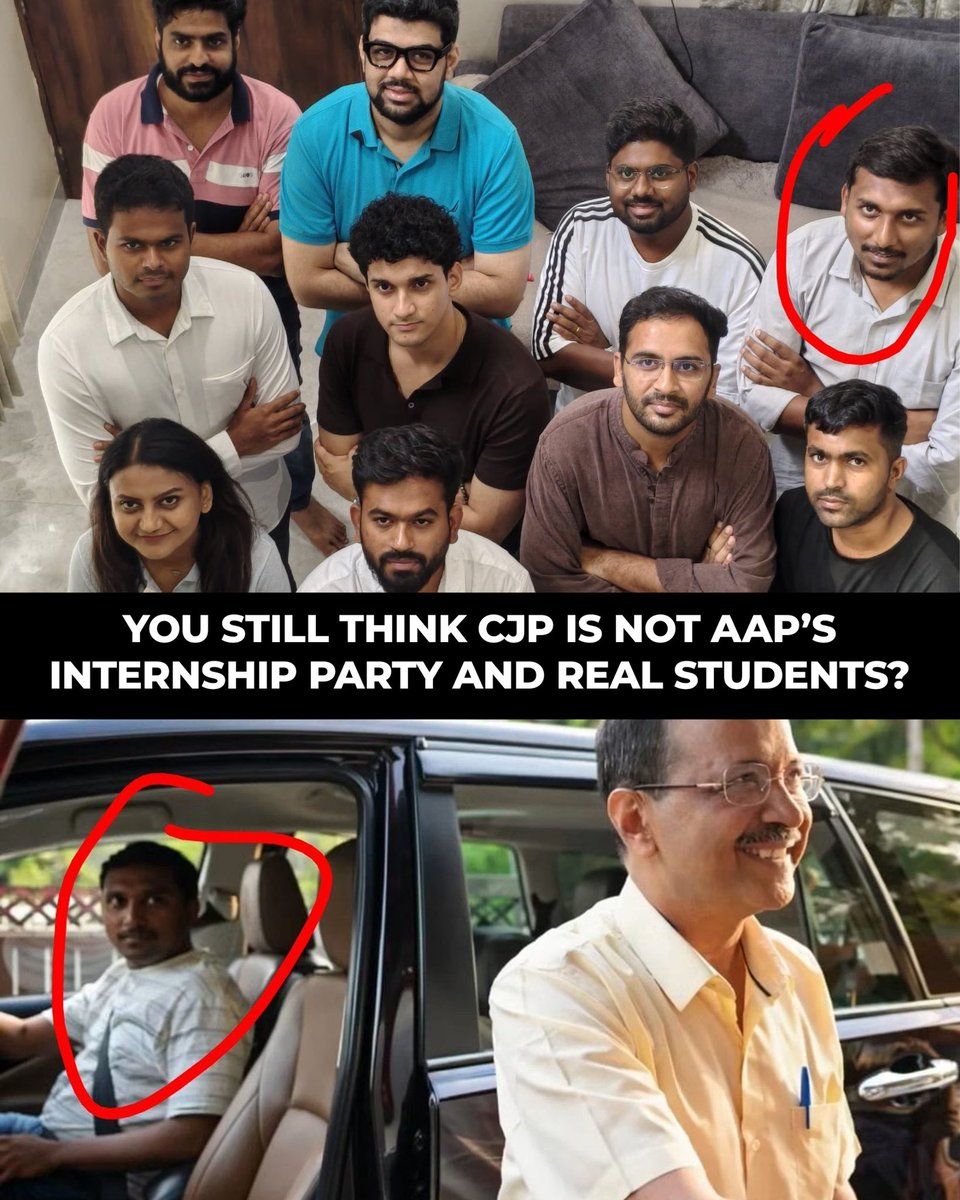
Interesting coincidence.
Arvind Kejriwal’s driver is also part of the core team of CJP.
The same ecosystem, the same faces, the same political agenda, only the labels keep changing.