Global Lead, Competitive Intelligence. Passionate about drug discovery in oncology. Former Postdoc, Oncology at @Servier. PhD at @VHIO. @Univcordoba alumnus.
Hermano,
Has ganado el mundial. Has hecho historia. 🥹❤️
Pero más allá del trofeo, gracias por esto: has hecho que millones de inmigrantes como nuestros padres se sientan orgullosos de que sus futuros hijos algun dia puedan vivir lo que tu has vivido y de que millones de españoles empaticen con nuestra historia que no es solo la nuestra sino la de todas las personas que dejan todo atrás por un futuro mejor, porque has tocado el cielo con los dedos y has demostrado que con trabajo y esfuerzo todo es posible.
Hoy el mundo te ha conocido mas si cabe y has puesto nuestro apellido en el infinito, por lo siglos de los siglos.
Te admiro. Te amo. Campeón del mundo ✊🏿🏆🥹
BREAKING: The most controversial article of the year, claiming that early morning immunotherapy works better than in the afternoon, is now retracted.
After reading the responses provided by the authors to the inconsistencies raised in the web, the @NatureMedicine editors no longer have confidence in the integrity of the results. The only prospective evidence that time-of-day matters for immunotherapy is now gone.
https://t.co/aXUY6aekhl
To me, this means (at least) two things.
First, it confirms that prudence on this topic was and remains critical. For as inexpensive it may be to give a drug earlier or later in the day, it carries a much more relevant cost: the one of scientific integrity. We owe our patients to make decisions based on solid data. We should not give up this practice too easily, particularly in the presence of several concerning red flags.
Second, this retraction should also prompt a broader reflection on the current state of peer review, in which unpaid reviewers struggle to keep up with a steady rise in submitted papers. Journals need to improve the process by implementing a formal, consistent, in-depth review of each paper by paid professionals. A practice that, in this case, may have avoided a retraction arriving after 22 citations and after inclusion of this study in at least one meta-analysis. And possibly, after some physicians had already changed their practice in IO administration.
For a thoughtful recap of this story, I recommend this well-written new piece in @ScienceMagazine by Laura Agudelo. I’m grateful to Laura for including my perspective in the article.
https://t.co/qHM5fMjwQ3
Drug development is supposed to be linear.
Build the drug → use the drug → resistance shows up → then figure out what to do next.
Aaaand not what Revolution Medicines is doing. 🧬
At #AACR26 they disclosed RM-055, which honestly is a unique concept.
Before daraxonrasib is even fully in the world, they’re building around resistance.
How it works:
• Most mutant RAS proteins are relatively resistant to GAP-mediated hydrolysis
• That helps keep RAS in the active state
• They’ve found a way to enhance that hydrolysis with RM-055
RM-055 can:
• restore hydrolysis in mutant RAS
• flatten daraxonrasib-resistant models
• generate activity even in RAS-amplified settings 👀
That’s a very smart way to think about this space.
Not just “here’s our inhibitor.”
More like: we already know resistance to our drug is coming, so let’s start building now.
That’s how we cure cancer, not more me-toos (if I hear about another new PD1 program I’m going to cry).
@OncoAlert@TheGutOncLab@Onco_Nexus
@bertrandmyd Muchos con nombres cristianos como tú están siendo explotados en invernaderos, con menos derechos que una rata. No solo eres una vergüenza para las personas negras, eres una desgracia para la humanidad. Por suerte para ti, tu falta neuronas tal vez haga que no seas consciente.
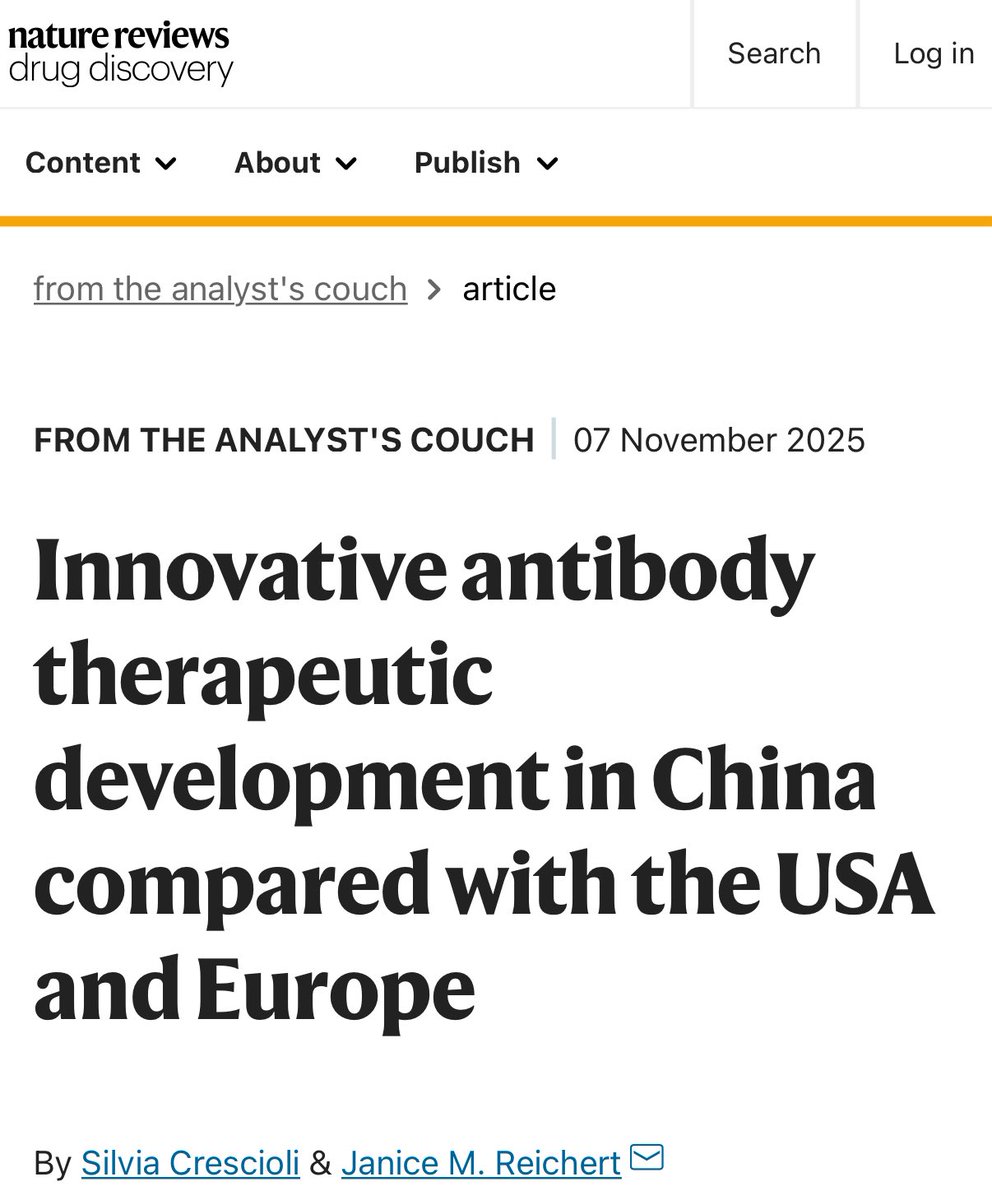
ADCs and multi-specific antibodies are transforming oncology at an unprecedented pace. Of note, of 500 “enhanced mAbs” in the pipeline, > half come from China. If the current trend continues, China is expected to dominate this therapeutic sector within 5y. https://t.co/N3dCaLdwUZ
Twenty Years In Early Stage Biotech VC (Part 1)
Here are some observations on the “Science” of startups from my vantage point as an early stage VC…
· Science-first opportunism beats top-down strategy for deal selection
· Don’t believe what you read in science papers at face value
· Don’t over-value reductionism, but also avoid phenotypic over-enthusiasm
· Rare disease drug development isn’t as “easy” as it seems on paper
· The single most important value creation activity in biotech is excellent clinical trial execution
· Novelty is great, but only when it’s unlocking something truly valuable to patients.
· Be skeptical, as most things fail, but embrace “a permission to believe”
· Understand the real risk you are underwriting and the value of discharging it
· Seek the scientific truth, not just “making money”.
· Innovation and optimism are tightly interconnected – and have been ever present in biotech
https://t.co/z6S4k7xtXi
Large Pharma accelerates U.S. manufacturing investments to mitigate upcoming tariffs
- Announced ~$368B of planned investments in U.S. manufacturing, with nearly half having already announced breaking ground
Source: William Blair
The precancer microenvironment (PME) is related to - yet distinct from - the tumor microenvironment (TME).
All studies on precancer biology & progression should incorporate a detailed assessment of the PME. In many respects, this is the linchpin for enabling cancer interception.
Mi hija me pidió que la cambiara de colegio.
Así. Sin lágrimas. Sin enojos. Sin rabia.
Solo se me acercó mientras yo preparaba la cena y dijo despacio:
—“¿Puedo estudiar en otro lugar?”
Le pregunté si había pasado algo.
Me dijo que no.
Le pregunté si no tenía amigas.
Me dijo que no sabía.
Entonces le pregunté si alguien la trataba mal.
Y se quedó callada.
Esa noche no pegué los ojos.
Al día siguiente inventé que tenía que hablar con la directora.
Pero en realidad fui a mirar.
Me quedé en un pasillo y esperé al recreo.
Y ahí la vi.
De pie junto a la verja, con el termo en la mano, mirando al suelo.
Un grupo de niñas pasó y se empujaron entre ellas riéndose.
Un niño le tiró el jugo en la blusa y salió corriendo.
Otra niña le sacó una foto escondida con el celular y la mostró entre risas.
Ella no dijo nada.
Solo apretó los labios.
Como si ya estuviera acostumbrada.
Pero lo que más me dolió no fue eso.
Fue ver que una profesora pasó justo en ese momento.
La miró.
Miró a los otros.
Y siguió caminando como si nada.
Como si mi hija fuera invisible.
Después escribí al colegio.
Les conté lo que ella me había insinuado.
Que en el aula le escondían los cuadernos.
Que en los pasillos le ponían sobrenombres.
Que en el grupo de WhatsApp se burlaban de sus fotos.
Me respondieron con la típica frase:
—“No se preocupe, son cosas de muchachos. Lo estamos manejando.”
Pero no hicieron nada.
Nada.
Esa tarde, al volver a casa, me preguntó bajito:
—“¿Ya lo pensaste?”
Le respondí que sí.
Y que no tenía que volver más a ese colegio.
No preguntó por qué.
Solo dejó su mochila en la esquina y respiró profundo.
Como quien por fin suelta un peso que llevaba cargando sola.
Ahora estudia en otro lugar.
Ni más grande.
Ni más moderno.
Solo más humano.
Donde la miran a los ojos.
Donde la llaman por su nombre.
Y donde no tiene que hacerse pequeña para no ser molestada.
Porque un niño —o una niña— no pide un cambio de colegio por antojo.
Lo pide cuando ya no puede más.
Y lo más desgarrador no es lo que hacen sus compañeros…
sino lo que no hacen los adultos que se supone debían cuidarla.
Y ojalá esto no fuera tan común.
Ojalá no fuera yo una de tantas madres que aprendió demasiado tarde.
Porque hay algo que nunca se olvida:
el día en que tu hija te pide, casi en susurros,
que la saques del único lugar donde debería sentirse protegida.
Historia anónima
Biotech leaders - Pharma oncology revolves around backbones & modality-agnostic combos. Miss this and you'll misposition your portfolio.
@sleuthinsights AI agents analyzed every major Pharma oncology pipeline over the last few years, tracking modality shifts, combo strategies and deal patterns. A few portfolio strategy principles emerged.
First, the importance of the backbone:
Every cancer treatment generation has a backbone therapy effective across tumors (most recently, PD-L1 inhibitors; in the near future, perhaps PD-L1 x VEGF - which explains the deal flurry here). Pharma must own this internally - it's table stakes for controlling clinical development destiny.
This explains why every Pharma pursued their own PD-(L)1, despite becoming a meme for inefficient R&D ("do we really need another.."). It doesn't matter if the drug sells well, without it, you're at the mercy of partners for combo development.
And that's the key: growth comes from smart, synergistic combo plays on top of backbones. And Pharma's betting on modality-agnostic approaches to get there.
~5 years ago, most Pharma pipelines had 1-2 modalities per company. Today we see ADCs, TCEs, multispecifics, targeted therapies and radioligands all in one portfolio, and all frequently combined.
Platform concentration is too risky. Cell therapy's decline is cautionary - big infrastructure bets can get leapfrogged by more nimble modalities (i.e. BsAbs) that offer similar or superior efficacy, cleaner manufacturing & modular combo potential.
The new playbook is modality flexibility + tumor-specific expertise. For Pharma, the goal is 1L treatment ownership in large patient populations. The mandate is to get there by any means necessary (modality-agnostic). And in a post-IRA world with exclusivity clocks starting at 1st indication, you can't just build up from late-line approvals in smaller indications.
Branding around a large, specific tumor means:
• ROI to commit multiple shots on goal
• Compounding KOL / PI / provider / patient relationships for efficient trial execution
• Flexibility to pivot modalities as needed
For biotech leaders, 3 critical positioning strategies:
1. Lead with combo rationale. Don't pitch standalone assets. Show exactly how you enhance their backbone strategies.
2. Map to tumor franchises. Understand which Pharma are investing in your tumors so you can position as the missing piece (@sleuthinsights maps this for you)
3. Design around future backbones. Synergistic data here can transform a BD process.
If you're developing oncology assets and want to see how your portfolio maps against Pharma's evolving strategies, DM me! Our AI platform tracks every pipeline globally to spot strategic gaps before your competitors do.
Comment below for a hi-res PDF.
🆕🗞️Hot off the press! @NatureMedicine#KRAS Vaccine💉for patients with RAS➕cancers🎯.
Benefit➡️durable.🙌🏽
More to come with the randomized study📚✔️!
Opens to doors to off the shelf vaccine for so many patients with KRAS/NRAS mutations.
@OncoAlert
🔗https://t.co/ihKZWxGTLE
I read this Cell paper that argues to have discovered a molecule (betaine) that mimics the geroprotective effects of exercise.
This is a very valuable multi-omics resource, but the authors seemed to get caught in the rabbit hole of chasing a high-impact narrative🧵
Tomorrow is the 20th anniversary of Be. It’s hard to grasp that it was 20 years ago. What Ye was doing was super special, what J Dilla was doing was super special and I am forever grateful to them and everyone who contributed to this album. Be means so much to me because I have had so many different types of people tell me what it means to them. And there is no greater feeling than to have your music mean something. Thank you GOD you are the greatest.
In celebration of this album, we have pressed a 2LP translucent yellow marble blend. This limited-edition vinyl includes the original track list on LP 1 and the albums instrumentals on LP 2. The first 750 copies will include a signed print from me of the album cover.
We have also released a deluxe version on all streaming services which features the album, instrumentals, and these bonus cuts. Go check it out wherever you listen to music and celebrate 20 years of Be with me. https://t.co/KLM22wiSZ3
- The Corner (Remix) Feat. Mos Def & Scarface
- The Corner (Last Poets Reprise)
- Go! (Remix) Feat. Joy Denalane
- The Food (Main Version) Feat. Kanye West
- So Cool Feat. Sa Ra
Love,
Rashid