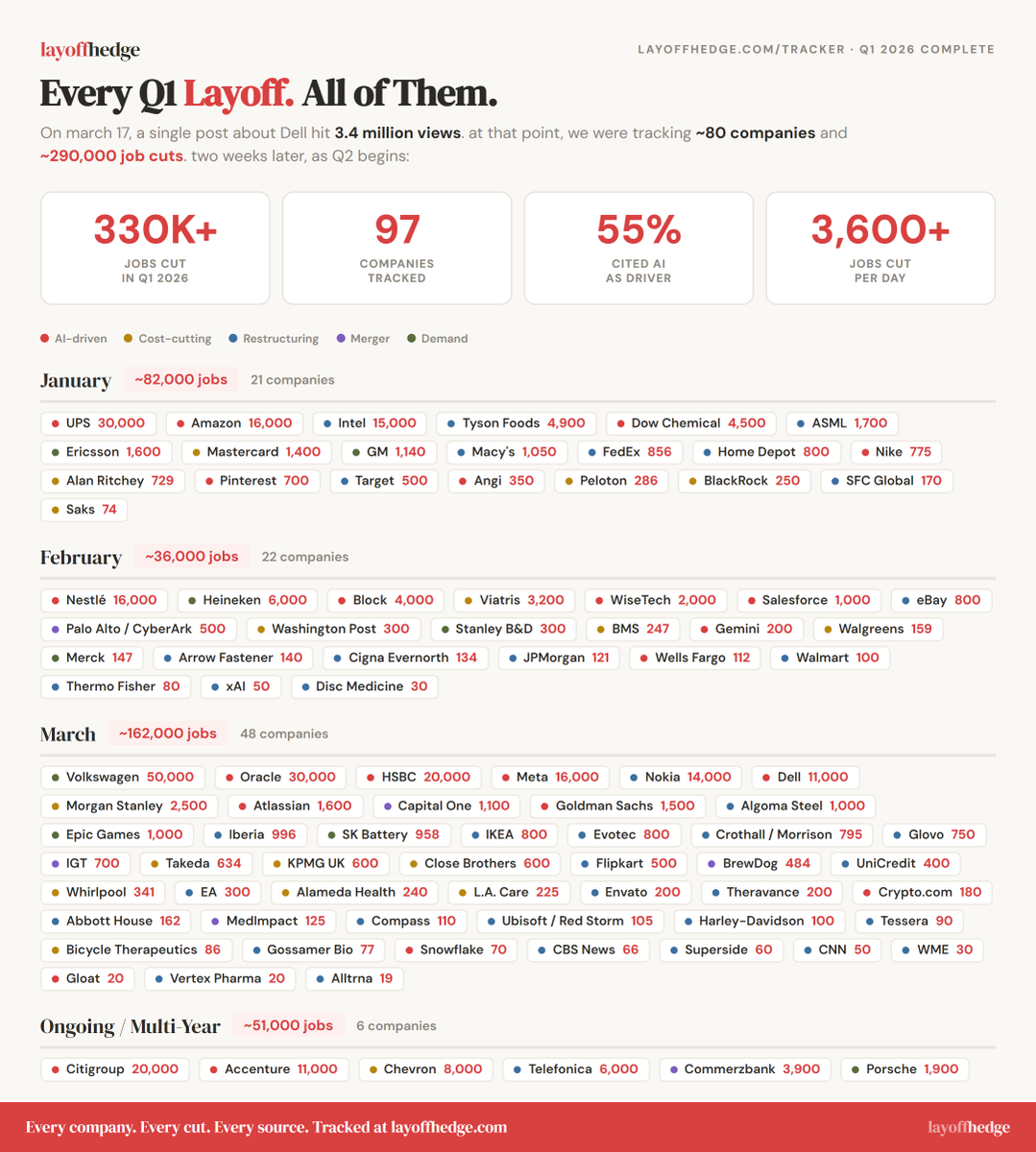
Dell’s 11K cut went viral two weeks ago.
Since then:
Oracle: 30,000
HSBC: 20,000
Meta: 16,000
Nokia: 14,000
We’re already tracking 100+ more companies expected to cut in the next 3 months.
Here’s the full Q1 2026 recap. Buckle up for Q2.
PYTHON is not difficult to learn, but it's important to Master its fundamental concepts !
Introducing "Master Python Fundamental" PDF.
You will get:
• 70+ pages
•Save 100+ hours on research
• And for 24 hrs, it's 100% FREE!
To get it, just:
Like ❤️
REPOST
Reply "PYTHON"
Follow @beginnersblog1 (so that I can DM)
ChatGPT has now a serious competitor.
Anthropic has just released Claude 2 and it's really powerful.
Here's why you should use Claude 2 instead of ChatGPT (for free):
[Thread]
Fullstack Web Development Bootcamp!
Master Your Full Stack Web Development Skills and Start Earning Instantly!
Course Download Links:
Part-01
https://t.co/3Vapaqcmta
Part-02
https://t.co/uqiJUpLS6u
For the latest tech knowledge, updates, career growth, and insights, make sure to Follow @ZabihullahAtal
All the best!
On 10 November, during a live stream from Al Gad TV, a reporter captured the moments when Israel targeted the vicinity of the Indonesian Hospital in Gaza. After wearing his safety helmet, the reporter quickly returned to the live stream
Explaining 9 types of API testing. Next week's topic will be listed at the end.
🔹 Smoke Testing
This is done after API development is complete. Simply validate if the APIs are working and nothing breaks.
🔹 Functional Testing
This creates a test plan based on the functional requirements and compares the results with the expected results.
🔹 Integration Testing
This test combines several API calls to perform end-to-end tests. The intra-service communications and data transmissions are tested.
🔹 Regression Testing
This test ensures that bug fixes or new features shouldn’t break the existing behaviors of APIs.
🔹 Load Testing
This tests applications’ performance by simulating different loads. Then we can calculate the capacity of the application.
🔹 Stress Testing
We deliberately create high loads to the APIs and test if the APIs are able to function normally.
🔹 Security Testing
This tests the APIs against all possible external threats.
🔹 UI Testing
This tests the UI interactions with the APIs to make sure the data can be displayed properly.
🔹 Fuzz Testing
This injects invalid or unexpected input data into the API and tries to crash the API. In this way, it identifies the API vulnerabilities.
Next week, we will talk about:
- Our recommended materials for cracking your next technical interview (YouTube)
- How mobile releases work
- 12 Tips for API security
- What can go wrong with Caching
- Log parsing tips
Subscribe to our weekly newsletter so you won't miss it: https://t.co/uc5M7CdXXC
🌐 RESTful API Simplified 🚀
RESTful API stands for Representational State Transfer API. 🔄 It's like a 🗂️ file cabinet for data on the internet! 🌐
🔗 REST uses standard HTTP methods like GET, POST, PUT, DELETE to interact with data.
✅ GET: 📥 Fetch data (Read)
✏️ POST: 📝 Create new data (Create)
✏️ PUT: 🔄 Update existing data (Update)
❌ DELETE: 🗑️ Remove data (Delete)
🔗 REST APIs are easy to understand and work with. They use URLs as endpoints like 🌐 https://t.co/ruau3BtZgV to access data about courses.
🔵 They are stateless, meaning each request is independent. No need to remember previous interactions! 🧠
��� Data is usually exchanged in formats like JSON or XML. 📤📥
RESTful APIs are the backbone of the internet, powering apps, websites, and more! 🌍💻
🚨 Join Waiting List for New 10+ Hour Linux Course - https://t.co/EolNQecppN
#systemdesign #coding #interviewtips
Build reliable CI/CD pipelines with code
Learn how to write pipeline as code with Jenkins, Docker, and Kubernetes in Pipeline as Code: https://t.co/U0Inw8F29W.
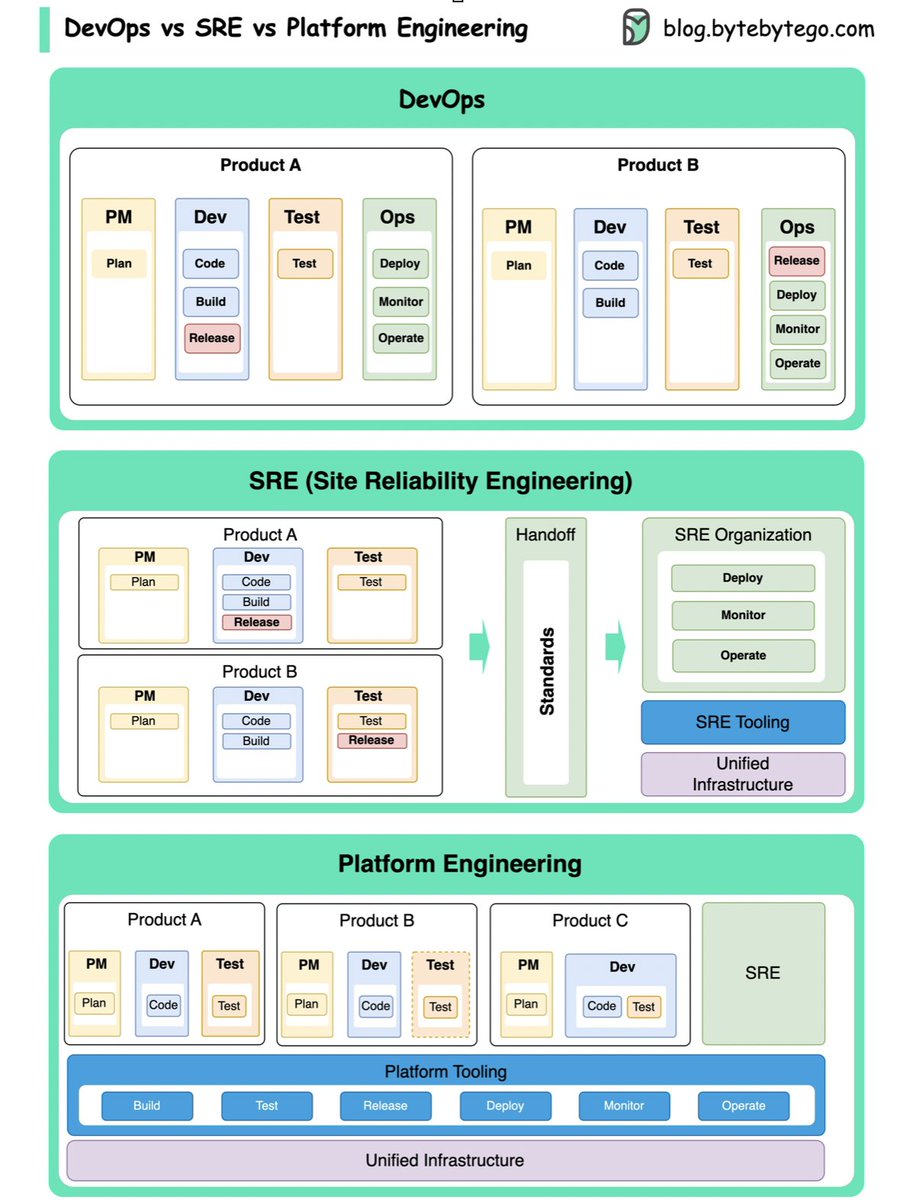
DevOps vs. SRE vs. Platform Engineering. What is the difference?
The concepts of DevOps, SRE, and Platform Engineering have emerged at different times and have been developed by various individuals and organizations.
DevOps as a concept was introduced in 2009 by Patrick Debois and Andrew Shafer at the Agile conference. They sought to bridge the gap between software development and operations by promoting a collaborative culture and shared responsibility for the entire software development lifecycle.
SRE, or Site Reliability Engineering, was pioneered by Google in the early 2000s to address operational challenges in managing large-scale, complex systems. Google developed SRE practices and tools, such as the Borg cluster management system and the Monarch monitoring system, to improve the reliability and efficiency of their services.
Platform Engineering is a more recent concept, building on the foundation of SRE engineering. The precise origins of Platform Engineering are less clear, but it is generally understood to be an extension of the DevOps and SRE practices, with a focus on delivering a comprehensive platform for product development that supports the entire business perspective.
It's worth noting that while these concepts emerged at different times. They are all related to the broader trend of improving collaboration, automation, and efficiency in software development and operations.
Over to you: Which topics would you like us to address in our next discussion?
--
Subscribe to our weekly newsletter to get a Free System Design PDF (158 pages): https://t.co/FIzCeaWsZV
Do you believe that Google, Meta, Uber, Twitter, and Airbnb put almost all of their code in one repository?
This practice is called a monorepo.
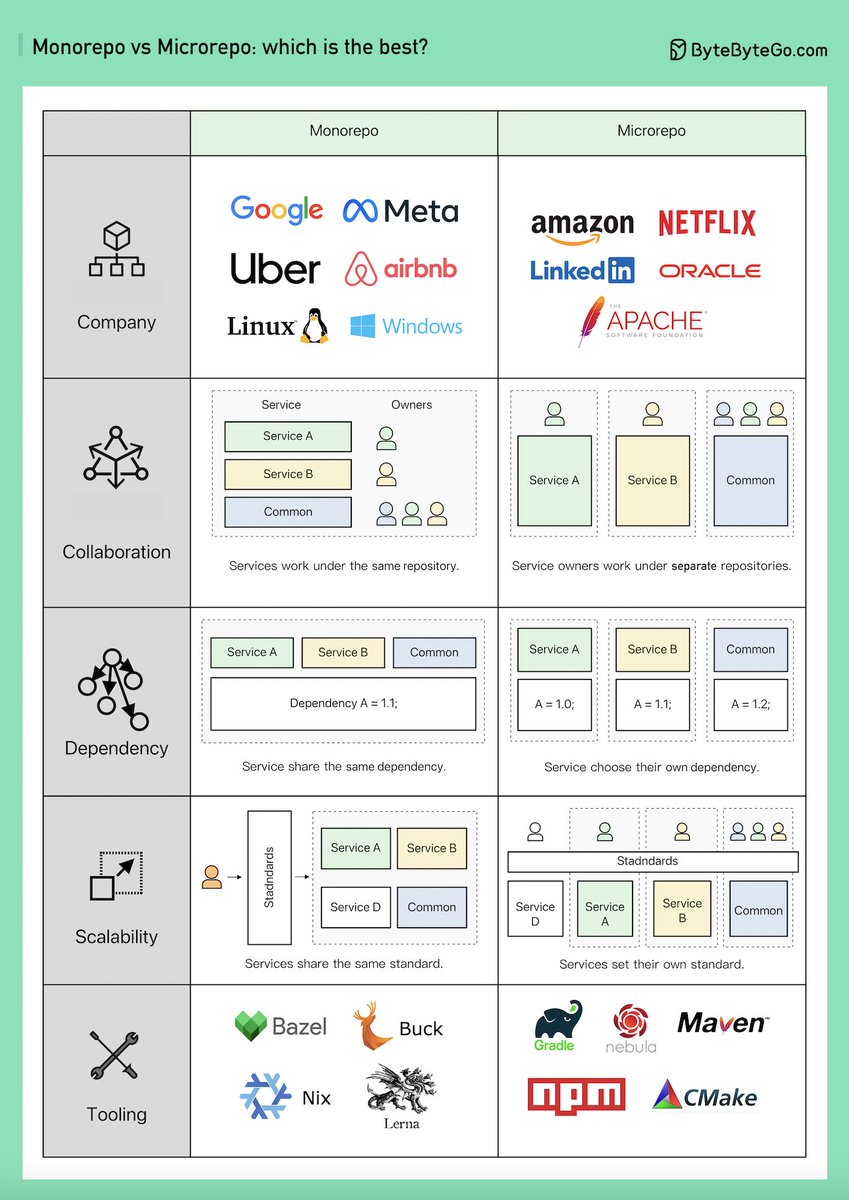
Monorepo vs. Microrepo. Which is the best? Why do different companies choose different options?
Monorepo isn't new; Linux and Windows were both created using Monorepo. To improve scalability and build speed, Google developed its internal dedicated toolchain to scale it faster and strict coding quality standards to keep it consistent.
Amazon and Netflix are major ambassadors of the Microservice philosophy. This approach naturally separates the service code into separate repositories. It scales faster but can lead to governance pain points later on.
Within Monorepo, each service is a folder, and every folder has a BUILD config and OWNERS permission control. Every service member is responsible for their own folder.
On the other hand, in Microrepo, each service is responsible for its repository, with the build config and permissions typically set for the entire repository.
In Monorepo, dependencies are shared across the entire codebase regardless of your business, so when there's a version upgrade, every codebase upgrades their version.
In Microrepo, dependencies are controlled within each repository. Businesses choose when to upgrade their versions based on their own schedules.
Monorepo has a standard for check-ins. Google's code review process is famously known for setting a high bar, ensuring a coherent quality standard for Monorepo, regardless of the business.
Microrepo can either set their own standard or adopt a shared standard by incorporating best practices. It can scale faster for business, but the code quality might be a bit different.
Google engineers built Bazel, and Meta built Buck. There are other open-source tools available, including Nix, Lerna, and others.
Over the years, Microrepo has had more supported tools, including Maven and Gradle for Java, NPM for NodeJS, and CMake for C/C++, among others.
Over to you: Which option do you think is better? Which code repository strategy does your company use?
--
Subscribe to our weekly newsletter to get a Free System Design PDF (158 pages): https://t.co/uc5M7CdXXC






![itsPaulAi's tweet photo. ChatGPT has now a serious competitor.
Anthropic has just released Claude 2 and it's really powerful.
Here's why you should use Claude 2 instead of ChatGPT (for free):
[Thread] https://t.co/0MXRkty2cR](https://pbs.twimg.com/media/F01xiDiWwAE-LVr.jpg)