My first author paper is published in Nucleic Acids Research, co-led with Satish Nandipati and Ambar Kachale.
In this work, we build on the implications of the unusual genetic code features of Blastocrithidia nonstop and...
#RNA#evolution#phd
https://t.co/dliif822yf
Trypanosomal MICOS Is Assembled on Non-Respiring Mitochondrial Crista Precursors and Associates With Two Integral Microproteins https://t.co/KZPCE3cCW6 PubMed
MiaA-mediated tRNA modifications couple tryptophan attenuation and changes in tRNA abundance to complex phenotypes in Pseudomonas aeruginosa
https://t.co/9nDBZVCLtN
I hear this argument all the time that people in academia are not there "for the money" and therefore, so the implication, you can trust them.
It's true in the sense that academics didn't chose their profession to become rich-rich. But it's untrue in the sense that they want to keep their job because most of them haven't learned anything else.
They have very strong economic incentives to want to keep their job, even though it won't make them super rich, they probably have a cozy position. And that is why they exaggerate the relevance of their work and ignore shortcomings, because the show has to go on, they need the next grant, the next job, they need to publish the next paper.
No, you cannot trust them to be honest about the relevance of their work, and for the most part you can't trust them to be honest about their colleagues work either, because their income depends on what their colleagues think about them.
A newly described role for tRNA: an architectural scaffold that helps organize the mitochondrial RNA-editing machinery of trypanosomes.
#RNA#phd#biology
https://t.co/0gjZBEHoqe
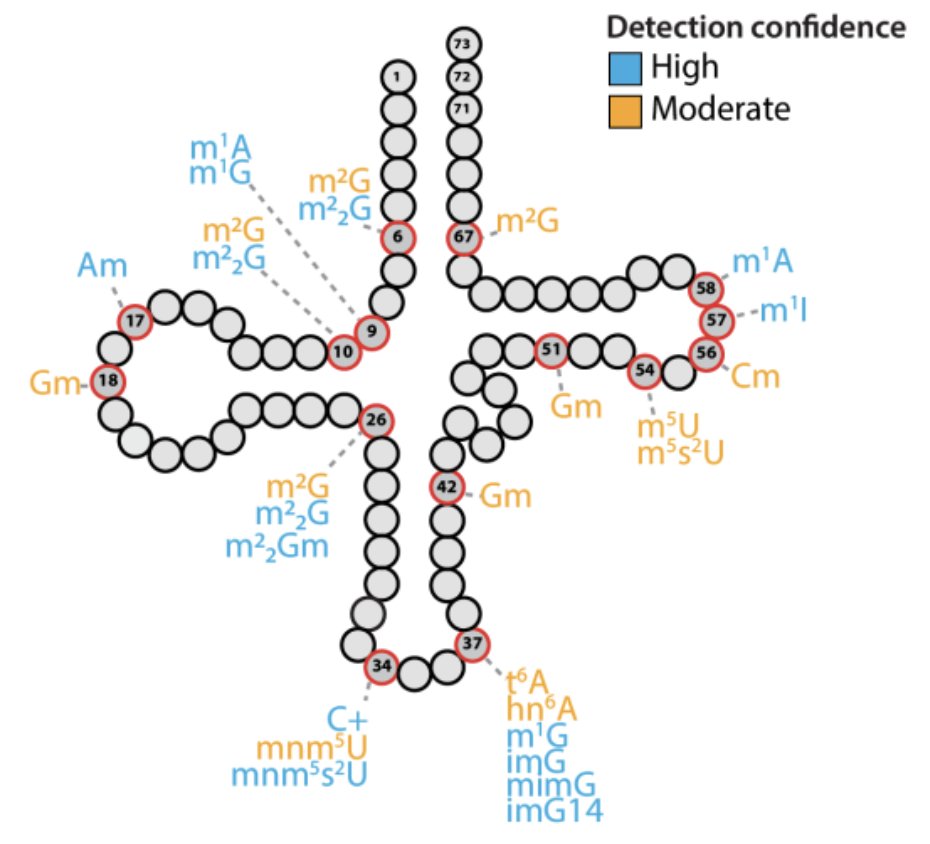
Learn about #tRNA#modification across archaeal species in our new paper
OTTR-seq profiling reveals dynamic tRNA modification landscapes across diverse archaeal species
https://t.co/hbmo4d6kqQ
Leavitt et al. Genome Biology (2026)
Since the 1960s, the genetic code has been used to predict protein sequences from DNA and mRNA sequences. Our @Nature article demonstrates that these predictions miss thousands of protein sequences present in human tissues.
Across >1,000 human samples, we identified numerous abundant proteins whose amino acid sequences differ from those predicted by the genetic code.
These proteins are not rare translation byproducts. They accumulate to thousands of copies per cell. Some are more abundant than the proteins predicted by the genetic code from the same transcripts.
Their abundance reflects a combination of alternate RNA decoding mechanisms — including codon-anticodon mismatches, tRNA abundance, and RNA modifications — and selective stabilization of the resulting proteins. The last factor – protein stability – emerges as a major determinant of protein abundance across proteins, proteoforms and cell types: https://t.co/IzOfAZKnxT
Alternate RNA decoding is pervasive across functional groups of proteins, healthy and diseased tissues. It affects proteins playing key roles in neurodegeneration, and some alternately decoded proteins show strong enrichment in tumors compared to their surrounding tissues.
This discovery has been a long and exhilarating journey with Shira Tsour and the @slavovLab team. It started in 2019 and proceeded through many challenges and thrilling highs. A journey that has opened new perspectives that we long to explore!
1/