2027 Is the Year of the Distressed Seller — The Housing's Breaking Point
Please ❤️like, bookmark🔖, and 🔁share with fellow investors
In this Short video, Melody Wright @m3_melody and @AdamTaggart discuss why 2027 could mark a major turning point in the U.S. housing market — the transition from motivated sellers to distressed sellers.
After years of homeowners holding out for lower mortgage rates, stronger demand, and better selling conditions, the financial pressure is reaching a breaking point.
*
Foreclosures are finally becoming a material factor in the housing market, just as conventional home sales are weakening dramatically.
Rising rates are pushing regular transactions even lower, reportedly beyond the weakness seen in 2023, while foreclosure sales are beginning to increase.
*
For years, median home prices remained relatively resilient because higher-end transactions and government-supported programs helped sustain valuations, while foreclosure activity remained limited.
But that dynamic is now reversing. Higher-end sales are declining, distressed transactions are increasing, and the forces that previously supported median prices could soon begin pulling them lower.
*
The critical distinction is between a motivated seller and a distressed seller.
In late 2025 and throughout 2026, many homeowners wanted to sell but still had the flexibility to wait. They could withdraw listings, reject lower offers, and hope that falling mortgage rates would eventually revive demand.
*
First, the expectation was simply to survive until 2025. Then lower rates were supposed to save the housing market. When that didn't happen, some hoped the massive data center construction boom would provide economic relief.
But those anticipated improvements haven't materialized in the way sellers needed.
*
Now, an increasing number of homeowners may no longer have the luxury of waiting another six months. They aren't selling because they want to. They're selling because they have to.
And that's where the housing market could fundamentally change.
*
Melody's biggest warning comes from early delinquencies emerging in prime mortgage portfolios associated with Fannie Mae and Freddie Mac.
These warning signs began appearing during the summer of 2026. While substantial loss-mitigation options remain available, she expects the financial deterioration to become more visible in distressed-sale numbers over the next 12–18 months.
That makes 2027 potentially just the beginning of a much larger distressed-selling cycle.
*
Could the government intervene with another foreclosure moratorium? Possibly.
But Melody believes intervention could come too late to reverse the underlying trajectory. She points to the regulatory response around 2011 as a precedent: measures may slow the process without preventing the broader adjustment.
*
The implications for home prices could be significant. When sellers can afford to wait, they can resist lower offers and restrict available inventory.
But when financial distress forces properties onto the market, that pricing power disappears.
*
2026 was the year of the motivated seller. 2027 could be the beginning of the distressed seller.
And with mortgage delinquencies potentially taking another 12–18 months to work through the system, the most consequential phase of the housing adjustment may still be ahead.
*
💡 Get access to notes with the key takeaways from this interview by visiting Thoughtful Money Substack (link in the @AdamTaggart 's bio OR in the tweet below)
11-23-26 46 Market Corrections Since 1928: What History Says Happens Next
Not all 10% market corrections are created equal. Some turn into prolonged bear markets, while others set the stage for powerful recoveries. The difference isn't simply how far stocks fall, but what's happening beneath the surface.
I analyzed 46 market declines of 10% or more since 1928, examining forward returns over 1, 3, 6, 9, and 12 months when the RSI dropped below 25, signaling extremely oversold conditions.
The historical evidence reveals an important distinction: when corrections occur WITHOUT a recession, widespread credit stress, or a major earnings contraction, stocks tend to deliver significantly better forward returns.
And that's the environment we're dealing with today.
Goldman Sachs recently compared this selloff to the 2018 correction. But here's what's interesting: for example, the Nasdaq $QQQ has already experienced 69% of the total decline seen in 2018.
More importantly, today's fundamentals are different. Corporate earnings are stronger, economic conditions aren't comparable to the dot-com crash or 2008 financial crisis, and broader credit spreads remain relatively contained.
The biggest risk to watch? CREDIT.
We're seeing stress in CCC-rated bonds and some widening in high-yield spreads. But the real warning would come if that stress spread across BB, B, BBB, and A-rated corporate debt.
That's when a market correction could become something much more serious.
Then there's the Federal Reserve.
Markets are pricing in another 75 basis points of rate hikes, but expectations can change quickly. Remember, the Fed pivoted within just 16 days during the 2018 episode.
A pivot doesn't necessarily mean rate cuts. Even a pause in tightening could provide meaningful relief to equities.
Meanwhile, investor positioning is relatively light, potentially setting up year-end rebalancing flows back into stocks. Volatility is already running ahead of 2018, and deeply oversold conditions could fuel a powerful rebound.
Does that mean the bottom is in? Not necessarily.
But history suggests that a 10% correction without a recession, earnings collapse, or systemic credit crisis is fundamentally different from the beginning of a prolonged bear market.
The key takeaway: don't judge this selloff by the size of the decline alone. Watch earnings, economic growth, and especially credit spreads.
The market may be pricing in a crisis that the underlying fundamentals haven't confirmed.
Please ❤️like, bookmark🔖, and 🔁share with fellow investors.
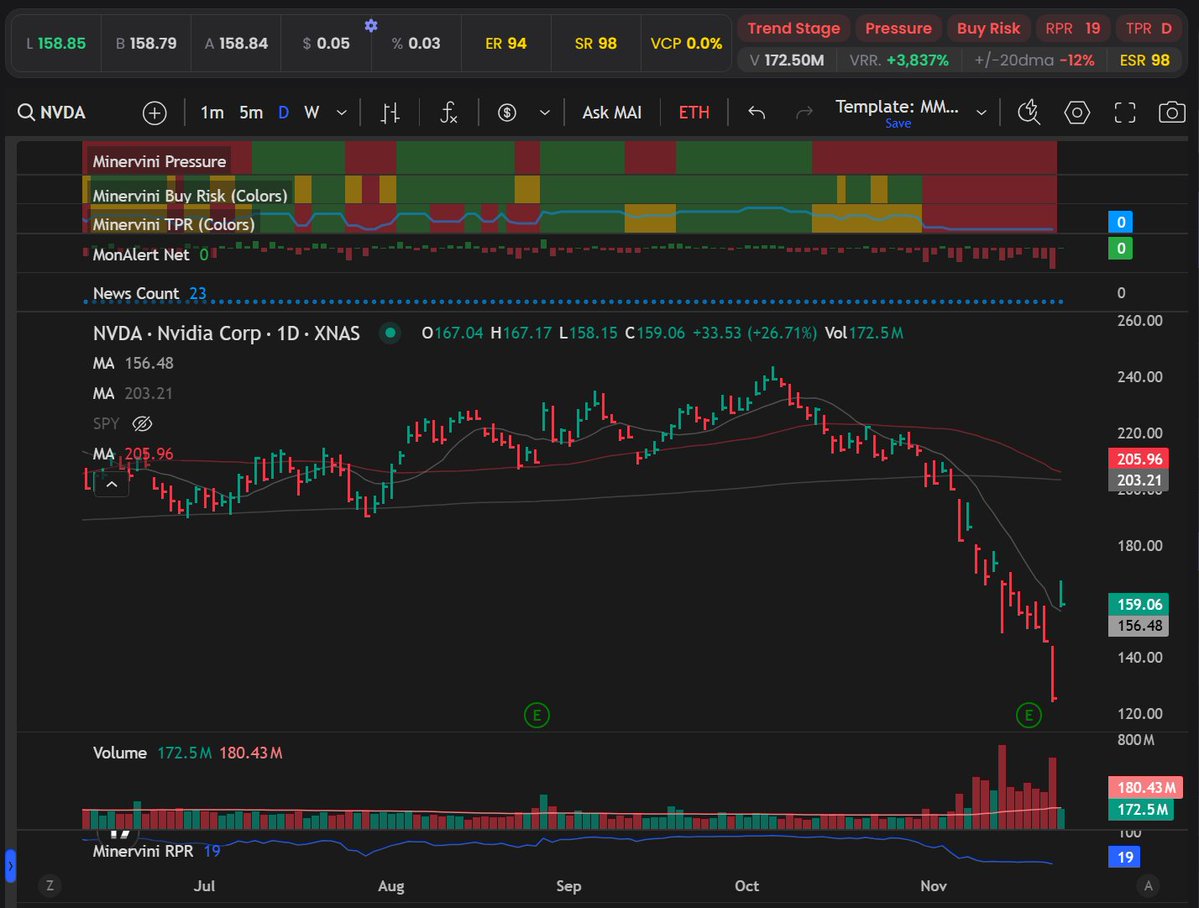
BREAKING: President Trump says Nvidia's board, $NVDA, asked for "assurance" on the national security threat and "we gave them assurance."
It now seems as though the Trump Administration is suggesting that the national security threat will not be as big of an issue as many expected for Nvidia.
Trump also said he spoke with China's President Xi "at length" about Jensen Huang when they met last week.
Trump says Jensen Huang is developing chips "far more advanced" than Blackwell.
This morning’s rally may look impressive, but this is exactly why I covered the shorts. The market had gotten oversold enough to produce a rip-your-face-off rally. After capturing nearly 7R on the downside, there was no reason to overstay the trade.
That said, keep this morning’s action in perspective. A number of stocks are up a whopping 10%-30%, but most are barely a blip on the charts. For now, they’re counter-trend rallies in stocks that are still in significant downtrends, particularly in Technology.
The S&P 500 fell 11.6% from its October 6 record high, the first 10% correction since the February-April 2025 selloff, but we are not out of the woods. There’s still work to do before we can say an effective bottom is in place. One strong day doesn’t suddenly create a new uptrend.
For now, I expect volatility to remain elevated. Enjoy the rally, but keep it in context. The market still has to prove itself. Prepare for backing and filling, and even lower lows in the major indexes before this correction is over.
The tricky thing about an oversold market is that it can always get more oversold. And even after momentum bottoms, price can still go on to make lower lows while divergences develop.
What I want to see now is whether this rally can last more than a day or two and broaden out beyond the most beaten-down stocks. That would increase the odds that a sustainable year-end rally can develop. If it can’t, then what we’re seeing is probably just short covering with more selling still to come.
Stronger signals have come from upside breadth thrust signals than downside oversold readings. For example, returns after 10:1 upside volume days have been higher than after big downside volume days. An even stronger message would come from two 10:1 up days without an intervening 10:1 down day. It pays to wait for upside confirmation.
A follow-through day (+1% on higher d/d volume) could occur as early as this Friday, assuming Friday’s lows hold. That would be an initial step in determining a low has been made.
During corrections, my focus ultimately turns to individual stocks and market leadership. Currently, our list of potential candidates is small. A market cannot carry itself very far on the backs of counter trend rallies in broken leaders. To get bullish, we need to see more. https://t.co/JXzFFTmMtn
Extreme Fear. Historic Opportunity?
The $VIX closed above 35 on Friday while Bitcoin's RSI fell below 20 which signals extreme oversold conditions.
Since 1990, there were 17 times the VIX first closed at or above 35, and the S&P 500 went on to deliver the following median returns:
1 Week: +2.5%
1 Month: +5.7%
3 Months: +10.4%
6 Months: +16.8%
1 Year: +21.6%
The market was higher one year later in 82% of those instances.
Bitcoin's 14-day RSI dropped below 20 on Friday, a level that shows unusually extreme selling pressure.
This has happened 6 times since 2015 and bitcoin went on the deliver the following median returns:
3 Months: +34.3%
1 year: +143.6%
Positive 3-month returns: 83% of instances
2026 had already produced two of those sub 20 readings before this month. The RSI hit 15.9 on Feb. 5 with Bitcoin at $62,791, and the price was 29.7% higher 90 days later. It hit 18.7 on June 3 at $64,040, followed by a 20.9% gain over the next 90 days.
We're seeing extreme fear in traditional markets at the same time Bitcoin, Ether, and crypto equities are experiencing significant selling pressure. Even some of the usual places to hide out have struggled. Through Friday, gold was down roughly 19% YTD, silver was down more than 40%, and bonds are negative even after counting interest payments. You could have been well diversified in several different kinds of asset classes or sectors and still saw your investments fall significantly.
Stock prices and cryptocurrency prices can decline dramatically even as the underlying technology continues to gain adoption. When it comes to crypto, we are witnessing a fundamental transformation in how money moves, how assets are owned, and how financial markets operate. Institutional adoption continues to expand, stablecoins are revolutionizing global payments, tokenization is opening the door for trillions of dollars in traditional assets to move onto blockchain networks, and companies are building the infrastructure to support this emerging financial ecosystem.
While prices have experienced significant declines, the long-term opportunity hasn't diminished. In fact, I believe the disconnect between short-term market fear and long-term adoption is creating one of the more compelling investment opportunities in digital assets.
Does this mean we've reached the bottom? Not sure. Markets can continue declining even after reaching extreme oversold levels.
BUT the combination of extreme fear, deeply oversold technicals, and continued long term adoption is creating an increasingly attractive setup for markets and bitcoin positive forward returns.
The market selloff has caused a lot of damage, especially for investors that used margin or were heavy in crypto and tech, but investing is about looking forward, not backward. Some of the greatest investment opportunities emerge when investor confidence is at its lowest. A 17× forward S&P 500 P/E, VIX close above 35, and oversold market conditions provide three compelling signals for improved forward returns.
Looking back on more than 20 years of investing, I've learned two important lessons: Markets have always recovered and eventually reached new highs, rewarding those who had the discipline to stay invested through uncertainty; and some of the greatest opportunities are found during the very moments when investors are most afraid. Looking back on past market selloffs, I rarely find myself wishing I had sold more. I usually find myself saying, “Why didn’t I buy more?” If it feels uncertain and scary, that is usually the right time to buy and stay invested.
She was the only woman in her postgraduate maths class in Kolkata.
Years later, she broke a 1949 puzzle that had stumped the world’s top mathematicians for over six decades.
While everyone is busy arguing over the Bollywood covers on TIME’s first-ever TIME100 Next India 2026 list, ISI Kolkata professor Neena Gupta just made the cut as an Innovator.
Back in 2014, she cracked a major version of the Zariski Cancellation Problem (in positive characteristic).
In plain english if you want to understand if two geometric objects look identical after you add an extra dimension to them, were they identical to start with? For decades, people tried to prove yes. She proved them wrong in three or more dimensions.
Since then, she has quietly stacked almost every top honour in the field:
* Shanti Swarup Bhatnagar Prize (2019)
* Ramanujan Prize (2021)
* Infosys Prize (2024)
* Emmy Noether Lecture (2025)
* TIME100 Next India (2026)
No PR machine. Just pure algebraic geometry from a Kolkata classroom to the global stage.
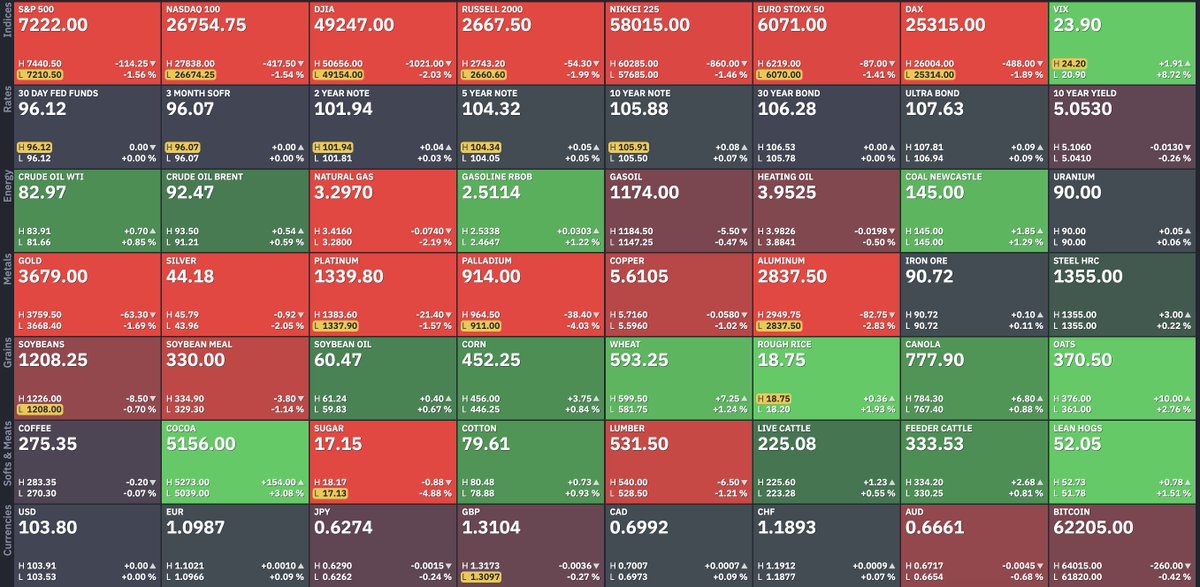
We're back to the sea of red across everything but oil & VIX
Sure, it's possible this is the start of the big decline the bears have warned of
But things are SUPER oversold in the immediate term right now
More often than not, times like these see a face-ripping rally to the upside
Time to place your bets...
Over the past week, I’ve been overwhelmed by the love and support of friends, industry colleagues, and people I've never met. Thank you to everyone who has shown kindness to my family and me. It means the world to me.
I came to the United States 53 years ago, and becoming an American citizen is one of the greatest gifts and proudest moments of my life. NVIDIA has been my life’s work. Building it into the company it is today alongside my colleagues has been a privilege and an honor. Nowhere but in America could a company like NVIDIA be possible. I love our country, and I love NVIDIA.
I did not live up to the standards expected of everyone at NVIDIA, and I have made serious mistakes in my personal life. I created problems for the Board that I deeply regret. I own my mistakes completely, and I am committed to cooperating with the Board’s independent investigation.
Since my departure, I’ve seen an outpouring of calls from NVIDIA’s employees, investors, business partners, and customers for me to return as CEO. Many continue to reach out to me directly as the company navigates complex technology, market, competitive, and geopolitical dynamics. NVIDIA is a once-in-a-generation company. If the Board of Directors decides that my return is in the best interest of our shareholders, our employees, the company, and America, I would be honored to answer these calls and return as CEO.
Thank you again to everyone who has shared their good wishes. I am profoundly humbled by your support. To my family: I love you, and I will spend the rest of my life being worthy of yours.
Jensen
As secretary, I made sure to leave air travel in better condition than when we arrived. We reversed a decade of decline in air traffic controller staffing, drove down runway safety incidents, and when I left office we were experiencing the lowest flight cancellation rates in years.
As part of that work, I launched a project to transition the FAA's communications system from copper wire to a modern network. I am glad the Trump administration has continued that work, but they have so far failed to explain why their execution of it triggered the worst FAA communications breakdown this century.
I support more funding for FAA upgrades, but this episode is another blow to the public’s confidence that the administration can deliver. The Trump administration owes Americans an honest accounting of how they have spent the billions of dollars already authorized, clearer answers on why their repair work brought down the entire system on Friday, and an explanation of what they are doing to make sure this failure is not repeated.
🇺🇸 A U.S. rocket failed just 10 minutes after launch today and destroyed 40 Amazon satellites.
The Vulcan rocket belongs to United Launch Alliance, a company jointly owned by Boeing and Lockheed Martin.
It took off from Florida but failed before delivering the satellites into orbit. Engineers still don't know what went wrong.
It's the company's first failed mission in its 20-year history.
The loss is another setback for Amazon Leo, which is trying to compete with Elon's Starlink.
Amazon has launched 398 satellites so far compared to Starlink's 11,000-plus.
And unlike SpaceX, Amazon has to rely on other companies to launch its satellites.
Source: Reuters / Writer: Daniyal
U.S. intelligence assesses that Iran still has up to 2,500 ballistic missiles in storage (Again)
A WSJ report mentions that, according to U.S. intelligence, Iran may still hold stockpiles of up to 2,500 missiles.
U.S. officials estimate that Iran retains a stockpile of 1,500 to 2,500 ballistic missiles despite damage from previous military strikes. While the evaluation is marked by a low confidence level due to tracking difficulties, officials indicate that Tehran continues slowly rebuilding its arsenal from existing components.
We are facing the same old problem, and this reminds me that CENTCOM publicly estimated before the war that Iran’s total arsenal stood at around 3,000 ballistic missiles.
If that pre-war figure had been accurate, and considering the thousands of missiles Iran has already fired alongside the storage sites destroyed by bombings, it would be mathematically impossible for Tehran to still have up to 2,500 missiles today.
To avoid publicly admitting that they miscalculated the initial stockpile by thousands of units, official reports justify the current figure of 1,500 to 2,500 by claiming that Iran rebuilt more than half of its pre-war arsenal using stockpiled components, even with its factories destroyed and under blockade.
Months ago, I pointed out that Iran likely possessed around 17,000 missiles with the range to strike Israel. This arsenal was built over more than 20 years and includes over 15 different models of ballistic and cruise missiles.
I also noted that there is simply no way a military industry like Iran's would take more than 20 years to produce just 2,000 to 3,000 missiles. We are talking about a defense industry entirely focused on missiles, three times larger than North Korea’s, and one of the largest missile industries on the planet.
At the time, I estimated that the majority of these were cruise missiles, alongside roughly 5,000 to 8,000 ballistic missiles.
This calculation should be done by multiplying the annual production capacity of Iranian factories by the decades each model has been manufactured, including older systems like the Shahab missiles.
The discrepancy in numbers stems primarily from Western intelligence focusing only on projectiles it can identify at active bases and on mobile launchers ready for immediate use.
I also pointed out that Iran is currently prioritizing the maintenance and preparation of its ballistic stockpile over cruise missiles, taking advantage of the vast volume accumulated in reserve over decades.
Another point worth highlighting is the similarity to the script we saw in Ukraine in 2022, when Western reports claimed Russian missiles would run out within weeks because they only counted high-end active stockpiles while ignoring refurbished or semi-finished older reserves.
Read more
https://t.co/LPGebOCDhg
*Below are my previous posts on this subject:
https://t.co/5FAOE7quFX
https://t.co/w5khi9POgq
In his new book, Valentino Rossi looks back on his memorable, for better or worse, 2015 season, reiterating that there was never a kick on Marquez in Malaysia. #MotoGP#SepangClash
🇺🇸 You can't make this up! Democrats miss Hegseth impeachment vote for an AIPAC-backed event 1.5 MILES AWAY
The Republican motion to block impeachment passed by just SEVEN votes, 211-204, with 11 Democrats absent.
Four of those Democrats attended a reception hosted by Elect Democratic Women, whose affiliated PAC received $2.35 million from AIPAC's super PAC.
The event's RSVP list included 132 lobbyists, with representatives from Lockheed Martin and major defense lobbying firms.
Quite the irony: attending a party with defense lobbyists while missing a vote on the defense secretary.
Source: Drop Site News \ Writer: Naz
Already familiar with $OVL? Meet $OVQ. The same Overlay Shares philosophy, now applied to @Nasdaq 100 exposure.
Learn more with the link in this thread.
For a link to the prospectus and other important information, see this thread.