I have read dozens of outraged posts because the US special envoy Witkoff called Putin a "humanist." But no one is writing about the fact that the American negotiators are simply not doing their job. Let me explain.
Peace negotiations are important in their own right. Even if they do not lead to a lasting peace, the process itself is an opportunity to resolve urgent humanitarian issues. If, of course, the human dimension is a priority for the negotiators. But it is entirely obvious that neither Witkoff nor Kushner cares about people's fates in this war.
The Pope calls on Putin to save thousands of people from starvation in occupied Oleshky and the surrounding villages. The UN speaks about a humanitarian catastrophe and asks Russia to allow the evacuation of the civilian population. European Parliament Vice-President Pina Picierno goes on a hunger strike to draw attention to this tragedy unfolding before the eyes of the whole world.
And what are Witkoff and Kushner doing?
That's right, almost nothing.
Except for passing along greetings from Putin’s aide to the First Lady.
Thousands of people are already eating grass to survive and begging to save their lives. The Ukrainian side raises the issue of Oleshky at every meeting. And I can name dozens of such urgent humanitarian issues off the top of my head where American negotiators must be proactive.
Trump’s peace negotiations have already gone down in history as the deadliest years for Ukraine’s civilian population since the start of the full-scale invasion.
I don’t know if anyone will remember the names of Witkoff and Kushner.
But history will certainly record how American negotiators, who had the opportunity to save a huge number of people, refused to raise uncomfortable questions before "humanist Putin."
European surveillance technology continues to enable repression across MENA ⚡️
@TimepDC just published an article by @RamyRaoof documenting how European surveillance technology facilitates repression in Egypt and MENA.
‘Each moment of impunity makes the next war more likely, in Europe and beyond.’
Oleksandra Matviichuk, in the foreword to our Dispatch ‘Human Rights Hold the World Together’ 🌍
https://t.co/6sNBIVFQGJ
➡️ Each of these factors helps explain violence and crime. Understanding causes is how societies prevent violence, and the violence itself deserves unequivocal condemnation. Even more so when it undermines a movement for better school conditions (shut, no socio-economic causes…)
Violence broke out on the margins of France’s peaceful youth demonstrations over the past few days. Now the political right tells us the root causes do not matter ⚡️
Three versions of the same move ⤵️
3️⃣ Macron’s camp says the continued deterioration of the economy and the cuts to social security for popular and working-class households since 2017 are irrelevant.
Let this sink in: Trump said that Russia ‘has been fine on Ukraine…hasn't been doing much’.
The day he said it, 19 Oct, a Russian drone struck a public park, killed six people, incl two children, and overnight missile attacks targeted nearly 30 energy facilities in Ukraine 🇺🇦
Manson on what he'd tell Columbine's students: 'I wouldn't say a single word to them. I would listen to what they have to say.'
France's students protested for weeks over their schools. A weekend of disaster.
Time for all of us to start listening. https://t.co/9CC1Et6Uff
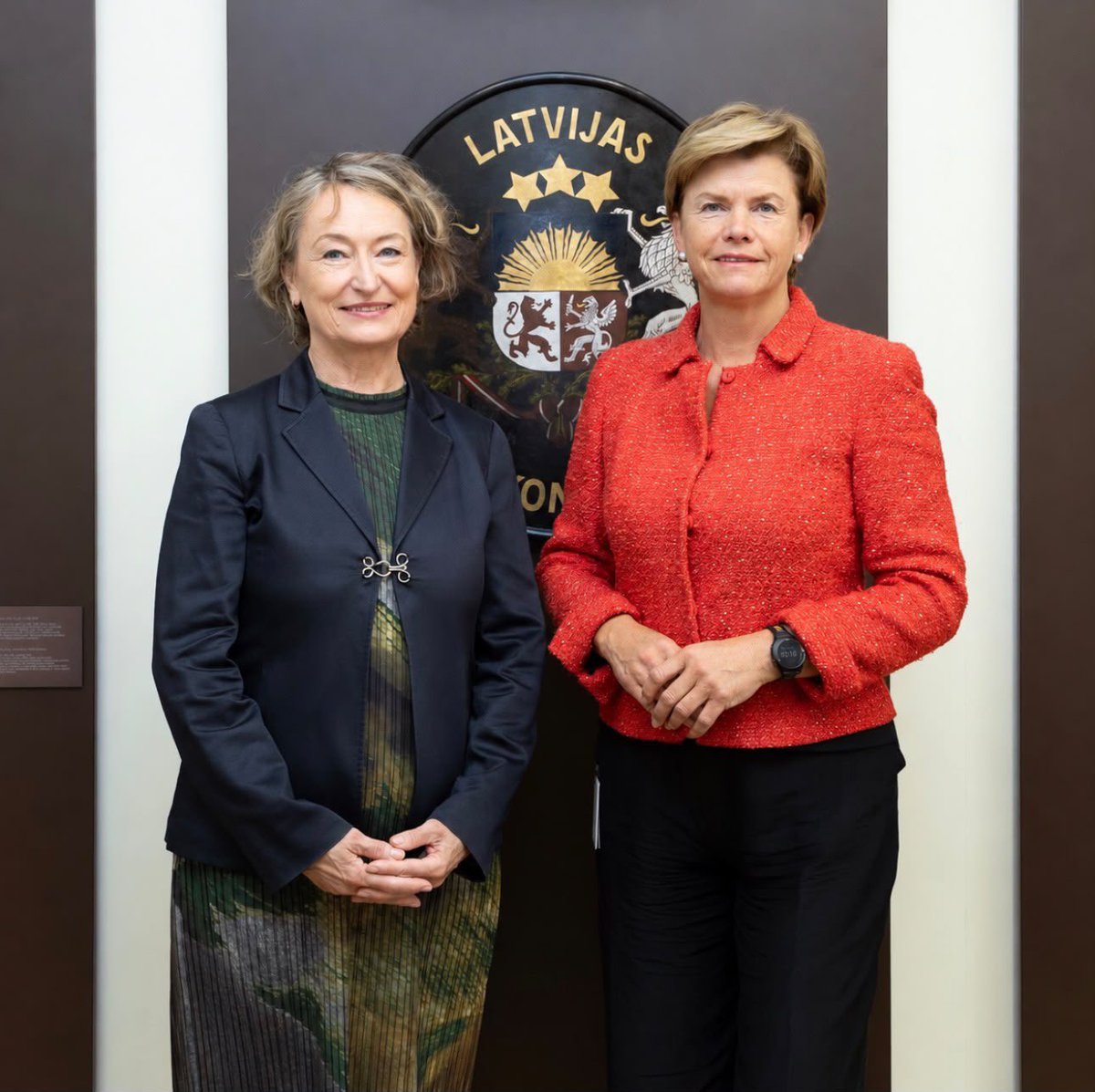
Congratulations to Latvia’s renowned human rights expert Ilze Brands-Kehris on her appointment as the EU Special Representative for Human Rights! 🇪🇺🇱🇻
I thank all EU countries for their support.
Wishing Ms Brands-Kehris every success in representing the EU globally!
7 intermediate powers provide nearly half of the voluntary contributions UN Member States make to @UNHumanRights: Sweden, Norway, Finland, Denmark, the Netherlands, Switzerland, Ireland.
We ask other states to match them with a pledge of 0.001% of GDP.
0.001% is all it needs ⚡️
A trilateral meeting between the leaders of Ukraine, the US, and Russia could help end the war sooner. A trilateral meeting between the leaders of Russia, China, and the US would do only the opposite: encourage Putin to continue this war.
Inviting Putin to such a meeting would feed his appetite for self-aggrandizement and give him a stature he does not deserve. He is not a global leader; he is a war criminal. And Russia is not a global power; it is a global problem.
The Russian economy is at least 13 times smaller than America’s and 8 times smaller than China’s, and it continues to shrink rapidly, along with Russians’ living standards. Russia has lost 1.6 million soldiers killed and wounded in a failed war it cannot win and refuses to end. Under heavy sanctions, its technology, industry, and business continue to stagnate.
By any pragmatic or moral measure, Putin has no place at the table with presidents Trump and Xi.
The only thing that could earn him that seat is a serious step toward peace, such as accepting a ceasefire proposal before any such meeting. Instead, we are seeing the opposite: intensified terror against civilians. As long as he continues this terror, there should be no place for him at any table.