The job ad has just gone live for a 3-year postdoc position in my group at Edinburgh University, working on high-redshift galaxy evolution with JWST and MOONS. The deadline for applications is a month today on 20th December https://t.co/XOxDQSg38k
New paper today!🤠
For a sample of star-forming galaxies at z ≈ 4 from the EXCELS survey, we measure the electron temperatures, densities, and the Ar/O and Ne/O abundance ratios. Our main result is that Ar/O is lower at high-z compared to local sources!
https://t.co/GSpr5F0TyZ
@dr_guangtou@chen_yuguang Here are some UV templates from the VANDELS survey that might be useful, split by stellar mass and LyA equivalent width: https://t.co/S5xXMoGHH8
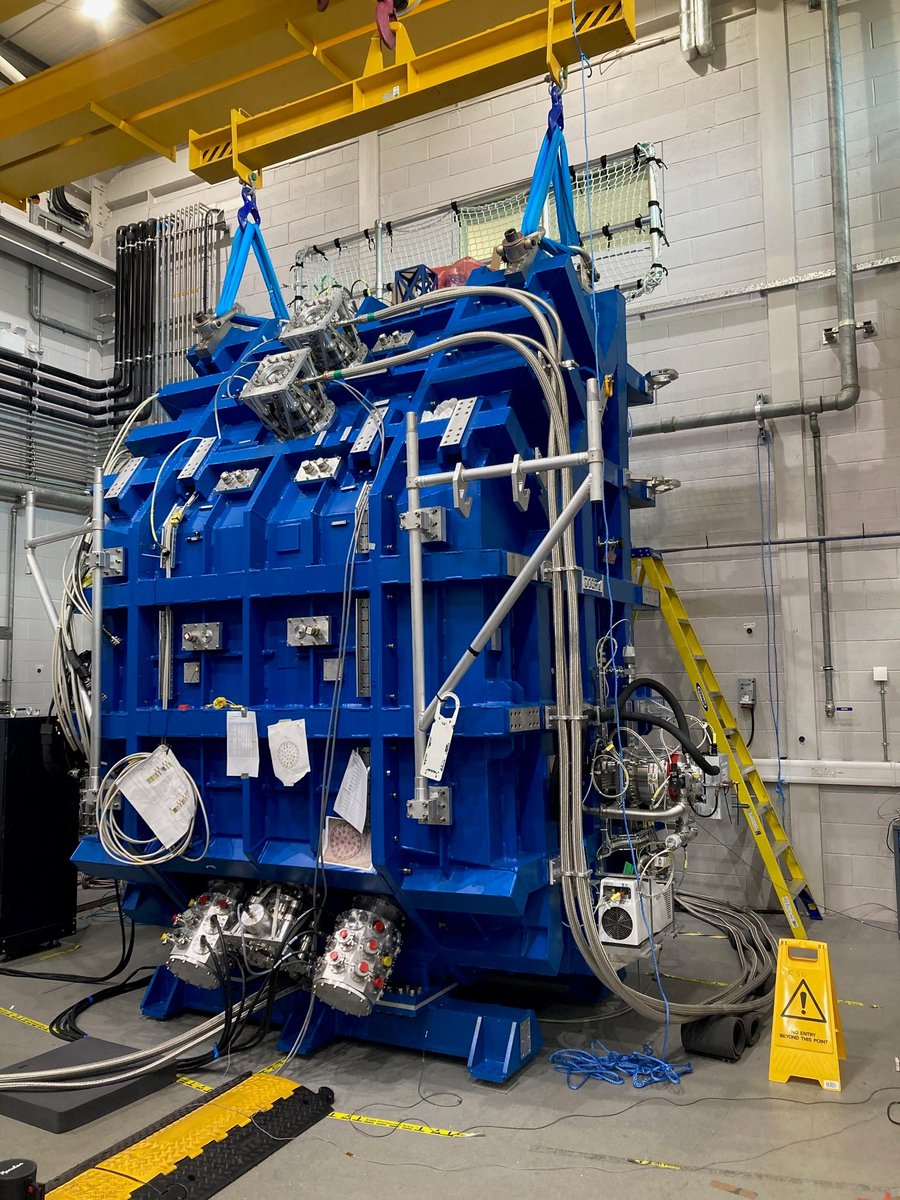
MOONS vibration tests successfully completed!✅
Vibration levels on the 8.5-tonne MOONS spectrograph had to be carefully checked to ensure it won’t interfere with sensitive observations on @ESO's Very Large Telescope. 🇨🇱
Find out more 👉 https://t.co/gBhhN1Yt4f
#MOONSToChile
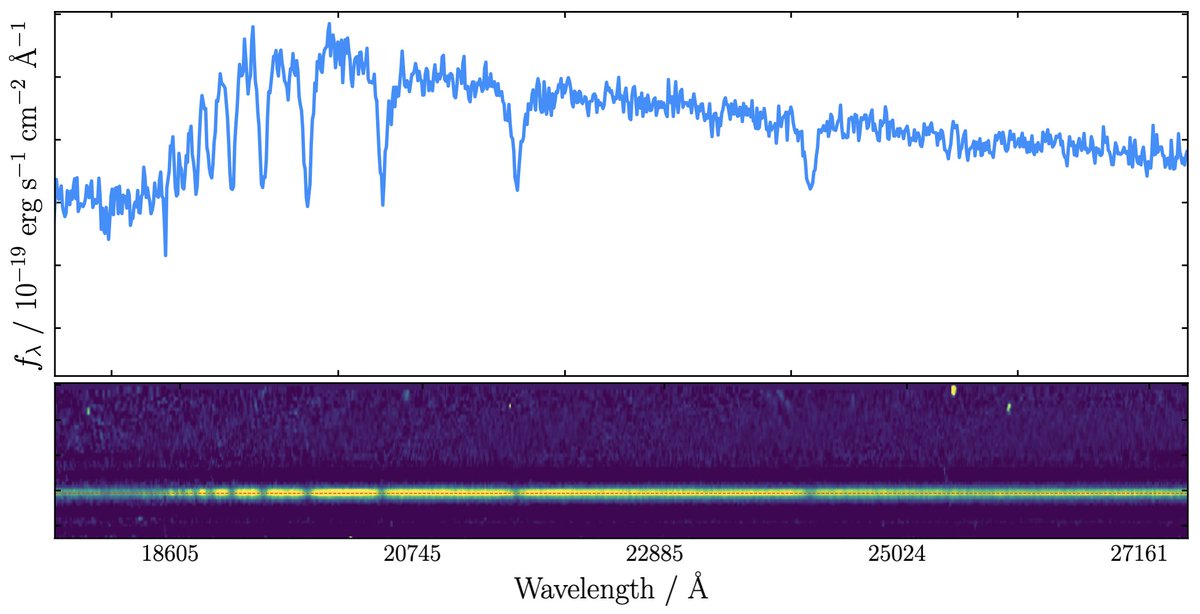
Too much, too young, too fast? The first results from mine and @FergusLPCullen's EXCELS JWST Cycle 2 programme are out today. We show beautiful new spectra for 4 ultra-massive galaxies that formed way too many stars when the Universe was way too young 1/3 https://t.co/K9ca8EdwcS
My first lead-author paper is on arxiv today! 🤠
By measuring the O and Fe abundances of star-forming galaxies at z≈3.5, we constrain the stellar + gas-phase mass-metallicity relationships and find our galaxies have ubiquitously supersolar O/Fe ratios!
https://t.co/OgUGBU4OkZ
Happy to be back in Leiden, co-organising a @lorentzcenter workshop to bring the fields of gravitational wave observations (in particular stellar mass BH mergers) and galaxy formation (in particular chemical enrichment)!
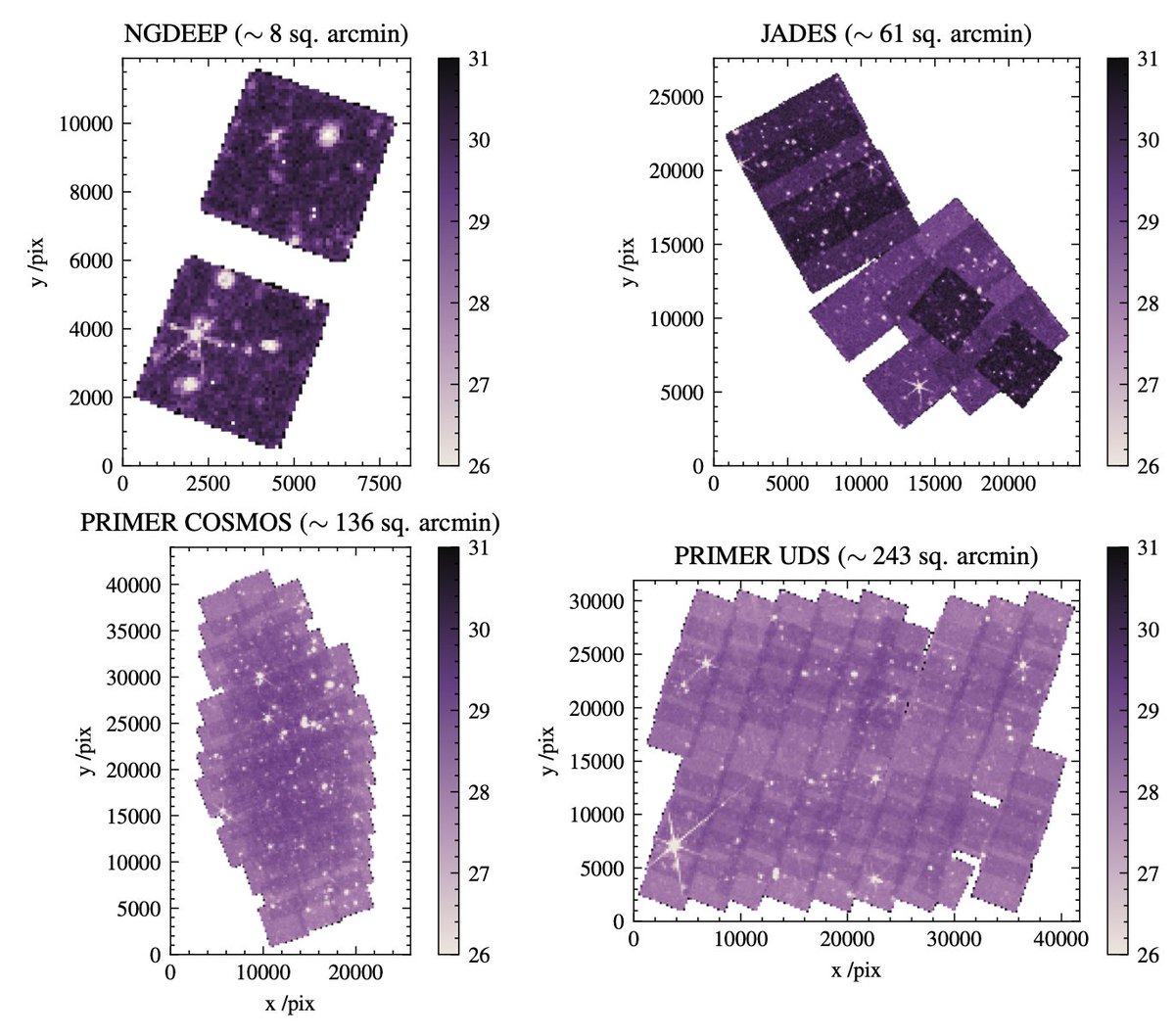
I'm happy to present our new paper on the UV luminosity function at z=9-15! We use a combination of the PRIMER, JADES and NGDEEP surveys covering 370 sq.arcmin. and reaching depths of 30 AB mag in the deepest region. 1/6
https://t.co/wIrvmANcIn
The first half of mine and @FergusLPCullen's JWST Cycle 2 EXCELS programme was observed just before Christmas and the results are looking pretty stunning. For more than a year we've only had data like this for one high-redshift massive quiescent galaxy, now it's quite a few more!
New paper on the arXiv today - investigating the UV continuum SEDs of galaxy candidates at z > 8. Our main new finding is that at z > 10 the UV continuum looks uniformly `dust-free' . https://t.co/nxz9wu7Shg
There's a fair bit more in the paper for those interested (including a detailed argument for why we think beta=-2.6 represents a 'dust-free' SED) . Finally, a big thank you to a great team of collaborators for all their help!
We're not the only group looking into UV SEDs at z > 9, and most studies so far are reporting similarly blue slopes (e.g. https://t.co/Z4dd2leWtx; https://t.co/yXyrfYNZRm). The next step is to get PRISM spectra and confirm these results spectroscopically.
Ready to dive deep into the Physics and Astronomy world? Join us for our PG Virtual Open Days; you'll learn more about our programmes, talk to academics and students, and get a look to the opportunities at the University of Edinburgh.
Book your place!
#EdinburghOpenDay
An advert is now live for a PhD position working with me on @NASAWebb and @VLT_MOONS data, starting September 24. Details of the project and how to apply, along with the other astronomy projects on offer at Edinburgh can now be found at the link below. https://t.co/cuek2KjCKV