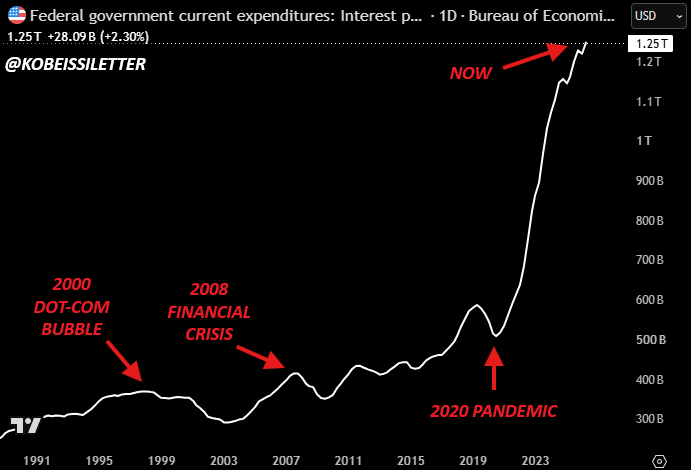
What stops this train?
The US government is now spending $3.8 billion on interest PER DAY.
By 2028, estimates show that the US will spend ~$5 billion per day on interest, more than any other category.
To put this into perspective, the US now spends $3.1 billion per day on Medicare and $2.5 billion per day on defense.
When the cost of your debt becomes your biggest outlay, you know something is broken.
Intervention by the US Treasury is only a short-term "solution."
I still sometimes think about the NCO who put one of the the Delta(CAG) squadrons training/recruitment montage video on YouTube and how they kept flagging it and taking it down but it always keeps finding its way back on the tubes🫡🤘🇺🇸
Brian Thompson's family is expected to give victim impact statements in Luigi Mangione's trial.
I'm more interested in hearing the victim impact statements from the family and clients of United Healthcare who were denied coverage and had their lives ended it ruined.
A new study confirms that Medicare for All would save 114,000 lives every year and reduce overall healthcare spending by more than $1 trillion annually.
Do not tell me we cannot afford Medicare for All.
What we cannot afford is a broken healthcare system based on greed.
CNN w/ Michael Smerconish @smerconish
Investigative journalist Annie Jacobson walks through a nightmare biological warfare scenario that could take the U.S. from an initial outbreak to anarchy in just six days.
https://t.co/6QfQRANXqK
The NYT reports that Iran has effectively rejected a deal on the Strait and presented a list of very hard-line demands in order for an agreement to be reached.
My understanding of what has transpired differs somewhat.
I see three possible interpretations, some of which overlap with the NYT's reporting.
1. There are divisions within the Iranian system in which hardline elements want to prolong the talks and have the current blockade inflict more damage on Trump and the global economy. Their narrative is that Iran agreed to the MOU too quickly, which contributed to the MOU's deterioration later. Tehran should have held out longer then, and it should also do so now, essentially. A variation of this explanation is what the USG is advancing: The lack of agreement is because of divisions in Iran.
2. Rather than a division, it may also be that a united system is seeking to prolong the talks to pressure the US. As such, a narrative of divisions in Iran may be seen as helpful, as it diverts from an arguably more problematic reality: The more flexible elements within the Iranian system also agree that talks should be prolonged.
3. The Iranian narrative, however, is that new elements were added to the talks at the last minute by the US and that Iran's on-the-surface hardened position is a reaction to what Tehran says is an attempt by the US to move the goalposts. Whether this is true or not, Tehran has tended to react in this manner (escalation) when it believes the US has shifted its position or added additional demands at the last minute. This is, however, not a denial of Zolghadr's list of demands. That list is an accurate reflection of Iran's broader goals, but ultimately, they won't be its demands for the immediate deal on the Strait.
If the truth is closer to the third explanation, then a deal may still be within reach in the short term.
@AnnieJacobsen Congrats Annie! Ordered online but I couldn't wait for the delivery so I'm about half way through the audiobook. What a mixture of emotions between fascination and terrified.
What a nightmare. By implementing the tariffs illegally, and now having to unwind them, the Trump administration created over $100 billion of profit for corporations selling foreign products, at the expense of American consumers.
Your refund: $0.00
Apple’s profit: $2.2 billion
"Data Center Alley" a section of Virginia with the densest concentration of data centers in the country, caused the power to flicker across the East Coast.
On Wednesday, July 22nd the electricity flickered on and off for about 10 minutes throughout the Eastern U.S., from Chicago to Boston to Miami.
The cause appears to be a concentration of data centers straining the grid.
Video from: @NBCWashington