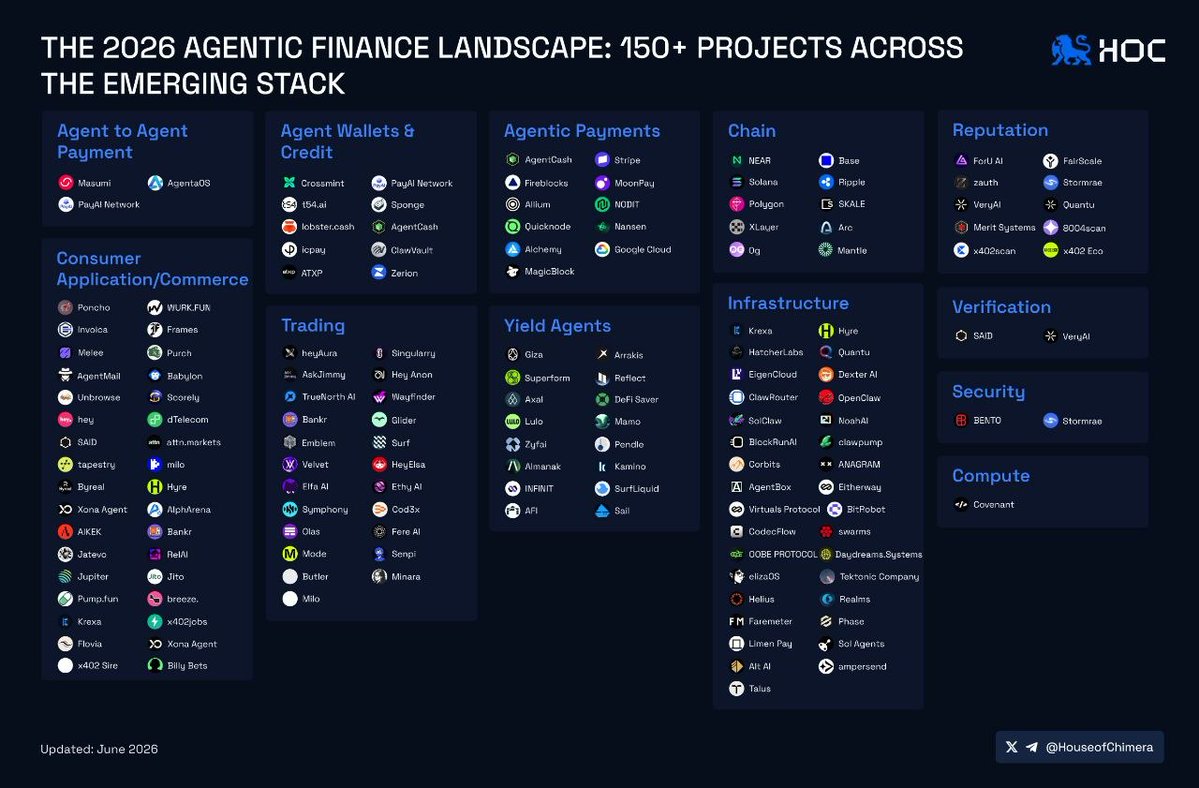
Agentic finance spans payments, wallets, credit, yield, identity, reputation, verification and security.
🔹 Agents need rails to hold & move money
🔸 Apps need infrastructure to price & automate financial actions
We mapped 150+ projects across the stack.
Who did we miss, anon?
You don't need 6 months to learn Agentic AI.
You need 26 minutes and Claude Code.
While most people are still watching explainer videos about what AI agents "could" do — this tutorial shows you how to actually build one from scratch right now.
Zero to fully working Agentic workflow.
26 minutes. Step by step. No fluff 👇
I thought AEO (read: SEO for LLMs) was a hunk of bullsh*t.
And then i spoke to @kippbodnar, CMO of @HubSpot, who knocked the skepticism out of me.
His first jab: In one year, they grew AI search traffic by 15x. It went from rounding error to real line item on the P&L.
His second jab: AI search conversion rates are 5x higher than Google search. On some queries, 13x higher.
His hook: 60% of AI citations don't come from the top 20 Google results. The companies dominating Google aren't automatically winning in AI search, which creates a huge advantage for early adopters.
He then took me through his process for crushing AEO & seeing results in days, not months (like SEO):
1) Grade: your current AEO presence across ChatGPT, Perplexity, and Gemini with a tool like Hubspot's AEO grader.
2) Restructure: your content into chunked, answer-first pages with natural language headers.
- one consolidated page, not 8-10 interlinked pages
- lead with natural language questions like "What is X?"
- 1-2 paragraph sections, not 1,000 word sections
- table of contents on a single page
3) Separate: Mentions from citations and optimize differently for each
- Mention = when AI references your brand or product in its answer but doesn't link to you
- Citation = when an AI references you AND links to your page
4) Open up: your information — ungate content, build Reddit presence, make pricing public
- Optimize for entity understanding: how well do AI models understand what your company does, based on every signal from Reddit to review sites, awards lists to help docs
5) Tool up: with AEO-specific software to track prompts and share of voice
- Check out Xfunnel or Limey[.]ai
6) Rethink attribution: measure source of customers, not source of traffic.
- Metrics that matter: share of voice, citation count, sentiment, mention frequency, source of customers not traffic
Announcing my new course: Agentic AI!
Building AI agents is one of the most in-demand skills in the job market. This course, available now at https://t.co/zGHUh1loPO, teaches you how.
You'll learn to implement four key agentic design patterns:
- Reflection, in which an agent examines its own output and figures out how to improve it
- Tool use, in which an LLM-driven application decides which functions to call to carry out web search, access calendars, send email, write code, etc.
- Planning, where you'll use an LLM to decide how to break down a task into sub-tasks for execution, and
- Multi-agent collaboration, in which you build multiple specialized agents — much like how a company might hire multiple employees — to perform a complex task
You'll also learn to take a complex application and systematically decompose it into a sequence of tasks to implement using these design patterns.
But here's what I think is the most important part of this course: Having worked with many teams on AI agents, I've found that the single biggest predictor of whether someone executes well is their ability to drive a disciplined process for evals and error analysis. In this course, you'll learn how to do this, so you can efficiently home in on which components to improve in a complex agentic workflow. Instead of guessing what to work on, you'll let evals data guide you. This will put you significantly ahead of the game compared to the vast majority of teams building agents.
Together, we'll build a deep research agent that searches, synthesizes, and reports, using all of these agentic design patterns and best practices.
This self-paced course is taught in a vendor neutral way, using raw Python - without hiding details in a framework. You'll see how each step works, and learn the core concepts that you can then implement using any popular agentic AI framework, or using no framework. The only prerequisite is familiarity with Python, though knowing a bit about LLMs helps.
Come join me, and let's build some agentic AI systems!
Sign up to get started: https://t.co/FX35dloqw4
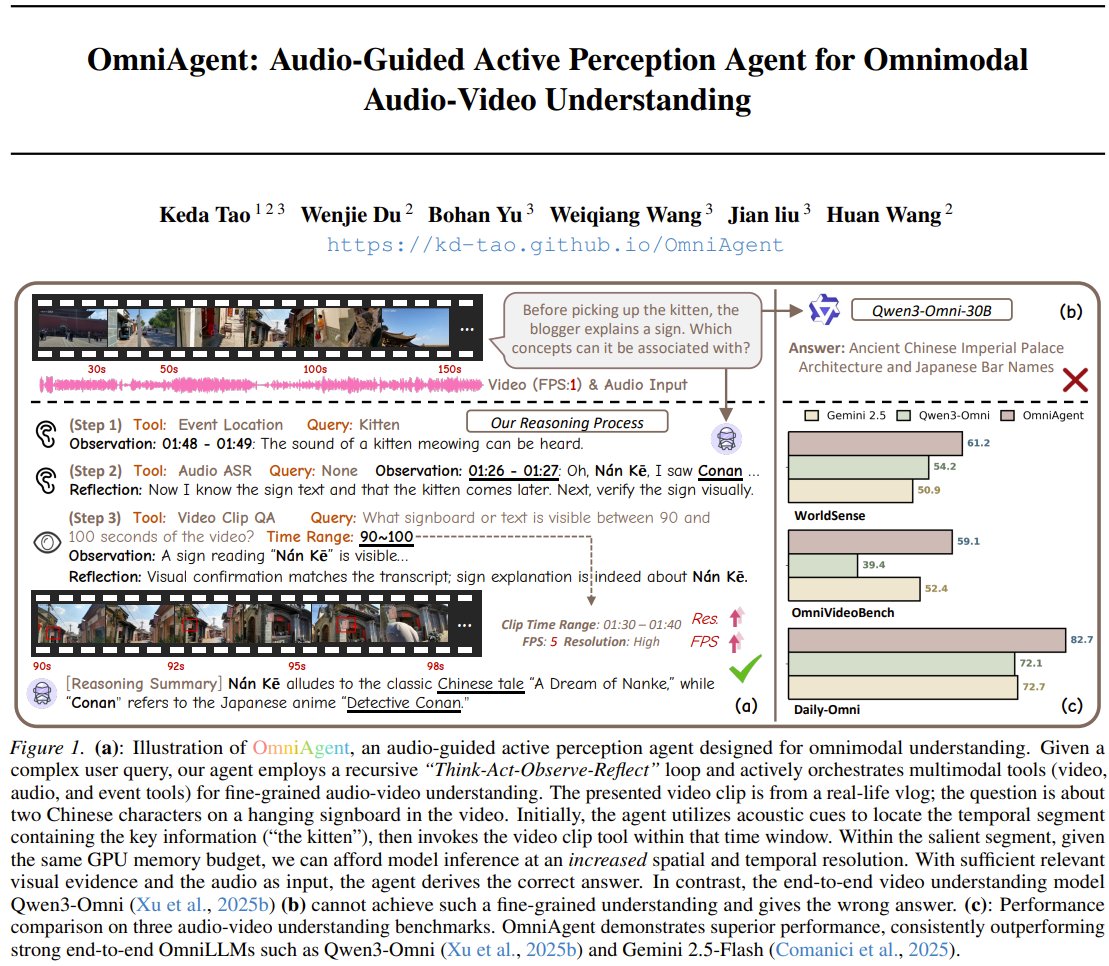
What if an AI could listen to a video to know exactly where to look?
Researchers from Zhejiang University, Westlake University, and Ant Group present OmniAgent.
Instead of processing every frame, it uses audio cues—like a cat's meow or spoken words—as a guide. It then actively focuses its high-resolution visual analysis only on those key moments.
This active, audio-guided method outperforms leading models like Qwen3-Omni and Gemini 2.5-Flash by 10-20% on audio-video understanding benchmarks.
OmniAgent: Audio-Guided Active Perception Agent for Omnimodal Audio-Video Understanding
Paper: https://t.co/cbREQi9oI7
Project: https://t.co/2jDRspTBcG
Our report: https://t.co/VFkJo45KHx
📬 #PapersAccepted by Jiqizhixin
Just launched OmniAgent 🤖
An AI that builds your e-commerce site, manages your tasks, and runs your businesses in the background. 24/7.
Smarter than Genspark. More autonomous than anything out there.
https://t.co/Kl2l1Tqx2j
What if an automated, AI-powered customer interaction didn’t feel automated at all?
🎥 See how CallMiner OmniAgent handles SMS scheduling, balancing efficiency, experience, and positive outcomes.
WEBINAR: Join Napster CTPO Edo Segal and @SolgariConverse CEO John Colgan on Feb. 25 as they introduce the Omniagent, a new AI-powered model for customer engagement at scale.
Register now: https://t.co/zvKTBiKezz
@FaithFadareSEO World has been divided with AEO and GEO.
Eventhough both are same AI generated answers, AEO is comparitively adopted widely and from industry leaders.