Latest post on #WallStreet#wallstreetdealmaker dot com:
"On the wheel of full-throttle snobism, here at Wall Street Financier I am the only one seeking refuge from the vagaries of this vane and empty world. I stand alone, as I always stood, firm in my ancestor’s- Spartacus place
Anthropic pays engineers $750,000+ a year to understand how LLMs work.
Stanford just put a 2 hour lecture that covers 80% of it for FREE.
Bookmark this. Give it 2 hours today.
It might be the highest ROI thing you do this month:
Jack Dorsey just published something that should be required reading for every founder.
The premise: the org chart needs to be replaced entirely. And the argument starts 2,000 years ago.
For thousands of years, every organization on earth has run on the same logic the Roman Army invented.
Small teams report to a leader → Leaders report to managers → Managers report to executives.
The whole structure exists for one reason: to route information up and down the chain.
That's it. The whole system exists to solve a bandwidth problem.
Jack's argument is simple: AI solves it better.
Block built what they call a "world model" - a continuously updated picture of everything happening across the company. Every decision. Every customer. Every transaction. Every bottleneck. In real time.
No status update needed. No weekly sync. No manager to translate what's happening on the ground into language the executive can understand.
When the world model carries the information, you don't need the layers.
So they eliminated them.
Block now runs on three roles:
Individual contributors who build.
DRIs who own specific outcomes for a fixed period.
Player-coaches who develop people while still doing the work themselves.
No middle layer. The system handles coordination. The humans handle the work.
I've coached thousands of founders. The number one problem is always the same: information latency.
By the time a problem surfaces from your front line to leadership, it's already compounded. By the time a decision travels back down, the damage is done.
That lag costs you deals, people, and momentum. And most founders accept it as the price of scale.
Block is trying to prove you don't have to anymore.
I think they're right.
Because the hierarchy was never the point - it was just the best tool we had. The moment something better exists, the layers eventually collapse.
This is either the biggest structural shift since the 1850s - or it breaks at scale like everything else before it.
Either way - every founder should be asking the same question: how much of your org exists just to route information?
If the answer is "most of it" - that's your problem. And your opportunity.
-DM
In case you missed our Aviation Tax & Regulatory webinar with FORVIS Mazars: Here are 6 aviation tax and regulatory risks aircraft owners need to understand in 2026—and how to avoid costly compliance issues. Read the takeaways → https://t.co/ECh9FDhPBH
Com suas asas de maior alongamento, aumento no peso máximo de decolagem e melhor eficiência de combustível, o E2 agora pode voar 3.000 milhas náuticas. Viva o sonho do voo transformador com o E2, o small narrowbody mais eficiente do mundo.
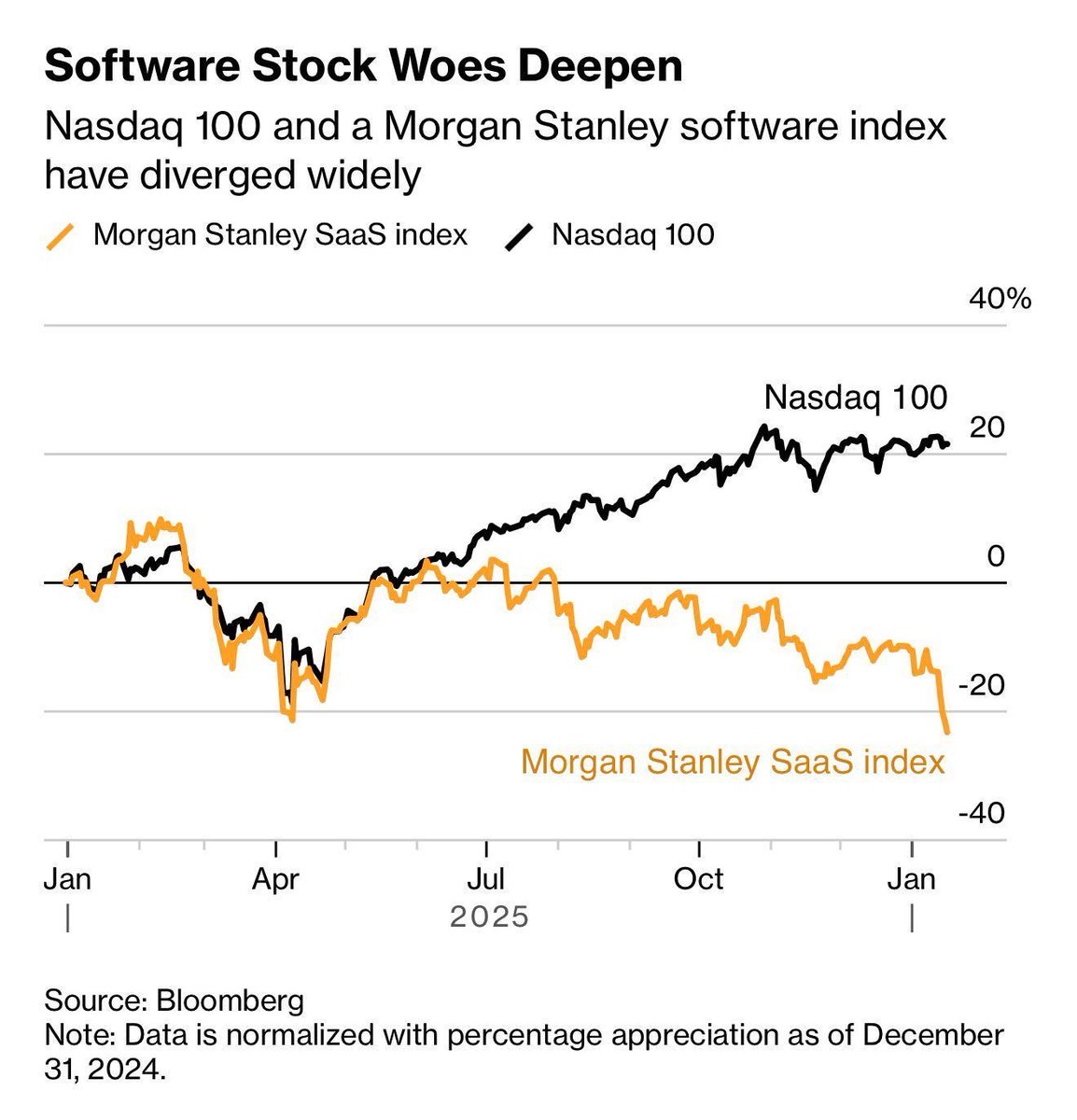
We've talked a lot about this on the Pod, but the Great SaaS Meltdown has started and there's no going back.
What exactly is happening?
In short, hi growth, low/no profitability SaaS is no longer a winning strategy because the big question mark is the durability of that growth in the short term and, because of AI, the lack of profits in the long term. Every SaaS company has sold the dream (to investors and employees) that they will growth quickly now, and harvest lots of cash later. With AI, this assumption may be completely out the window.
Now the threshold question is whether their growth will be overtaken by a much cheaper AI-developed solution?
If you are a venture supported SaaS startup and are a legacy Heuristics+APIs+CRUD product, it is likely that a new AI oriented workflow is coming for you.
Investors in private markets can see this now and think that money to fund short term growth will not be rewarded. Investors in public markets no longer believe long term profitability is possible. They would rather pivot into something they think is more resilient.
This is a change in the risk calculus that has existed for the past 15 years and why the chart below is the chart below.
Good luck to all the players!
The next time you want to give up, remember Elon Musk sat here after losing $100 million.
This photo shows Elon Musk right after his third rocket exploded. He had just lost $100 million of his own money. SpaceX was weeks from bankruptcy, Tesla was struggling, and he was sleeping on friends’ couches
The media called him reckless, investors pulled back, and everyone told him to quit. But instead of giving up, Elon risked it all on one final launch. If it had failed, SpaceX would have been finished
The launch succeeded, changing history. Today, SpaceX is worth $800 billion and dominates the private space industry. Most people quit just before a breakthrough. Elon kept pushing when everything was against him, that’s the difference between success and almost success.
@UnchartedFather @FWPlayboy No, bro. Only men are. Women, especially in America have the body counts of 5 X their men counterparts do. While a guy has slept with maybe 5-6 women -at age 30- women of same age have slept with 40+ men. And counting. A lot of American women are into triple digits.
We found a significant bug in the 𝕏 For You algorithm that resulted in users seeing far fewer posts from people that they follow.
It should be fixed by tomorrow.