Where “imagine if” gets to work. We've helped 500+ companies (like @NotionHQ, @Roblox, @Uber, @Square) take a straighter path from idea to product-market fit.
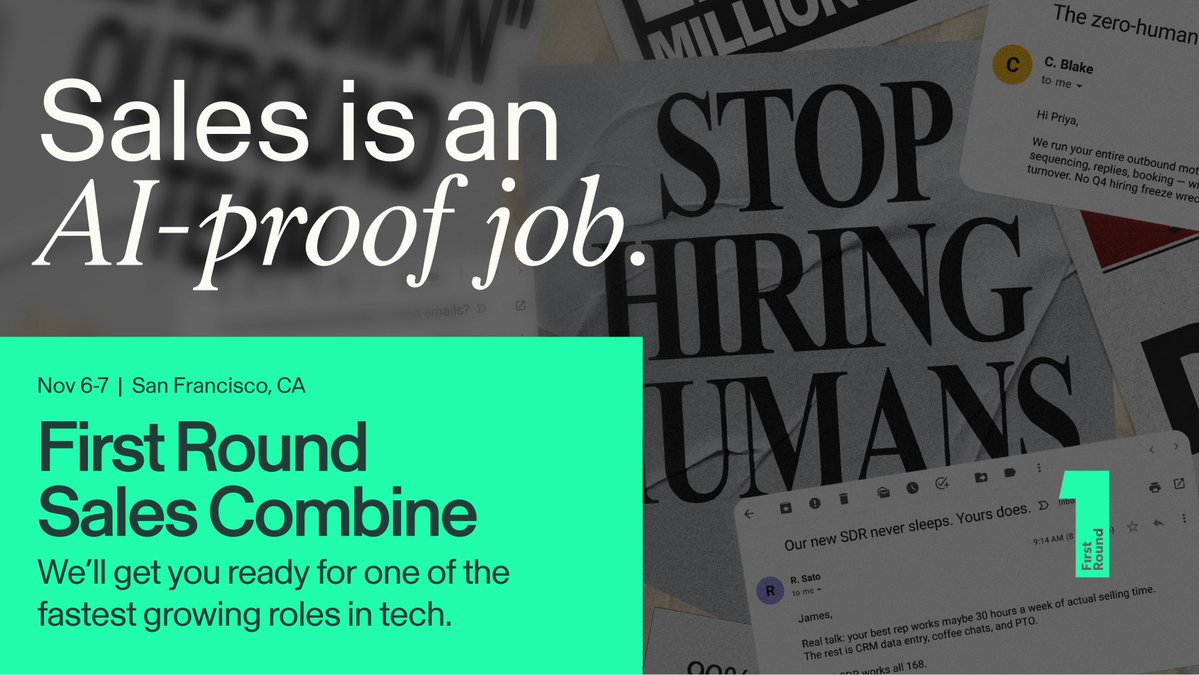
The mechanics of sales may be automated away, but that was never the hard part.
We want to find and train the next generation of sellers who excel at the uniquely human craft of sales (and aggressively use AI for all the rest), so we’re launching Sales Combine.
Spend two days in SF for FREE training with extremely experienced sales leaders, and then we’ll introduce you directly to companies like @NotionHQ, @fal, @togethercompute, @p0, @reductoai, @Gumloop, @clay, & many others that are hiring new sellers.
Apply by 10/3: https://t.co/7L1HiNijd7
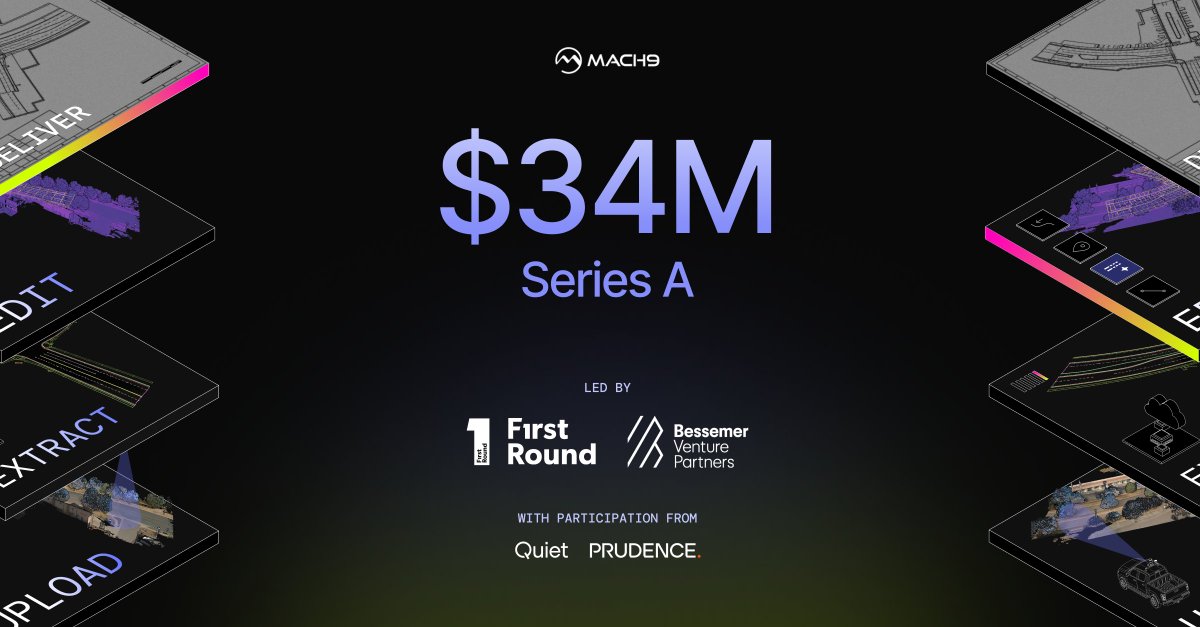
I’m excited to share that Mach9 has closed a $34M Series A co-led by @firstround and @BessemerVP , with participation from @Prudence_VC and @QuietCapital .
During the first week of my freshman year at Carnegie Mellon, I walked into Red Whittaker’s office wanting to build field robots. Red handed me blueprints of a nuclear waste storage tunnel and told me to turn them into a CAD model, simulate it, and then build a robot to actually inspect it.
Our robots and software helped infrastructure owners and engineers understand what was there and plan what came next. The problems we worked on had real consequences for people and their communities.
That experience shaped why we’re building Mach9.
So many of the smartest people in the world are building software to serve better ads or AI to optimize a sales process, while entire industries that keep the world running still rely on tools from a generation ago.
Civil engineering is one of them. While civil engineering teams are using tools like LIDAR that make collecting data on their projects super fast, turning that raw data into usable CAD drawings and designs still takes months of manual drafting. And there are simply not enough people to do the work.
At Mach9, we’re building AI CAD software to expand the world’s capacity to build and maintain the infrastructure people depend on. Our software turns reality capture data into centimeter-accurate CAD drawings, helping surveyors and civil engineers deliver projects faster.
We’ve brought together an exceptional team from SpaceX, Tesla, Apple, and NASA to tackle hard technical problems in an industry where better tools can have a lasting impact. We’ve already helped nearly 100 organizations deliver over 2,500 projects spanning 100,000 miles of infrastructure in all 50 states. Behind those numbers are real problems we’re helping customers solve:
- On I-8 near San Diego, Caltrans is using Mach9 to turn scans into an accurate inventory of road safety assets, helping their team plan upgrades to make California’s roads safer.
- Fibersmith is using Mach9 to help design fiber networks that bring high-speed internet to more than 120,000 homes and businesses in some of Louisiana’s most underserved communities.
I’m so proud of what our team has built, and grateful to the customers and partners who have shaped Mach9 along the way.
Whether you’re looking for better tools for your next project or want to help us build them, we’d love to hear from you. Join us in bringing civil engineering into the AI era
You’ve likely seen surveyors standing on the street with their yellow vests and tripods. These days, a lot of that work is done faster with LiDAR, but turning those scans into engineering drawings is still a surprisingly slow process. It requires weeks/months of manually tracing every curb, paint line, telephone pole, and sign. @Mach9Geo is solving this bottleneck for civil engineering teams, and we’re proud to be their partners at @FirstRound, co-leading their $34M Series A with @BessemerVP.
Their AI CAD software turns 3D scans of roads, utilities and construction sites into draft drawings for surveyors and engineers. Work that used to take months can happen in days, giving infrastructure teams the capacity to deliver at the pace we need (which is especially helpful given how hard it is to hire surveyors right now).
Teaching machines to read the physical world is one of the hardest problems in AI, but @alexbaikovitz, Zach Sussman, Haowen Shi, and Michael Mong are the ones to do it. They’re a world-class team with robotics roots at Carnegie Mellon and experience spanning SpaceX, Tesla, NASA, Apple and GoogleX.
And they’ve made tons of progress here (both technical and commercial). Mach9 has now been used across more than 2,500 projects in all 50 states for customers ranging from civil engineering firms to transportation agencies (such as Caltrans, Minnesota DOT and the Maryland State Highway Administration).
Whether it’s bringing high-speed internet to rural Louisiana, increasing pedestrian safety around schools in San Francisco, or road safety upgrades on Interstate 8 in San Diego, these are meaningful projects that move our country forward.
100K miles down, millions more to go.
Wow...@endurancegeo put a power plant on an undersea volcano nearly a mile below the Pacific and generated net-positive electricity.
It’s the first end-to-end demo of subsea geothermal power.
Andrew Redd has built a killer team with enormous ambition, and they’re backing it up with real (and incredibly fast) technical progress.
We’ve been lucky @firstround to partner with this team since the pre-seed and less than 2 years later, they’re generating power on the ocean floor. This awesome video gives you a sense of the work it took to get here.
I first got access to the alpha version of @TownAI at the start of the year, and it’s almost hard to count all of the new AI assistants that have launched since then. Most of them are free and built for your personal life. Town is intentionally built for work.
The team isn’t focused on helping you plan a trip or book a restaurant reservation (although you can definitely do those things with Town). Instead they’re obsessed with the everyday work that truly makes you and your team faster.
Several interesting product decisions have flowed from that:
- You need multiplayer mode to truly be effective. AI has made each of us faster on our own, but the work we do together hasn’t kept up. Town is doing some of the most interesting work on multi-player collaboration (with humans as well as other agents) IMO. You can CC your Townie on an email or add them to a group text to let other people work with it directly. Your Townie can also reach out to your teammates’ Townie to help get you unblocked.
- You are not the product. Town has been a paid product from Day 1, and none of your context is used to train a model. The team believes your business’ own data is your asset, not something for a 3rd party to monetize.
- Your life is easier when AI figures you out, not the other way around. You don’t need to hack anything together or figure out what to ask Town. In addition to making proactive suggestions and picking up on your style, projects, etc., Town also picks the right model for each job behind the scenes, so you’re never locked into one provider.
And the team keeps shipping. You can now talk to your Townie live, have it build decks, and make purchases and manage passwords through new partnerships with Stripe Link and 1Password, with tons more to come.
I’m a bit biased after working with @jgreze and @tonydevincenzi at Dropbox and backing them from the very beginning, but I love their relentless focus on making you more effective at work, and I’m excited to see them put their $108M Series B (led by @ForerunnerVC and @MenloVentures) to work as the agent wars continue to heat up.
More from the Town team here: https://t.co/l6ULzj3H14
Sixteen years ago, when @William_Blake and I were on the founding team of the Thiel Fellowship, we called it an older young person’s homeschool program.
In a very Thiel-ian way, we built something that fostered independent thinking by giving young people permission to explore what interested them in an environment that trusted them to make decisions and execute on their work.
@firstround’s editorial team wrote a really thoughtful piece about those first years of the fellowship. It also covers my journey — going from school founder to handing out $100K grants to teenagers.
So wonderful to chronicle that very special time that has become the genesis of 1517 💗 (Link in comments)
How’d staff in the early years of the Thiel Fellowship identify the people who’d go on to found Ethereum, Figma, Anthropic and more?
Danielle Strachman — founding member and former program director of the Thiel Fellowship — told us what they were looking for:
Sixteen years ago, when @William_Blake and I were on the founding team of the Thiel Fellowship, we called it an older young person’s homeschool program.
In a very Thiel-ian way, we built something that fostered independent thinking by giving young people permission to explore what interested them in an environment that trusted them to make decisions and execute on their work.
@firstround’s editorial team wrote a really thoughtful piece about those first years of the fellowship. It also covers my journey — going from school founder to handing out $100K grants to teenagers.
So wonderful to chronicle that very special time that has become the genesis of 1517 💗 (Link in comments)
What happens when you pay ambitious young people to skip college and build?
Thiel Fellows have gone on to found @AnthropicAI, @figma, @ethereum and so much more.
But how did the fellowship actually work—and what did it feel like from the inside in the early days?
We spoke with @DStrachman and fellows like @zoink and @tarstarr to tell that story.
Read the essay: https://t.co/gR2vdS05M8
“We were very much building the airplane on the way. Up or down. Whichever way we were going.”
Our editorial team took an in-depth look at the Thiel Fellowship's early years:
Sixteen years ago, when @William_Blake and I were on the founding team of the Thiel Fellowship, we called it an older young person’s homeschool program.
In a very Thiel-ian way, we built something that fostered independent thinking by giving young people permission to explore what interested them in an environment that trusted them to make decisions and execute on their work.
@firstround’s editorial team wrote a really thoughtful piece about those first years of the fellowship. It also covers my journey — going from school founder to handing out $100K grants to teenagers.
So wonderful to chronicle that very special time that has become the genesis of 1517 💗 (Link in comments)
I’ve found this is one of the simplest and most revealing questions to ask during a reference call: “In as much detail as possible, describe the difference [candidate] made in your business. Said differently, if [candidate] had never worked at your company, what would be different?”
"Our WiFi password used to be 'vacuum2020.' We were gonna ship robots in 2020, and it didn't happen."
Inside the nine years of hard work and failed prototypes that went into making @maticrobots:
I often find myself pushing hiring managers to do more reference calls and to do them better. Lots of great advice on doing it right from @brettberson
> At the end of every single reference call, I ask the reference for the names of other people who would have a perspective on the candidate and use that to expand my list of potential people to call.
@btrenchard at @firstround was our first backer.
We had no customers, revenue or proof that anyone could build an agentic ERP from scratch.
He saw the vision early, backed a hard build, pushed us where needed and supported us when things didn’t go well.
Thank you Bill. Couldn’t have done it without you.