@SpearfishingCap I don’t believe it is appreciated what $EOSE represents, and for their own reasons, the company goes out of its way to keep it that way.
@bert_gilfoyle This is the reason why we have heard Joe say all at once many times before and the company’s low profile. The battery is inherently easy to manufacture. When we do scale it will be at a blistering pace imo.
@0marginalreturn Could you share your reasoning on the expected timing? I know the public comment period closed on April 20, but based on what I’ve seen, it appears the preliminary list could be released anytime between now and the end of June.
@MarketNewsLLC I doubt that we do. They are being very deliberate with their ramp, and new lines run only what, 50 million a pop. With the right timing, and tax credits, they should be able to ramp as fast as they can manage without new capital.
@SpearfishingCap@DesignClimate Can’t imagine, at this point, shaking the tree is going to cause retail to sell. Seems intended to maintain doubt. Bert’s hand in this is illuminating.
$EOSE Q4'25 Review 1/n
Core Framework: Where Did the Money Go?
COGS breaks into two types: Fixed (paid regardless of production) and Variable (scales with every kWh produced). Each of the three operational failures hit a different layer.
───────────────────
Problem 1 — Downtime: 35% actual vs 10% target
When the line stops, workers are still on site, depreciation still runs, factory overhead still accrues. Zero production, full cost.
Q4 fixed cost base (est.):
Total COGS: $112.4M (official, 8-K)
Adj. COGS (ex D&A/SBC): $107.1M (official, 8-K)
D&A in COGS: $4.7M (official, 8-K)
SBC in COGS: $0.6M (official, 8-K)
Est. fixed portion (~45%): ~$50M
25 excess downtime points = ~$14-17M in fixed costs paid for zero output.
Volume impact:
Actual: 65% utilization → ~227 MWh shipped
Target: 90% utilization → ~314 MWh
Delta: +87 MWh just from fixing downtime
Revenue impact: 87 MWh × ~$256/kWh ≈ +$22M left on the table
──────────────────
Problem 2 — Bipolar Yield Failures
Every defective bipolar plate = materials consumed + labor spent + no sellable product. Rework means paying twice. Scrap means writing it off entirely.
Target: 97% first-pass yield (official, Q4 earnings call)
Actual: est. ~80-85% (Jan'26 target achieved = large improvement)
Per 100 units needed:
@97%: 103 attempts → 3 scrapped
@83%: 120 attempts → 20 scrapped
Delta: 17 extra units of wasted effort per 100
Material + labor waste:
Est. direct material ~55% of COGS: ~$60M
Bipolar plate: critical high-cost component
~15-17% overconsumption: ~$7-10M material waste
Rework labor: ~$2-3M
Total bipolar waste: ~$9-13M
───────────────────
Problem 3 — Supplier Outage: 1 Week Lost
Line stopped. Fixed costs kept running.
1 week = 1/13 of the quarter = 7.7% of quarterly capacity
Fixed costs for 1 week: ~$50M / 13 ≈ $3.8M stranded
Lost production capacity: ~35 MWh
Revenue impact: 35 MWh × $256/kWh ≈ $9M
───────────────────
The Amplification Effect — The Hidden Layer
The three problems above didn't just create direct waste. They forced the same fixed cost base to absorb across far fewer units.
Actual output: 227 MWh → fixed burden ~$220/kWh
Target output: 357 MWh → fixed burden ~$140/kWh
Gap: $80/kWh × 357 MWh = ~$28M excess COGS
This $28M wasn't new spending. It's the cost of underutilization — the same infrastructure, penalized by fewer units to spread across.
───────────────────
Summary: What Was Wasted
Excess downtime fixed costs: ~$14-17M
Bipolar scrap + rework: ~$9-13M
Supplier outage fixed costs: ~$3-4M
───────────────────
Total direct waste: ~$26-34M
Lost revenue (3x Q3 promise miss): ~$33.5M (official)
Fixed cost amplification: ~$28M (derived)
───────────────────
"What If Everything Had Gone to Plan?"
Target scenario Actual (official)
Revenue: ~$91.5M $58.0M
COGS: ~$91M $112.4M
Gross profit: ~$0 to -$5M -$54.4M
Gross margin: ~0% to -5% -93.8%
───────────────────
The fixed infrastructure for a profitable quarter was already in place. The output wasn't there to justify it. Same factory, same headcount, same depreciation — just 130 MWh short of where the math worked.
All three issues confirmed resolved by January 2026. $EOSE
@Bullstkpicks Add to that the observation that 16 of 16 Frontier projects using EOS batteries were advanced to the next round of selection, and the large number of project proposals in NYC, and you can safely assume that Eos batteries are highly competitive in many markets.
$EOSE — resurfacing this because I feel it didn’t get the attention it warranted.
Eos probably added ~$7 BILLION to its pipeline, from data-center projects ALONE since Q3. Let me repeat, SEVEN BILLION, in one single quarter.
From Joe’s Jan 14 interview: data-center deals grew to ~40% of the pipeline (vs. 22% on Sept 30). ~27GWh of additions tied to data centers at least.
$EOSE Q3 pipeline: 91GWh ($22.6B)
• 20GWh data centers → 22%
• 68GWh LDES → 64%
If all else equal (conservative — I expect net inflows), $EOSE added ~27GWh of data-center projects, 47GWh total, in order for it to become 40% of the pipeline.
30% growth QoQ just on data-center additions — the fastest, most urgent, time-to-power demand in the ecosystem.
At their ASP of $250/kwh, this is a $6.75 Billion increase in their data-center pipeline alone. If true, it's simply huge, expect additional eyeballs.
And I expect Eos to have grown its non-data-center business as well (as we've seen from their ~3.4GWh in total NYC projects for the upcoming RFP, just to name an example).
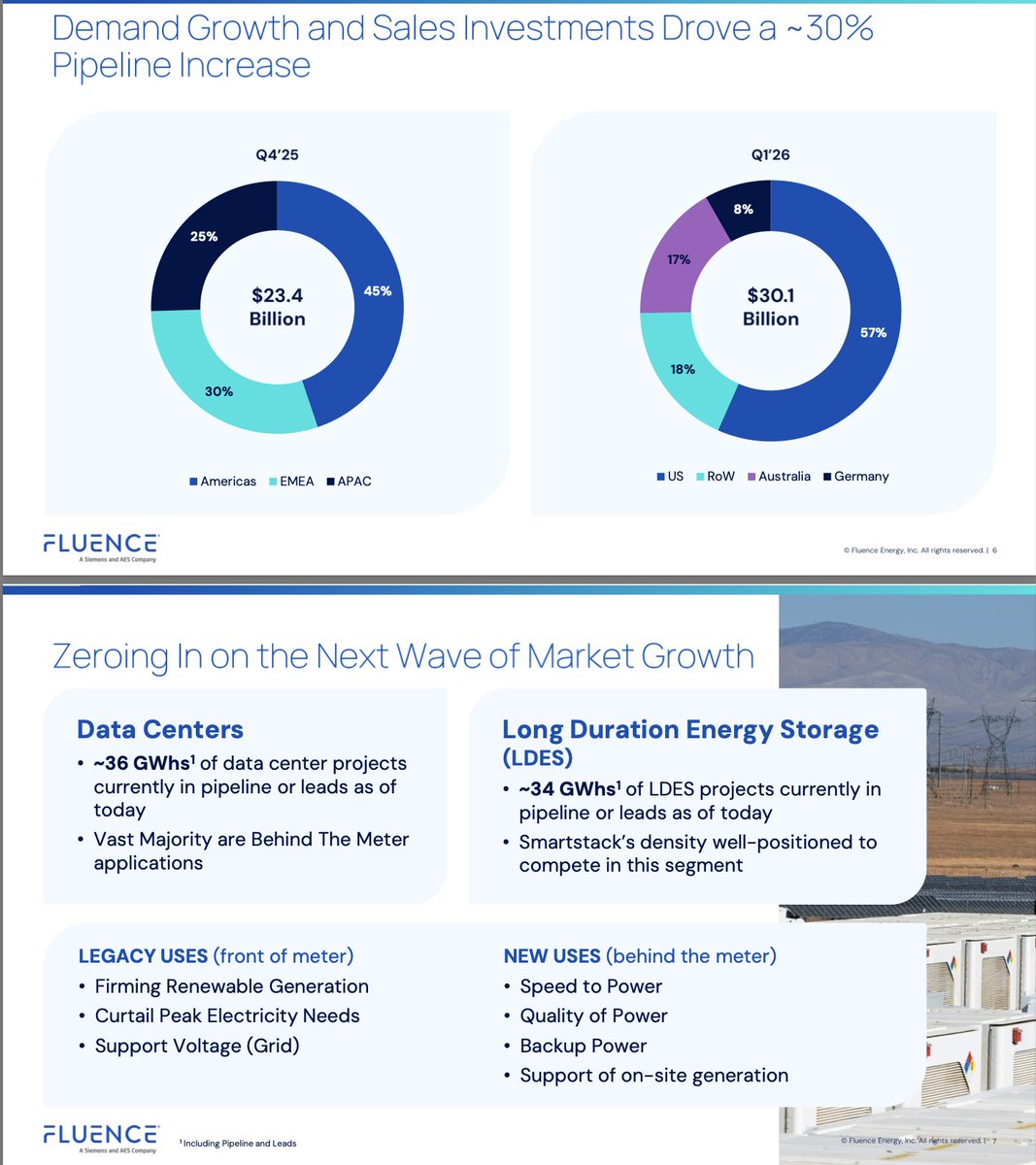
Use $FLNC as a reference: Fluence saw ~30% QoQ, $6.7 billion pipeline growth. Remarkable!
• 36GWh data center projects
• 34GWh LDES
These are not normal numbers: ~30% QoQ growth and multi-billion pipeline expansion. That’s what a demand tsunami looks like — and not enough people are aware of it.
Data Center demand and LDES. These are the exact pillars Fluence is highlighting. Expect Eos to lean into the same and show ≥1.3× Fluence’s DC exposure and ≥2× its LDES, at least.
Remember, Cerberus’ thesis is for $EOSE to become the First Solar ( $FSLR) of BESS. That is not winning ~3% of the market share. Its dominating. It's having structural cost advantages, localized manufacturing, and the ability to execute at scale.
Recommend watching Joe with Maria on FOX: https://t.co/RLRGH5amep
@isorry123 Easier to build. Easier to ship. Durable and flexible. Opens up new markets. From the very small to the very largest. Bigger news than it appears on the surface, One efficient product to manufacture with broad use applications, I like it.
@isorry123 I think this is an intelligent take on the new product announcement and significant near term fiscal impact. Final leg of assembly seemed to be where the new bottleneck was developing. Indensity probably is integral to new manufacturing line and faster throughput.
Now is a golden age for the “doers”. AI and the internet has leveled the playing field of information and the doers of the world are unleashed to reap the rewards. $EOSE
@HungStrikerCptl The event is also happening at an old abandoned steel mill. When Eos unionized with the steel workers union there were words at the time about being able to facilitate demand. Smallish detail maybe.