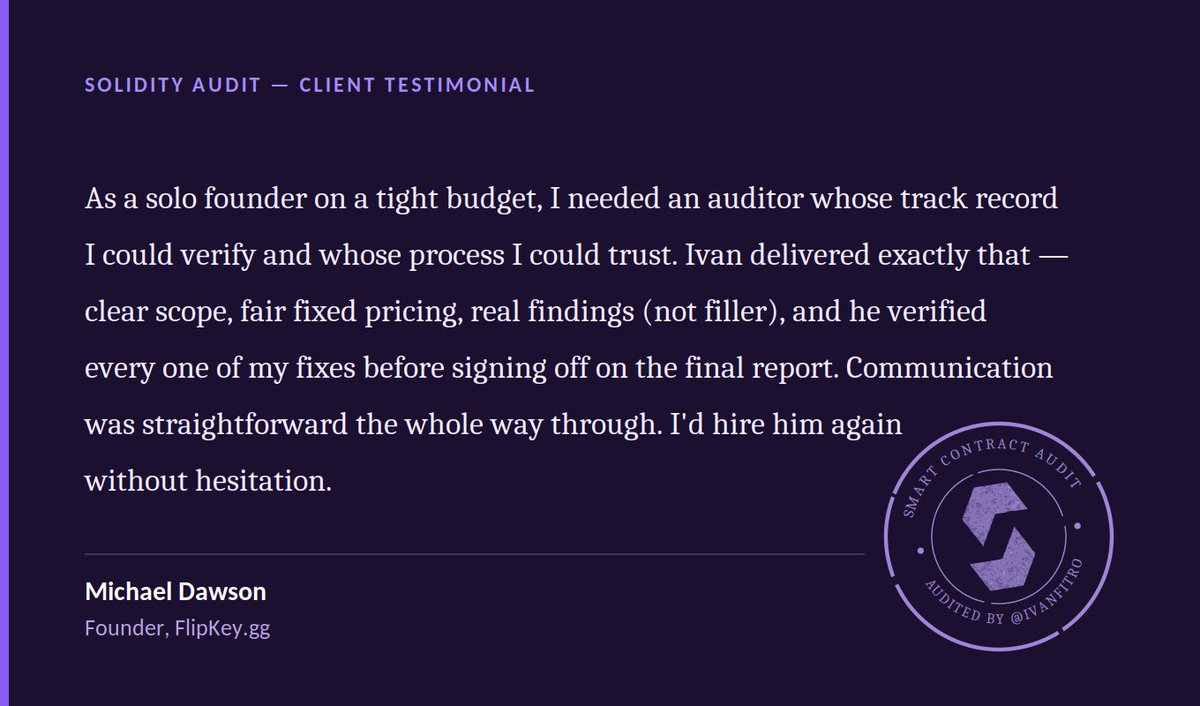
Thanks to @flipkeygg for trusting me to audit your project. It was a pleasure working with you.
Always focused on delivering the highest-quality security service and helping clients build more secure projects.
A few days ago, I had the pleasure of being interviewed by @b612security.
I shared some of the key lessons I learned while building my own AI-powered security auditing system.
Thank you so much for the opportunity and for your contribution to the ecosystem by sharing valuable knowledge and insights.
I highly recommend working with the B612 Security team. They are incredibly professional and have some of the best auditors in the space.
It was a pleasure sharing my experience with you! 🚀
Today, while reviewing some code, I came across something that surprised me: a low-level call written in assembly using address() as the target address.
At first, I thought, "What's going on here? Is it empty?" But that didn't make sense.
Then I realized that in assembly, writing address() is equivalent to address(this).
You learn something new every day in this field.
Gm guys.This Sunday is a bit different as I’m traveling to another city today. But as always, laptop in hand.
I'll be diving into some new Web3 security topics while on the move.
How’s your Sunday looking?
@_vMyth The code is always the source of truth. However, discrepancies between code and comments often highlight underlying issues that require investigation.
One important thing to include in your agentic auditing workflow is comparing the documentation with the code.
You can find some very interesting issues this way. I’m speaking from experience: I was reviewing a codebase where the code itself was correct, but the issue was the contradiction between the code and the documentation.
Don’t just audit the code. Audit whether the code does what the documentation says it should do.
@tarpert1 You can use the $20 to start. In the beginning, you don't need an agentic workflow, just use the AI to speed up your learning, test different assumptions, and get fast feedback.
Today's critical security breach on Binance resulted in an estimated $5.7 billion drain by an attacker.
The current investigation indicate that the vulnerability may be tied to EIP7702.
A lot of people ask which LLM is the best for smart contract auditing. While some models are faster, cheaper, or perform slightly better than others, model choice isn't the real key to finding vulnerabilities.
Today’s frontier models are already incredibly capable. The true game changer for an agentic workflow is the infrastructure backing it.
Think of the LLM as the engine and the infrastructure as the chassis. If your infrastructure is weak, even the most powerful engine won't be able to reach its full potential.
Sometimes, as SR, we focus only on on-chain verification, but the most interesting issues can be hidden in the off-chain components.
That's why it's crucial to trace the entire transaction flow, from beginning to end, and understand how all the components interact.
Otherwise, exploits like the Kelp DAO incident can happen.
$292M lost. Zero bugs in the smart contracts.
Kelp DAO's rsETH bridge trusted 1 verifier.
The attacker poisoned 2 RPC nodes it relied on, DDoSed the rest, and the DVN attested a message that was never sent.
Great breakdown by @OpenZeppelin 👇
https://t.co/HWjo9tujP2
An important thing to remember:
Your skills and knowledge aren't defined by one bad result in a bug bounty or audit. Sometimes things don't go your way, and you can't be perfect every time.
The most important thing is to keep learning, improving, and growing. The results will come.
Web3 security is incredibly challenging. Remember, your value isn't determined by one bad result, but by your progress, the lessons you learn, and the successes you achieve over time.
Keep going. You're playing the long game.
Solidity security lesson: an empty market turns 1 wei of rounding into millions.
Hundred Finance lost ~$7M on Optimism (Apr 2023) with code copied from Compound v2.
How cTokens are priced:
exchangeRate = (cash + borrows − reserves) / totalSupply
In a normal market, totalSupply is big, so rounding loses dust.
In an EMPTY market: totalSupply is tiny.
Anyone can donate tokens → cash goes up → the exchange rate explodes.
Now 1 cToken is worth a huge amount of WBTC
and every "round down" in redeem is no longer dust.
The attack:
1. Flash loan WBTC, mint, redeem almost all → hold only 2 wei of hWBTC.
2. Donate ~500 WBTC → those 2 wei are "worth" ~500 WBTC.
3. Use 2 wei hWBTC as collateral → borrow every other market dry.
4. Redeem the WBTC back: the cTokens to burn round DOWN → burn 1 wei instead of 2.
5. Repay the flash loan, keep the borrowed funds.
The attacker walks away with the loans and their collateral back.
What I check in every Compound/ERC-4626-style fork:
Can a market or vault ever reach totalSupply ≈ 0?
Does the price come from balanceOf (donation-sensitive)?
Shares burned on withdraw must round UP, shares minted on deposit round DOWN.
Seed new markets with dead shares before enabling them as collateral.
🚀 Kann Audits Internship Program 2.0 is here!
We're back with our second paid internship program for Security Researchers!
Looking for motivated hustlers across:
• Solidity
• Rust
• TypeScript / Off-chain
• ZK
We're giving emerging talent the opportunity to work on real security audits, build strong portfolios, collaborate with other researchers, and level up their skills.
Ready to prove yourself?
Apply here: https://t.co/nib0rIQRsM
Once you've applied, comment "Applied!" below 👇
Solidity security lesson: the same address on two chains is NOT the same account.
A CREATE address = deployer + nonce. Reach that deployer and nonce on another chain, and you own the address.
Optimism, 2022:
-20M OP sent to Wintermute's mainnet Safe address on Optimism.
-No Safe existed there yet.
-Attacker replayed the old Safe deployer txs (signed before EIP-155, no chainId).
-Then deployed Safes in batches until the nonce hit Wintermute's address, owned by him, 20M OP gone.
What I check in multichain deployments:
-Is the contract really deployed on the target chain before funds move?
-CREATE2 with the owner/config bound into the salt or initcode.
-Every signature and deploy tx includes chainId.