I think that there are dramatically more hacks / attacks than we are hearing about and that it has moved forward timelines to secure compute capacity - hence decapitating Nvidia and new rules on leasing cloud compute abroad. They are trying to do this without taking down the market given so much is data center capex. I think due to urgency around the risk the decision has been made to tighten it and let economy/market suffer as better risk/reward than continuing exponential ramp which makes more compute available for adversaries
I updated the chart to be more useful than just $/RVU. You have to account for how many RVUs are billed and who bills them. From 2021–25, Medicare allowed charges rose 10% for physicians vs. 101% for nonphysician practitioners. So comp per physician not going down, but certainly lagging other components of health care spending, with extenders dramatically gaining share (many of which are owned by physicians or hospital systems).
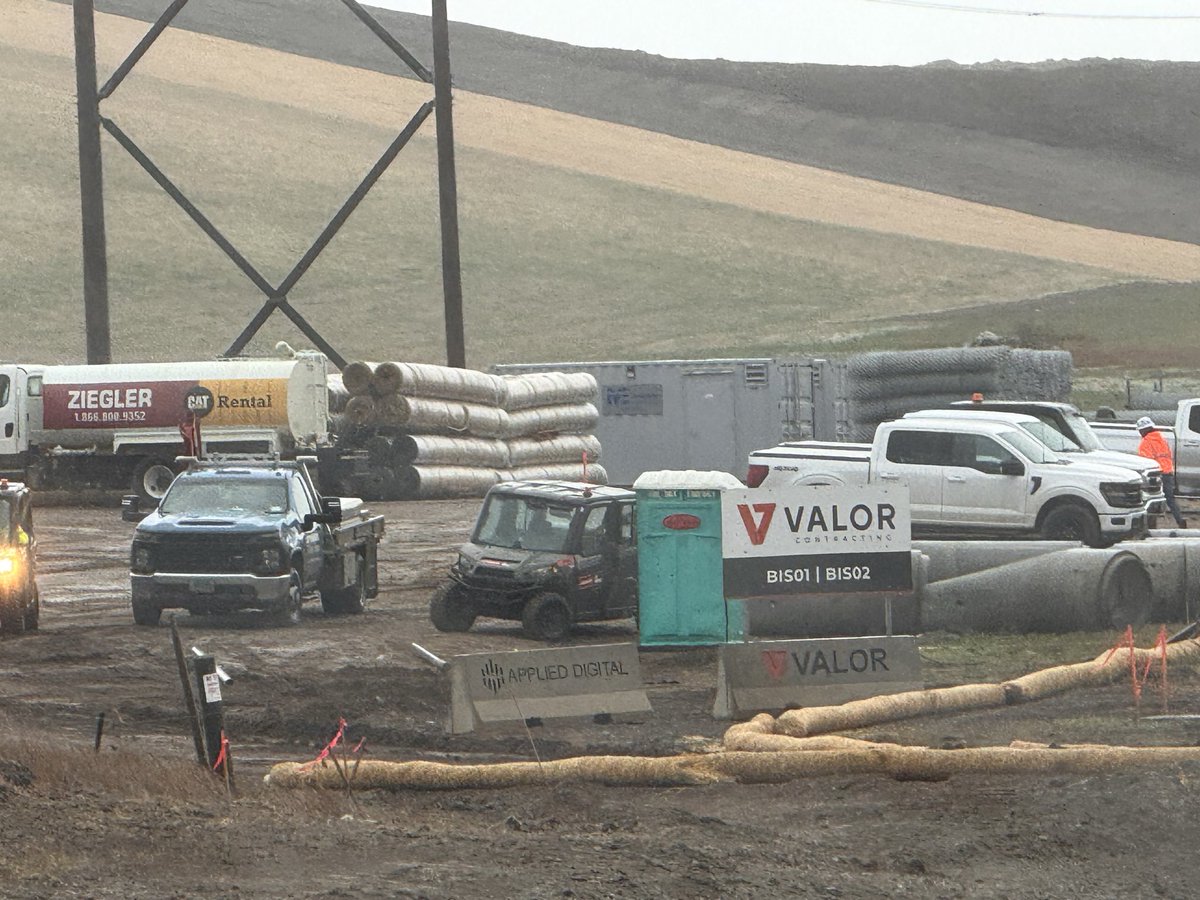
Visited the Applied Digital data center going up outside Center, ND recently. The scale is mind blowing. It sits on a full section, a square mile of former farmland, with an earth wall built around it so you can't really see it driving by. Behind the wall sit cranes and massive concrete shells.
What's going up right now is "only" 300MW of compute in two buildings for an undisclosed hyperscaler 15 year $7.5B base contract. The main building alone is ~907k sq ft, about 20 acres of roof or 15 football fields. This phase is on the order of 120,000 GPUs. At full load it pulls ~430MW from the grid. That's almost 2x what all of Bismarck-Mandan draws, and roughly two-thirds of the electricity used by every home in North Dakota combined.
Next door is the Milton R. Young coal plant. A dragline with a boom longer than a football field scrapes the earth 24/7, and 240-ton trucks haul lignite to the plant. All of that work, burning ~4M tons a year of 60-million-year-old Paleocene swamp, makes 705MW. This one campus would use ~60% of that entire plant's output. Put another way, that's roughly 6,700 tons of coal a day, about 28 of those 240-ton truckloads every day, just to keep the GPUs running.
Then there are the windmills spinning all around it. Each one is 1.5-3MW, but on average the wind only delivers ~40% of nameplate. Powering this site around the clock with wind would take ~350 turbines spread over ~140 square miles, plus storage for calm days.
300MW is just the start. The power will come from a new 1.2GW gas plant right next door (four 300MW units, targeted for 2030), built by Base Electron, which is run by Applied Digital's own CEO and president. On the last earnings call, the CEO said Center is set up for "almost unlimited capacity for expansion."
For a sense of what that 1.2GW gas plant means: it's 1.7x the coal plant next door, the equivalent of ~1,000 wind turbines on ~400 square miles, ~2x the load of Fargo-Moorhead, and more power than every home in North Dakota uses. All of it next to a town of 583 people.
The other constraint is people. I talked to an electrician on site making ~$140/hr. He's thinking about moving to Texas, where he's been offered ~$400k/yr working on data centers (with overtime and per diem). It takes 8,000 hours and 4-5 years to make a journeyman, so those licenses are in short supply.
It's one thing to run the IRR math on 1GW and say yes, the returns are strong and this is money good. SemiAnalysis is tracking ~50GW of new data center capacity outside China in 2027. It's another thing to stand there and see what 300MW takes, and ask whether we really have the space, power, energy and workers to do this 150+ times over.
These are the largest facilities I've ever seen. Our world will physically look very different ten years from now.
$APLD
@OnodaCapital I like it but add far OTM index leaps to hedge case AI really does result in step change in gdp growth and real rates go to 10%+ and bonds continue to get crushed.
@rev_cap If continue current trajectory real rates continue increasing and non-AI crowded out, multiple contraction continues, bankruptcies/restructurings spread. If hits wall it all goes down ST but non-AI gets renewed lease on life.
Everyone talking about wealth effect / fund flows to Bitcoin from Anthropic / OAI employees, suspect impact on cryptopunks will be larger.
For context employee wealth generation est $450B x 30% realized x 5% crypto allocation = $7B
$100M purchases sweeps floor to 100ETH
@TMTBreakout Think for a moment about the amount of traffic fastly serves today. Think about then CDN market growth relative to historical as assistance agents pick up, think about fastly incremental share. While thinking about this don’t overthink. It’s a long.
@RohanNayak2 Worth reading the fine print before uploading stories to Pocket FM’s Sherpa. You appear to retain copyright, but Pocket FM’s current Terms grant it a broad, royalty-free, transferable and sublicensable license to use, adapt, distribute and commercially exploit uploaded content.
@nic_carter It’s a superior business model; selling token access to gen pop keeps stuck on training capex treadmill with distillation shortening useful life, closed access allows to dream the dream for terminal value
The frontier of artificial intelligence is advancing at an alarming speed. Over the weekend, industry leaders voiced support for an idea that the American people and many AI researchers in their own labs have been calling for: We must responsibly slow the pace of frontier AI development.
A slowdown is critical in order to ensure AI serves the public interest. Pacing AI development does not mean giving up on this technology’s potential to produce life-saving benefits in fields like medicine — some of which we are already seeing. Rather, it is about setting up sensible guardrails so that AI does not completely escape human control and endanger our safety and collective future.
This moment demands the leadership of the United States government. Congress must work at an urgent pace to pass new laws and establish a new federal entity to provide oversight and independent testing for this technology, to ensure accountability, and to protect our wellbeing.
We need cooperation at an international level as well. The United States must continue to lead the world in developing AI technology even as we seek to impose common-sense safety standards. This means that the president must do his job to protect America’s interests by pursuing a treaty with countries like China to stop dangerous uses of AI, limit the speed of its development, and adopt global standards for testing.