Big thanks to @NYSDPS, @NYSERDA and @e_source. We are proud to have designed this first version of the Rate Plan browser and excited about what's ahead.
Flux Tailor is delighted to share the availability of an important new energy information resource for New York State.
Go check out the first version of NYSERDA's Integrated Energy Data Resource (IEDR) Rate Plan Browser: https://t.co/AwhAZL5reO
Back in 2018, Drury worked for Avangrid and we developed a Trust Portal concept for “managing consent for energy data sharing across utilities” as part of an innovative utility collaboration led by @Groarke@indigoadvisory
https://t.co/myxjy3P8AK
Now we get to help realize this
Big News: @FluxTailor is part of the team led by @e_source selected to build a statewide platform for access to energy related data in New York state. The platform will support DERs & accelerate the energy transition to meet New York’s goal of reaching carbon neutrality by 2050.
NYSERDA selected @e_source, women-owned business @FluxTailor & HumanLogic + Utility API & @TRC_Companies to design, build & operate NY's Integrated Energy Data Resource (IEDR) providing insights to determine policy, investment, & operational decisions. https://t.co/NLxVIsWp8y
Join us Thu @12pm ET for the official launch of the GeoPossibilities tool. We're proud to have supported the design and supported the development of the tool, which helps home owners, developers, and others as they consider ground source heat pumps.
#cleanenergytransition
Register now for the Geopossibilities Tool Launch + Q&A on July 22! Tune in to learn about this free new online tool for any #WestchesterCounty municipalities or property owners to assess the feasibility of #geothermal heating & cooling for buildings.
➡️ https://t.co/KxY0di3T2R
@JigarShahDC These households are least likely to be able to afford heat pump upgrades and most likely to benefit from the utility bill, health, and maintenance savings. Reach out to learn more about our work on #coolingequity, a huge issue currently largely overlooked by energy programs.
@JigarShahDC 4/4 Create more incentives for financing cooling upgrades for lower income households.
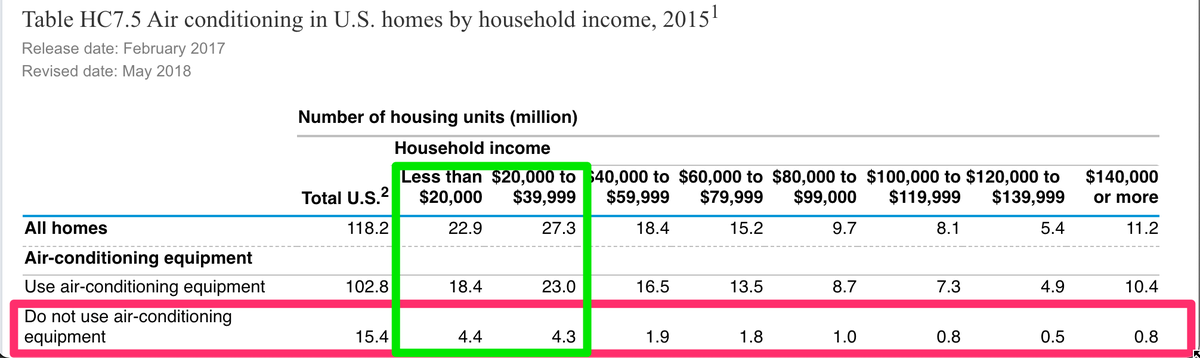
Per 2015 RECS estimates, of the 118 million housing units in the U.S., 15.4 did not use air conditioning. 8.7 million of those are in the 50.2 million households with annual incomes below $40K.
@mission_data 2/2
3. Fund efforts to include double and triple bottom line accounting in existing standardization efforts on e-invoicing
4. Provide education for software and service providers and the public on all this to speed up adoption (like @EPA already does for @ENERGYSTAR)
@mission_data 1/2
Hello new administration at @ENERGY and @EPA, the U.S. clean energy industry needs better #energydataaccess! Some ideas:
1. Fund @The_GBA to re-catalyze Green Button Connect efforts
2. Create real federal data privacy laws so state public utility commissions don’t get stuck
@mission_data Yes! Pre-VEE usage data will be marked as “raw” and interpreted as such! 🙄! Minimal latency is crucial for for example remote monitoring.
And: To actualize maximum feedback and savings we also need access to real-time usage data.
@RupertFausset@janrosenow@PassivhausTrust Also: Good point, but just standardized internal temp doesn’t get you a full picture of building performance. You’d also need to adjust for occupancy % over time. Energy shlurping luxury vacation homes may still look fabulously efficient on an annual basis.
@RupertFausset@janrosenow@PassivhausTrust Read the report! it did note this:
“The SAP calculation does not include detailed modelling of occupancy behaviour, nor does it include unregulated energy use (i.e. appliances and plug loads), so a discrepancy between modelled energy and actual energy use is expected.”