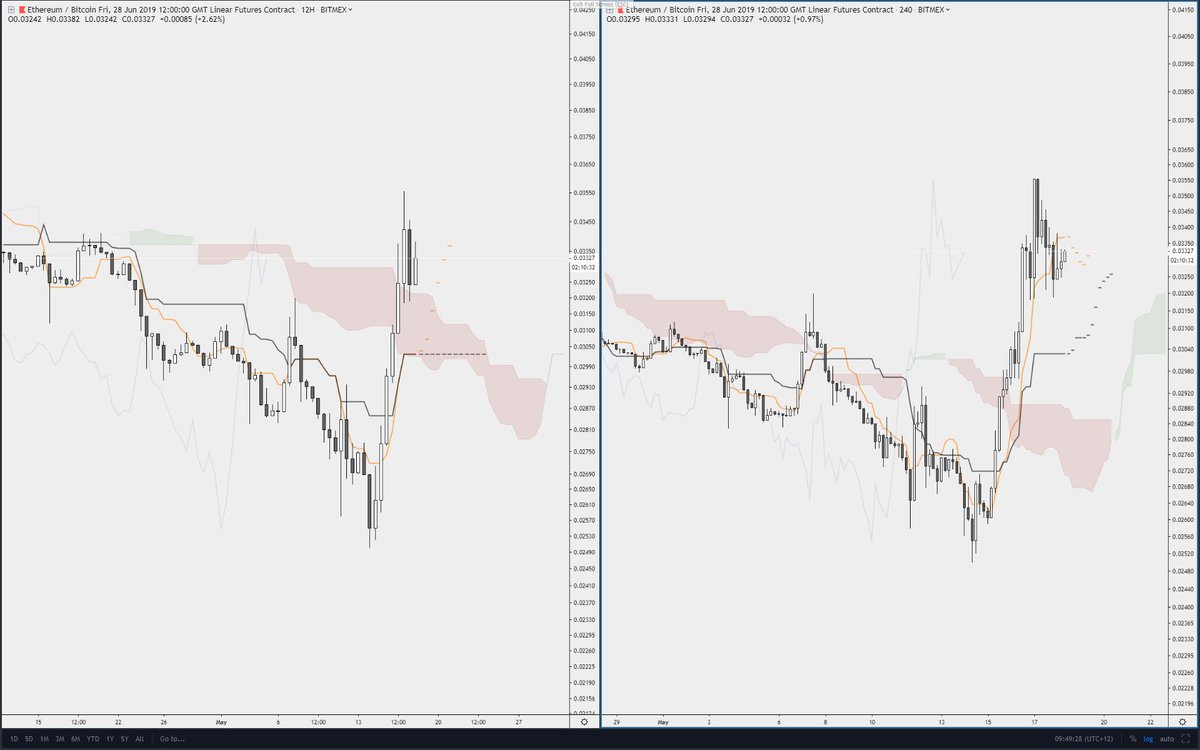
Anyone that uses the Ichimoku Cloud, I have developed a script that shows the future progression of the Tenkan-Sen and Kijun-Sen. It is available for free on trading view.
https://t.co/uXQN1my9bq
We're winning. We're so early. It's nuts.
If the tokenization thesis plays out we will see insane re-ratings of onchain primitives.
Stablecoin issuers like Circle, Tether, Sky, Ethena, M0, Bridge, and many others will grow to massive proportion.
Perps DEXs like Hyperliquid, Lighter, and Variational will explode in revenue and value. Total combined open interest will be in the hundreds of billions.
Lending protocols like Aave, Morpho, Spark, Infinifi and many others will win big.
Spot DEXs like Uniswap, Aerodrome, Jupiter, and many others will dominate.
Blockchain ecosystems providing the rails to tokenized assets like Ethereum, Solana, and others will grow in massive size.
It just takes some patience. Stay optimistic, we're going to tokenize the world.
Underwriting RWAs is a new challenge for much of DeFi - but if you already have a list of the right questions to ask, you can streamline a lot of the back-and-forth with AI-driven reviews.
Just gotta make sure to demand citations AND check them
Banks have run fractional reserve since the 17th century for a good reason. It works.
infiniFi runs the same play except now depositors keep the premium.
$iUSD $siUSD $liUSD
Introducing a new look for infiniFi.
We’ve refreshed the branding, launched a new website, & rolled out a new & improved app.
The same infiniFi system, built for what’s coming next.
"You're rewarded for time, not for taking on extra leverage." ⏱️
NEW 🎙️ @infiniFi DeFi Drop episode is LIVE
We sat with @RobAnon to discuss:
💰 Higher yields thru duration ladders
🔐 Single-party veto risk council for conservative selection
🔮 Prediction: DeFi TVL $150B by June
Missed today’s panel spaces?
Good thing we recorded it!
Come listen for some market breakdowns, looping vaults, & builders talking about what’s coming in 2026 🔥
https://t.co/kkJHf5cDeM
So @infiniFi recently announced they're entering Bitcoin-backed CeFi lending through direct @maplefinance deployment.
Honestly had to dig into what that actually means. Here's what I found:
What are they actually doing?
infiniFi takes your stablecoin deposits and splits them based on how long you're willing to lock them up.
You pick:
> Keep it liquid, get lower rates
> Lock for 1 week to 13 weeks, get higher rates
The locked stuff goes into Maple Finance institutional Bitcoin-backed loans. Market makers and trading firms put up BTC as collateral and pay fixed rates for committed capital.
DeFi rates got crushed in 2025. Bitcoin lending dropped from 6% to 1.5-4%.
But institutional borrowers still pay 8-13% for longer-term capital.
infiniFi is capturing that difference.
What does this maturity-matching thing mean?
Most DeFi lending is instant-access. You can pull your money anytime, which is great, but protocols like Aave have to keep 20-30% sitting around doing nothing just in case people withdraw.
That kills your yield.
infiniFi's approach:
> Want instant access → your funds chill in liquid pools
> Willing to lock → your funds go into institutional loans earning better rates
When you lock for 1-13 weeks, they know that capital isn't going anywhere.
So they can commit it to Maple's institutional loans.
Your lock period covers their loan duration.
How does Maple Finance work?
Maple does institutional lending with proper custody (BitGo, Copper, Hex Trust) and actual credit underwriting.
Their setup:
> $4B+ assets, $12B+ loans originated
> 160%+ overcollateralization (borrowers post $1.60 of BTC per $1 borrowed)
> Fixed-rate terms
> Vetted market makers and trading firms
> Institutions only (regular users can't just sign up)
infiniFi started with $10M at around 7.5-8%, scaling to 8-13%+ for longer locks.
Here's the thing: you can't access Maple directly as a retail user. It's institutional-only.
infiniFi bridges that gap.
Why are yields higher?
Aave: 3-8% because it's instant-access and needs those liquidity buffers.
infiniFi: Better rates through blended strategies and institutional loan access.
You're getting paid extra for locking.
The longer you commit, the better rates they can get you from institutional markets.
Right now TVL is around $185M with yields around 7-8% on the new Maple deployment.
What do you actually get?
Better yields than Aave without having to:
> Figure out Maple yourself
> Be an institution (because Maple won't let you in otherwise)
> Monitor borrowers
> Rebalance everything manually
You deposit stables, pick your lock period, collect yield.
That's it.
Tradeoff is you're trusting infiniFi's contracts and their allocation decisions. Risks are still there even with onchain transparency.
The capital efficiency thing
Traditional DeFi keeps big liquidity cushions for everyone. Super inefficient.
infiniFi splits it:
> Need liquidity? Funded by liquid reserves
> Willing to lock? Funded by institutional lending
Gets them to 100% utilization within each bucket.
Better yields because they're not keeping 20-30% idle.
Basically traditional banking (borrow short, lend long) but with transparent onchain reserves instead of black box balance sheets.
What this actually means
DeFi is shifting from "farm tokens at 1000% APY" to real yields from actual economic activity.
Institutional lending markets exist. Borrowers pay premiums. But these markets are closed to regular users.
infiniFi solves that.
You get institutional rates without needing institutional status.
That's the regulatory arbitrage play.
The logic is pretty straightforward: capture the gap between crushed DeFi rates (1.5-4%) and institutional rates (8-13%) by matching lock periods to loan durations.
That's what's happening, no fluff.
This is exactly what we hinted a couple of months ago: points were onboarding, not the endgame.
The real edge of @infiniFi is structural — duration layering built to warehouse collateral and backstop RWAs through redemption windows, stale NAV marks, and off-chain settlement.
RWA liquidations don’t happen “in the block”. They happen on the calendar.
Love to see where Infinifi is heading. Kudos to @Val_bpereira for giving such clarity on the roadmap!
As a DeFi protocol, you can safely:
Have no internal leverage, let people leverage your token
Have internal leverage, don't let people leverage your token
You should never have both - once that happens, the risk spectrum has too many degrees of freedom, and risk management flies out the window
RWAs are going to be one of the big themes of this year
But without someone who can warehouse their duration in the event of liquidations, lend/borrow markets on them won't be possible
Enter infiniFi:
Duration is our mandate, and we're here to make this vision a reality 😎