@BenRabidoux I think so—if he’s ruffling these holdovers’ feathers, he’s doing something right
✔️ He’s the man with a plan. Competence vs our long 10 yrs with incompetence
✔️He always lists rational reasons for his actions vs. Trudeau era clown rhetoric
In a new Stanford study, law professors by far preferred Gemini 2.5 Pro's responses over those written by their peers when they were unaware of who wrote the answers.
@johnarnold Legal advice (got me out of irrevocable period on real estate offer, by knowing the law better than real estate agent)
Copy editing (knows rules grammar, parts of speech/sentences, etc.)
Anything where lot of accessible data has to be applied rightly (case law, text, etc.)
I wrote about the Pope and why Christian tech critics often have a more compelling response to the AI crisis than their secular counterparts. Simply, Christian writers aren't afraid of "human nature" talk, and they understand THE question of the AI Age is: what are people for? 🧵
@lord_nasdax@paxtrader777 I think he lost still he started to see the inter-relationships, and he spread thereafter, one thing against another.
Think he stood on the balcony watching till he got it
@beauchasse@captive_dreamer Butts’ take was it was “understandable”.
And Trudeau rushed over and paused for the cameras—virtue posing—over what have now been identified as septic lines—not graves.
Finally, a big name has the courage to tell it: we are nowhere near AGI.
Demis Hassabis, CEO of Google DeepMind and Nobel laureate for AlphaFold, put it neat and clear:
"Today's systems are nowhere near [AGI]. Doesn't matter how many Erdős problems you solve… I think it's far, far from what a true invention, or someone like Ramanujan, would have been able to do."
This is the elephant in the room that many AI enthusiasts prefer not to see, or are actively trying to hide.
Erdős problems are well defined, often combinatorial, on finite spaces. They are exactly the kind of problems on which current AI can achieve spectacular performance with a lot of compute and knowledge.
A neural network can search a huge graph of possibilities. It can recombine existing knowledge at unprecedented scale. It can discover surprising solutions inside an already defined conceptual space.
But true invention is something else.
True invention is not only solving a problem.
It is inventing new objects, new dimensions, new connections. It is inventing new problems.
From resolving to inventing there is a discontinuity that we don't know how to bridge.
We are making extraordinary tools.
But we are nowhere close to AGI.
Anthropic is really a mixed bag; they rightly support moderate regulation, but they invite wildly anthropomorphic language about LLMs, and steal IP just like their peers.
@AlexRMcColl@TheHousecarl@TidalPowerBob@ClintonDesveaux F-35 “reliability”—Only ~1/3rd of UK ones are fully operational
Makes no sense for big country.
UK experience—as soon as they deploy them a distance and they break down, game over for months
@TheNatlInterest@ME_Council I wonder how it’s altered the psych of the protagonists, esp. Iran:
* Is Iran emboldened, feels it deserves a seat at the table w/ EU, China, Gulf now: a credible threat?
* The US the inverse—further isolated, alienating EU, etc.?
@TheNatlInterest Only 35% are fully operational, and yet we in Canada are supposed to buy F-35 vs. uber reliable Gripen, which operates in all conditions, off roads, etc.
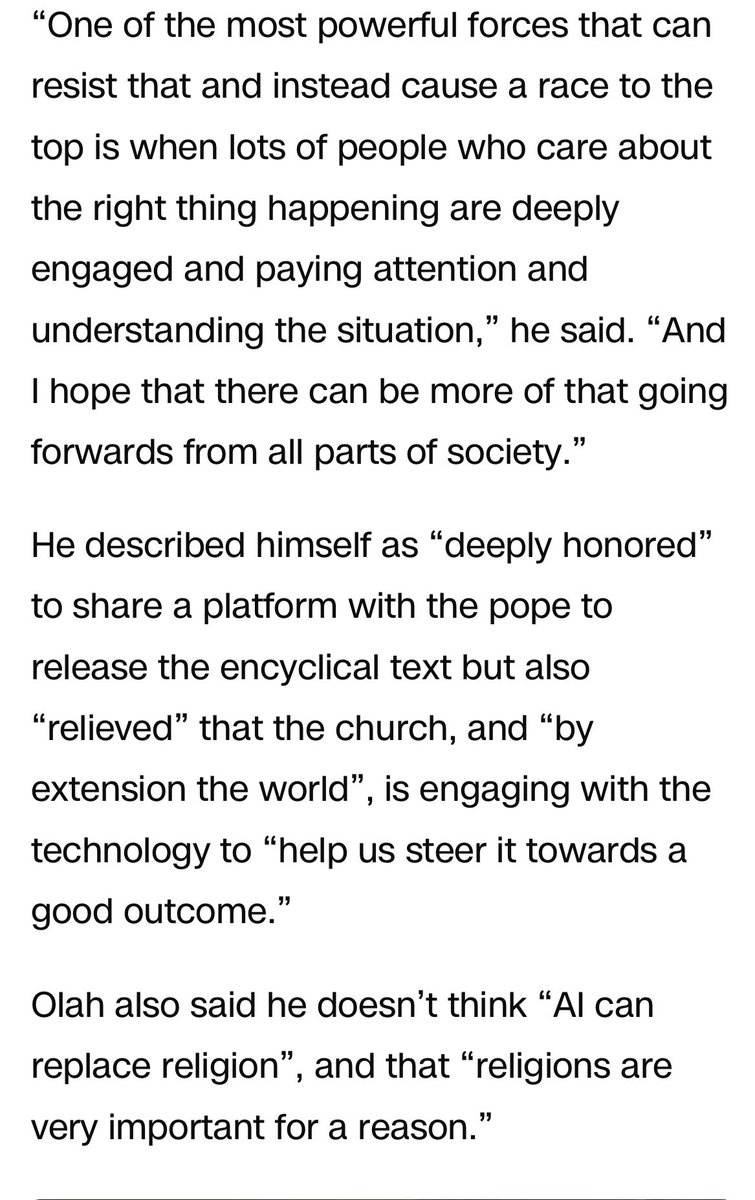
Speaking after the release of Pope Leo XIV’s encyclical on AI, Chris Olah of Anthropic told @CNN that having an “engaged and trying to push this (AI) in a good direction” is “really powerful”, since it helps counter the pressures that “could force a race to the bottom on AI.”
He also said he doesn’t think “AI can replace religion”
https://t.co/nrjLf484uM


![ValerioCapraro's tweet photo. Finally, a big name has the courage to tell it: we are nowhere near AGI.
Demis Hassabis, CEO of Google DeepMind and Nobel laureate for AlphaFold, put it neat and clear:
"Today's systems are nowhere near [AGI]. Doesn't matter how many Erdős problems you solve… I think it's far, far from what a true invention, or someone like Ramanujan, would have been able to do."
This is the elephant in the room that many AI enthusiasts prefer not to see, or are actively trying to hide.
Erdős problems are well defined, often combinatorial, on finite spaces. They are exactly the kind of problems on which current AI can achieve spectacular performance with a lot of compute and knowledge.
A neural network can search a huge graph of possibilities. It can recombine existing knowledge at unprecedented scale. It can discover surprising solutions inside an already defined conceptual space.
But true invention is something else.
True invention is not only solving a problem.
It is inventing new objects, new dimensions, new connections. It is inventing new problems.
From resolving to inventing there is a discontinuity that we don't know how to bridge.
We are making extraordinary tools.
But we are nowhere close to AGI.](https://pbs.twimg.com/media/HJKS-JdWkAAZOdT.jpg)