Human evolutionary geneticist @ Tartu university. Interested in admixture and demographic history of populations. Always fighting against python, R and BASH.
Previous work suggested that the role of genes in educational attainment was higher in contemporary Estonia than during the Soviet era. With a tenfold larger dataset, our new preprint finds limited evidence to support this.
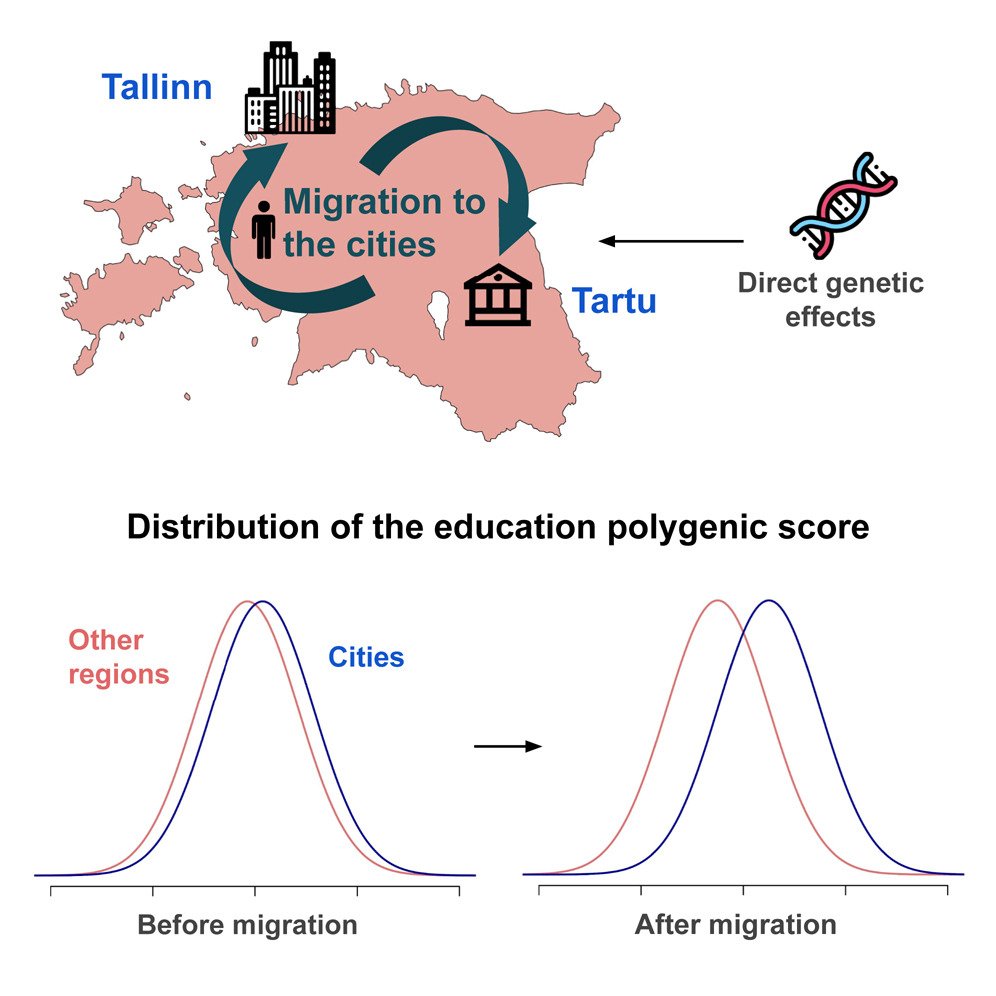
Remember the famous UKB migration paper? We found that internal migration also shapes population structure in Estonia. Key patterns replicate within families.
Paper link in the last tweet.
New pre-print out! 🎉 With Mathilde + team we traced spatio-temporal shifts in genetically regulated #transcription across 10,000 years of Western Eurasia, fine-mapping regulatory features targeted by #selection! 👉 https://t.co/ihS4OoBats ! #popgen#genomics
Matteo Ferro, a doctoral candidate in my team has a new blog on health data science where he is collecting the most interesting papers, each month.
Check it out!
https://t.co/gjmaiZCLn8
I wrote about how population stratification in genetic analyses led to a decade of false findings and almost certainly continues to bias emerging results. But we are starting to have statistical tools to sniff it out. A 🧵:
Our new Nature Genetics paper on human segmental duplications (SDs) provides a pangenome perspective of SDs, new potential protein-coding genes, and greater complexity in human variation with implications for disease and evolution. https://t.co/CYCI8xQEiH
Finding relevant papers for literature review takes a lot of time.
So, MIT researchers built Undermind, an AI-powered search engine.
It can generate well-researched overviews on any topic and is 10-50 times better than Google Scholar.
Here's how to use it:
Another chapter on generating in silico artificial genomes led by Antoine Szatkownik with @florajay_ , @emiliahsc and many others I couldn’t locate here. This time using diffusion models and with a utility perspective:
https://t.co/GRxzY8HjAm
Excited to share our review article on Denisovans, now out in @NatureGenet🥳I am very grateful to @emiliahsc for making this possible! Check it out 🔎🧬
https://t.co/aTZ8fNRHwZ
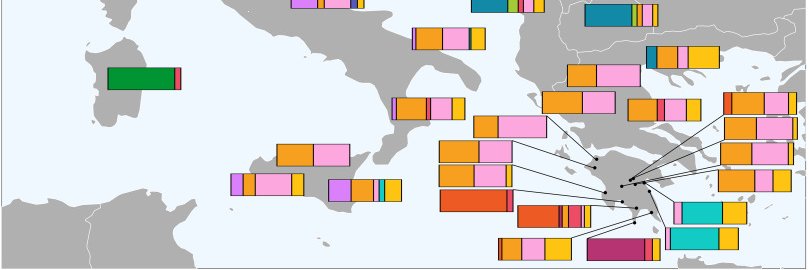
🚨Our latest preprint on ancient Italy is out with a new Republican sample!🚨
Is the Roman Empire ancestry shift towards the Near East really an Imperial thing?
⏲️We show that it probably began from the Republican period 200 years before the Empire.
1/n
https://t.co/ZignrCIgxL
🧬 A new study co-authored by our @davidebolo93 @Raveancic & @nicolesoranzo reveals that human amylase genes, crucial for starch digestion, underwent multiple duplication and deletion events throughout evolution.
📰 Published in @nature
https://t.co/F53uukuNXn
We're hiring 5 postdoctoral researchers for the ERC Synergy Last Neanderthals. Deadline: August 27th. Positions available in Ancient DNA, Biocultural Modeling, Excavation & Documentation, Histomorphometric & Isotopic Analysis, and Zooarchaeology
https://t.co/jHSRwNTxVI
Finally our ancient DNA study on Merovingian Flanders is out @PNASNews!
Discover our surprising capture of a fusion of 2 genetic ancestries on coastal Koksijde (Belgium) in 675-750 AD #EarlyMiddelAges
Our paper 👉 https://t.co/tFaVzCmEjx
🧵1/9 @KU_Leuven@CHG_CME
(Photo: @vioe)
“A molecular and cellular perspective on human brain evolution and tempo”; A must-read @Nature Perspective by @feline_lindhout@fennamk K. Pollard and @mad_lancaster
🧠🧬
https://t.co/nEelXKEb8P
Happy to see that our paper on archaic admixture and its phenotypic impact in Papua New Guinean populations is out now in @PNASNews! Thanks to all co-authors for this fun collaboration @genomicstartu https://t.co/2qxm5yB1sy