The first time American physicist Richard Feynman went to Brazil, he usually ate outside of normal hours, so he was always the only customer at the restaurant
One day, while he was enjoying a plate of rice with meat, a Japanese abacuses vendor came in.
The vendor turned to the waiters and bet that he could add much faster than they could.
The waiters, who did not want to make a bad impression, invited him to speak to the only customer who was sitting alone in a corner.
"I don't speak Portuguese very well!" protested Feynman.
"It doesn't matter," laughed the waiters, "numbers are easy to understand." So they brought him a pencil and paper, and the challenge between the physicist and the street vendor began.
In adding numbers, Feynman was largely defeated.
And the situation did not change when they moved on to multiplication: this time, however, Feynman was defeated by a small margin, because he was quite good at multiplication.
At this point, the man suggested moving on to divisions, without realizing that the results with paper and pencil improved as the calculations became more complex: the more complicated the operation, the greater the chances Feynman had of winning.
And in fact they both performed a long division, and in the end they were tied.
Unable to bear to be beaten by an anonymous customer at the restaurant, the Japanese man exclaimed:
"Raios cubicos!". Cubic roots!
He wrote the number 1729.03 on a piece of paper and challenged the physicist to extract the cube root.
While the street vendor worked frantically, sweating blood, Feynman sat quietly doing nothing.
"What are you waiting for?" a waiter asked him.
"I think," the physicist replied, pointing to his forehead with a finger.
He wrote 12, shortly after 12.002 and then 12.0023 again.
Wiping his forehead with a handkerchief, the man with the abacus said, "12!"
"Oh, no! You need decimals!" Feynman replied, knowing full well that, when you extract a cube root with arithmetic, calculating decimals is quite tiring and the tiring increases decimal after decimal.
The Japanese dove back into the abacus and after a while, said, "12.0!" A paltry result compared to the numerous decimals found by the physicist.
Humiliated, the abacus seller walked away with his head down, leaving the waiters to gloat.
This is how Feynman had managed to beat the abacus champion.
"I knew that a cubic foot contains 1728 inches, so the result had to be a little more than 12. That left 1.03, about two thousandths of 1728. I had learned from calculating small fractions that the excess of the cube root is equal to one-third of the excess of the number itself. So I just had to find the value of the fraction 1/1728, multiply it by 4 (that is, divide by 3 and multiply by 12). In this way, I was able to calculate so many decimal places." If Feynman's explanation is not clear enough for you, know that he refers to the binomial expansion.
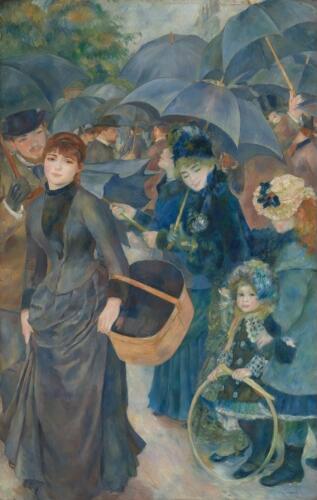
Renoir, The Umbrellas, 1881–86
Renoir started it as an Impressionist.
Then came a creative crisis and a trip to Italy. The Renaissance changed how he saw art.
Four years later, he returned to the canvas with a more classical approach and echoes of Japanese art.
Impressionism, Renaissance and Japonism, all in one painting.
Four equations. The complete map of physical reality.
Schrödinger’s equation tracks how a quantum wave function evolves in time under the Hamiltonian. Maxwell’s equations link electric and magnetic fields to charge, current, and light.
Einstein’s field equation equates spacetime curvature to the stress-energy tensor of matter. Dirac’s equation unifies quantum mechanics with special relativity for spin-1/2 particles and predicts antimatter.
They remain the sharpest language we have for how the universe actually works.
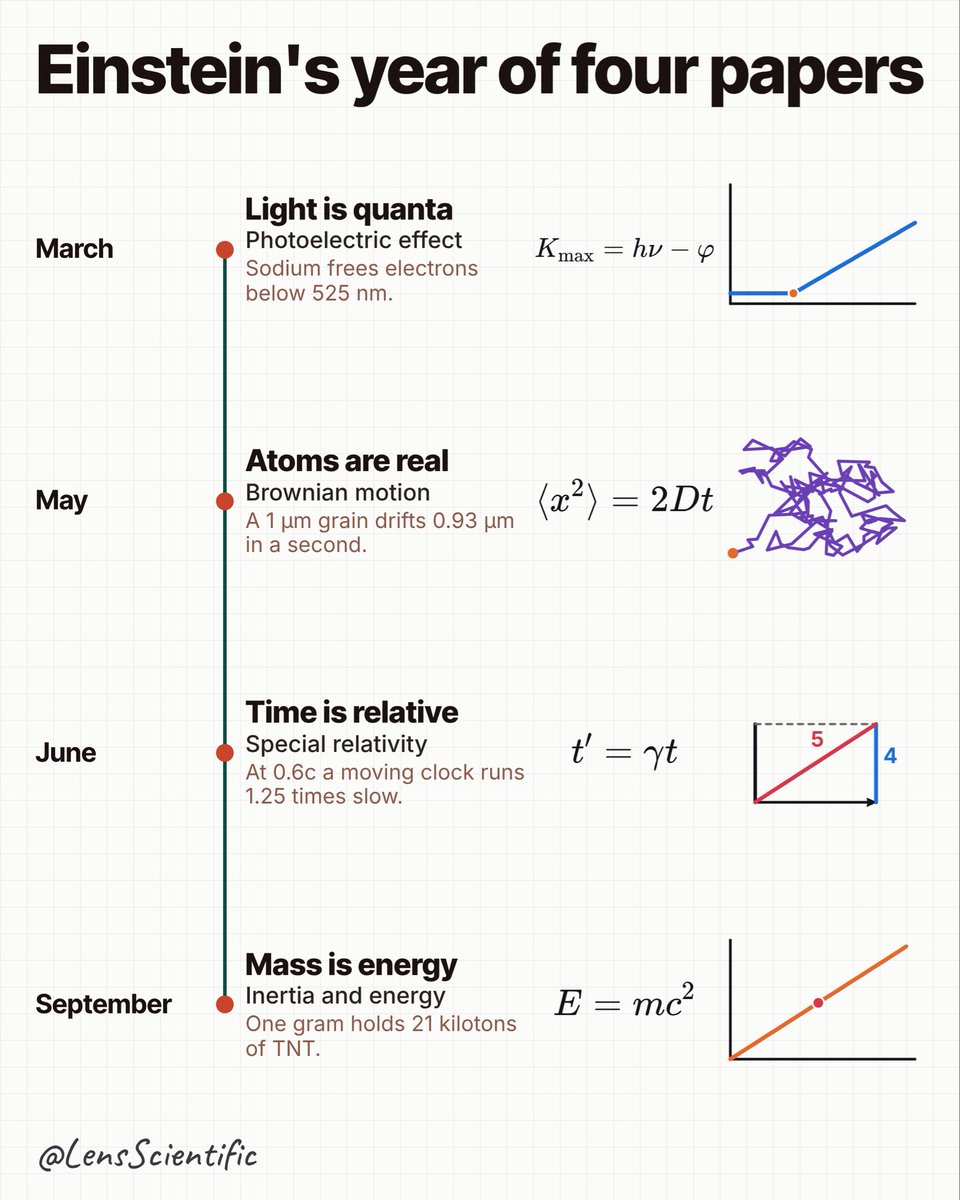
In 1905 Einstein published four papers that each changed physics.
Light arrives in quanta of energy hν, so light below a threshold frequency frees no electrons from a metal. Brownian motion obeys ⟨x²⟩ = 2Dt, evidence for atoms, and special relativity made moving clocks run slow by γ. The last paper showed that energy has inertia: one gram of mass is equivalent to 9 × 10^13 J, about 21 kilotons of TNT.
His 1921 Nobel Prize was for the photoelectric effect.
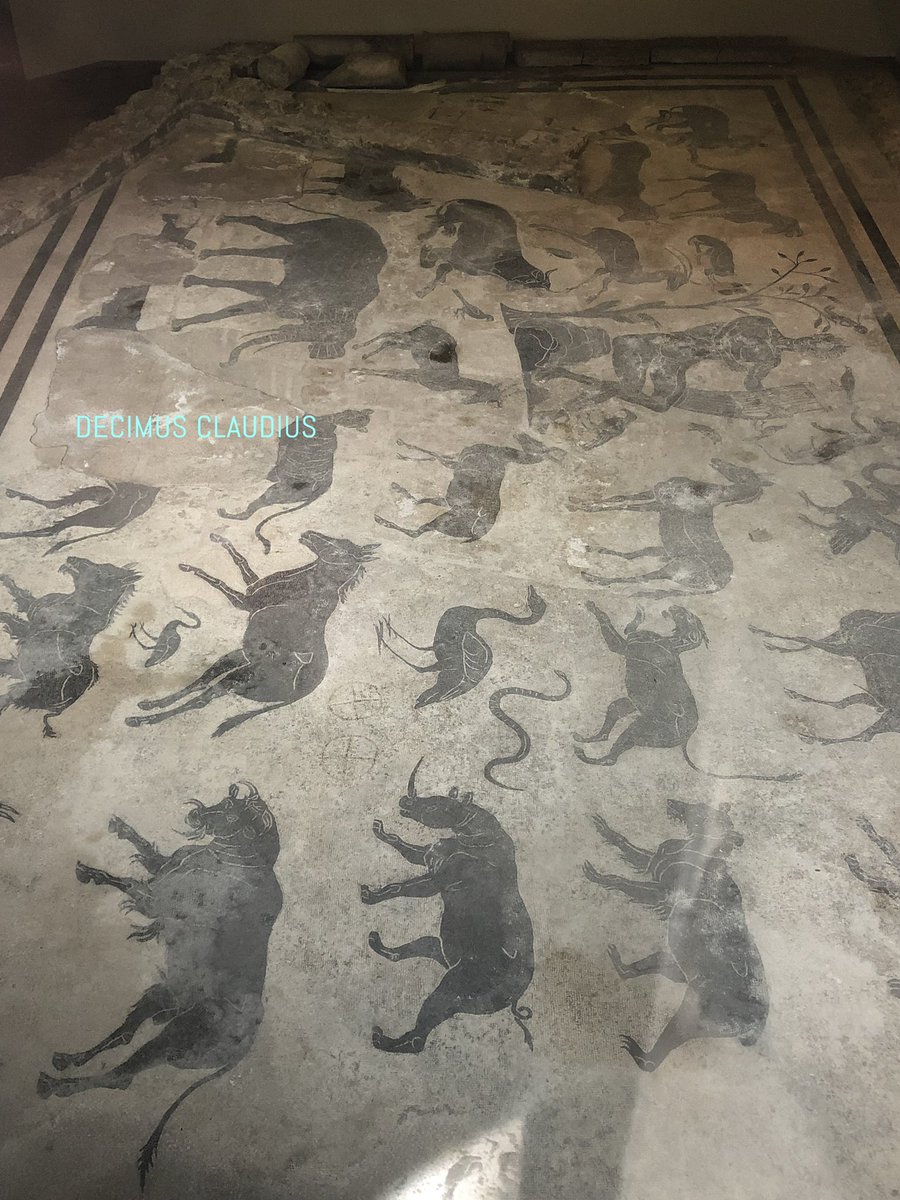
A Roman mosaic depicting many types of animals that were enchanted by Orpheus (in the upper right section) per Greek mythology. This dates to the 2nd century AD, was part of a bath house, and is behind protective glass in Perugia, Italy.
#mosaicmonday
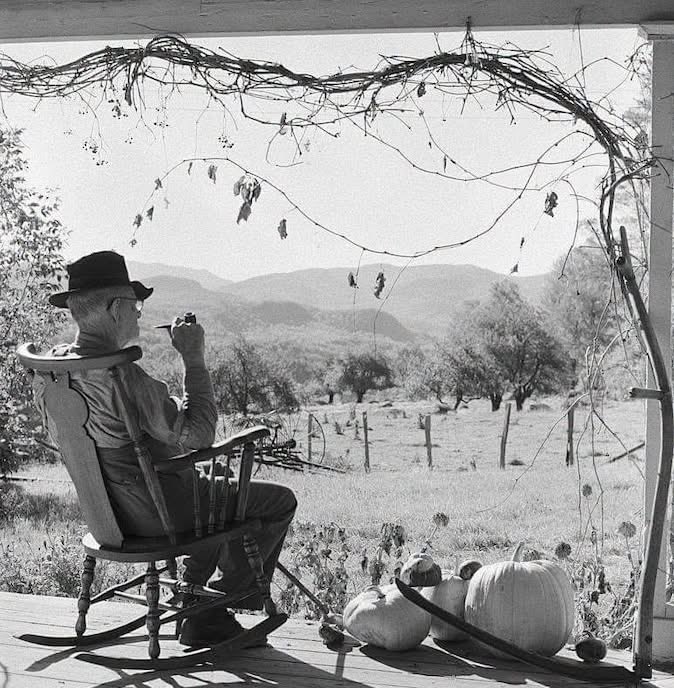
Ray Bradbury escribió en Fahrenheit 451: «Mi tío afirma que los arquitectos eliminaron los porches delanteros no por su aspecto, sino para evitar que la gente se sentara a conversar y balancearse. La desaparición de los porches sirvió para suprimir la reflexión y el diálogo. Ya no quedan jardines ni mecedoras; todo se ha vuelto incómodo. Han puesto a la gente en movimiento, siempre corriendo, sin tiempo para pensar».
Les listes d'approvisionnement des soldats romains retrouvées sur des tablettes de bois de la forteresse de Vindolanda sur le mur d'Hadrien nous apporte de précieuses informations sur le regime alimentaire des militaires sur la frontière nord de l'Empire à la fin du Ier siècle: beaucoup de vin et de bières, mais aussi parmi les ingrédients les plus courant achetés localement à des producteurs locaux, de la viande de porc, du lard, du poulet, des lentilles, des oeufs, du miel, du garum...
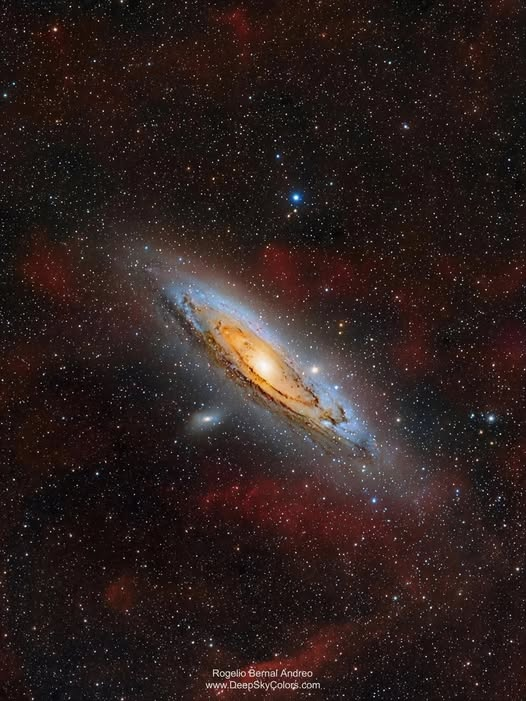
Clouds of Andromeda 🌌
The beautiful Andromeda Galaxy is often photographed by astronomers from Earth. Also known as M31, the nearest large spiral galaxy is an intimate spectacle, with its dark dust strips, bright yellow core, and spiral arms outlined by the blue star light.
📸: Rogelio Bermal Andreo
Pierre-Auguste Renoir, The Umbrellas. About 1881 to 1886.
Renoir's blue changed halfway through this painting. He replaced cobalt blue with French ultramarine as he reworked it, producing the slate-gray umbrellas.
Coordinates are labels, not distances. A one-degree change in longitude covers less ground near a pole than near the equator. The metric supplies the conversion from coordinate changes to physical lengths and angles. Even a flat plane has different metric components in Cartesian and polar coordinates, so changing components alone does not prove curvature.
In general relativity, the spacetime metric also determines elapsed proper time and the paths followed by freely falling objects.